“Typographical error” (Facilitated Communication)

OUIJA KEYBOARD

Despite Germ Theory, homeopathy still has a market. Despite the geologic column and Lucy, Louisiana public high schools still try to sneak creationism into biology class. So I am a little jaded to report that another completely discredited notion has been resurrected. Facilitated Communication has rebounded from what should have been a fatal blow.

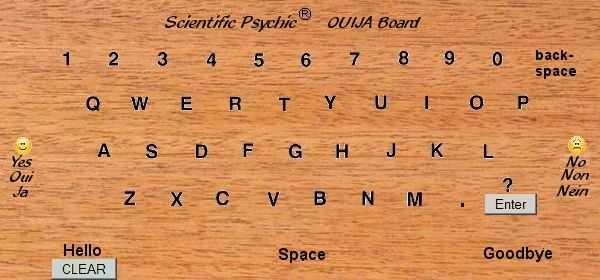
Twenty years ago, it was presented as a major breakthrough that allowed severely autistic persons to communicate through a conduit. Armed with only a keyboard and facilitator who held their hand or elbow, the previously uncommunicative could type words, sentences, even books.

The joy turned to horror when some also typed out allegations of sexual abuse against their father or other persons. This led to testing to determine if Facilitated Communication was valid. Communicators and facilitators were sometimes shown the same object and sometimes shown different objects. The correct answers were typed only when both were seeing the same picture. In the thousands of attempts where a different picture was shown to each, the facilitator typed what he or she saw 100 percent of the time. The seeming watershed breakthrough had really been the ideomotor effect in action, a voguish Ouija Board.

Instead of acknowledging the truth, the science, and apologizing to the falsely accused, some Facilitated Communication proponents repackaged and remarketed the concept. The primary weasel is Douglas Biklen of Syracuse University, which houses a Facilitated Communication institute. After the FC debacle, it now goes by the euphemism “Institute on Communication and Inclusion.” At least one other U.S. school, the University of New Hampshire, champions FC through its Institute of Disability.

In an attempt to stay one step ahead of the skeptics, the term keeps changing, from “supported typing” to “rapid prompting” to “informative pointing” to the most nebulous moniker, “progressive kinesthetic feedback.” But this linguistic lipstick still gets slapped on the same pseudoscience pig.

When things were going well 20 years ago, Biklen supported scientific research into FC. But now he has taken a page from the creationist and naturopathy playbooks. He bypasses peer review to take his message straight to those most yearning to hear it, the parents of severely autistic children. Double blind studies have been replaced by interviews with sympathetic journalists. There have been a series of books, movies, and TV features testifying to the power of FC, all omitting its .000 batting average in controlled studies.

Despite its dismal record, Facilitated Communication is receiving positive reviews, including 15 mentions in peer-reviewed publications. This includes a work by Anna Stubblefield in Disabilities Studies Quarterly. There are none of the stodgy statistics or vernacular usually associated with this type of publication. Rather, Stubblefield labels opposition to Facilitated Communication a form of hate speech in a ramble that more resembles a Facebook post than a scholarly journal entry. Other childish ad hominem tossed at FC critics by proponents included narrow-minded, evil, and jealous.

FC is once again at the center of a sexual assault allegation, with a key difference this time. Stubblefield is accused of sexually assaulting a cerebral palsy victim whom she acted as facilitator for. Her defense is that he typed his consent.

Besides a media campaign and circumventing peer review, another tactic is to play the dignity card and insist we should presume competence on the part of the autistic. But presuming it is different from making it happen for them. We don’t lead the blind by the hand and announce this as proof of sight.

FC also bolsters its position by using qualitative research, which leans heavily on narrative accounts and case studies, and fails to include control groups and randomness. Quantitative research, by contrast, uses controls and numerical data.

Since people will always get sick, there will always be some who gobble a homeopathic pill, with its allure of a quick, complete, painless fix. It seems too, that FC will survive as long as unscrupulous promoters are able to present their case to desperate parents.


“Nothing to sea here” (Atlantis)

ATLANTIS2

Atlantis is a make-believe continent that sunk after a doomsday combination of earthquakes and floods. It originated in the mind of Plato, who wrote about it in his tales “Timaeus” and “Critias.” It was part of a discussion of utopian societies, similar to Candide, and Plato was no more describing real events than was Voltaire.

Shakespeare used real places, but was unconcerned with geographic accuracy. He might have an Army reaching its destination in an unrealistic amount of time or an inland city with a coastal view. Where it was mattered not near as much as what was happening. It was the same thing with Plato’s tales. University of Arizona philosophy professor Julia Annas has said persons who read Plato and are inspired to scour the seabed are missing the author’s intent.

There are no records in Greece referencing a battle between Atlantis and Athens, which Plato had raging 8,000 years before he described it. While most persons asserting an authentic Atlantis paint it as ideal and greatly advanced, Plato described its inhabitants as vain and warlike. This is a relatively minor alteration compared to other changes made by those who try and make Atlantis fit their description.

Several locations for Atlantis have been offered, many of them outside the Atlantic, which requires taking Plato’s tale literally except for the most prominent detail. Some even find the Earthbound hypotheses too restricting and embrace the idea that Atlantis residents were aliens who sunk the island with futuristic technology gone awry or through a nuclear civil war. Atlantis residents have been credited with the primitive (cave paintings) and the advanced (airplanes centuries before the Wright Brothers).

Some refused to accept the idea that a utopian society vanished, and insisted tangents of it survived. Ignatius Donnelly wrote a 19th century book that suggested Atlantis refugees sired the Egyptian, Mayan, and Irish civilizations. Crediting Atlanteans with teaching Egyptians and Mayans how to write and build pyramids requires ignoring those civilizations’ gradual development, and their different alphabets and architecture. The idea that Mayans (and Aztecs) were of Atlantean descent began when Europeans encountered them, fueling both apocalyptic and utopian ideas.

Multifaceted psychic Edgar Cayce reported a vision that Atlantis had been situated on Bimini in the Caribbean and was doomed by some type of out-of-control fire crystals. Some hold that these crystals still misfire, sinking ships and aircraft in the Bermuda Triangle.

The notion that a large land mass had sunk was disproven by continental drift and plate tectonics. Additionally, sonar has revealed nothing as big as Australia (or even Tasmania) on the Atlantic Ocean floor. Furthermore, Plato’s tale had the war raging in 9000 BCE, much further back than any of the evidence ever uncovered for civilization in the Mediterranean Basin.

So keeping Atlantis in the Atlantic became even more problematic and the idea that it had been a real place became even fainter. Filling the void was Charles Berlitz, who penned a book on Atlantis, completing his trite trilogy that also included works on Noah’s Ark and the Bermuda Triangle.

The legend of the Lost Continent continues to adapt and works continue to be churned out. There is an Atlantipedia website and this millennium has seen at least three books dedicated to the premise that Atlantis was real.

Andrew Collins posits that a Phoenician colony in Iberia had contact with ancient American civilizations. Their combined efforts becoming Atlantis, located near Cuba. He considers many similar creation myths from Europe, Africa, and America as proof. This appeal to ignorance is the same tactic used by proponents of ancient aliens, Zermatism, and creationism. They insist that a motif of somewhat similar stories across different times and cultures prove their case. Tales like the ones they cite speak to man’s fondness for literature, adventure, and romantic ideas, but nothing more.

Perhaps the most wildly speculative of the contemporary authors is Herbie Brennan. From his work:

“The sudden appearance of five centers of civilization about 5500 years ago indicates an invasion from space.”

“Generally it is assumed that gods were invented by humans about 5600 years ago.”

Those two ideas lead to this one: “The conclusion is obvious: the Atlanteans were gods.”

Some try to bolster the Atlantis case by pointing out that 19th Century archeologist Heinrich Schliemann found Troy, which Homer had written about. The crucial difference is that the ruins of Troy were where Homer described the ancient city as being. Troy was also part of Greek culture and art, whereas Grecian references to Atlantis began and ended with Plato.

In 1969, seismologist Angelos Galanopoulos proposed that Atlantis was the island Thera, which experienced a volcanic eruption in 1500 BCE. However, Galanopoulos had to argue that a zero had been erroneously added and that the lost continent had sunk just 800 years before Plato spun his tale. Galanopoulos had to change the definition of Atlantis to prove it existed. He also failed to explain why Plato would change the name of the location when he was said to be relating a historic event.

Besides the date, the location is another distinction that must be altered to make Atlantis into a real place. Plato’s description was “outside the Mediterranean at a distant point in the Atlantic Ocean.”

Some use “outside the Mediterranean” as license to place it anywhere in the world. Rand Flem-Ath picks Antarctica, while John Allen goes with Bolivia. These choices ignore the whole sunken part. At least Julis Evola remembered that distinction when pegging the North Pole as its location.

Like any utopia, racists have gotten involved. Most Atlantis proponents fudge on dates or locations, but it was the character of its citizens that Helena Blavatsky altered to fit her views. She considered Atlanteans to be the fourth in a series of gradually ascending races that continued to until the perfect race, hers.

Atlantis continues to captivate people’s imaginations because it offers hope that lost ideals or untapped human potential will someday be uncovered. It’s not the masonry blocks that fascinate, it’s the advanced nature and ability of the persons who laid them. It appeals not to those interested in Pompeii and Angor Wat, but to those enthralled by UFOs and angels.

Like Bigfoot, ghosts, and ESP, skeptics can’t prove Atlantis doesn’t exist. But until a submerged continent with ruins suggesting a greatly advanced, seafaring civilization from 10,000 years ago is found in the Atlantic, the onus is on the other side.

“Healthy, wealthy, and lies” (Food fads)

HEALTH FADS

Scott Adams wrote that he once planned to pen an investment book for newlyweds, but scrapped the idea when he realized he could fit everything onto one page. With proper Dilbert reverence, I present my similar treatise for healthy living:

  1. Eat plenty of fruits and vegetables
  2. Get enough protein, iron, calcium, fiber, and potassium
  3. Exercise regularly, focusing on strength, endurance, and flexibility
  4. Consume adequate water
  5. Get enough sleep
  6. Vaccinate
  7. Have an annual check-up
  8. Get medical advice from your doctor, not a friend or a chat room
  9. Limit sweets
  10. Limit alcohol
  11. Don’t smoke

Number eight cancels out if your friend is also your doctor.

I would stack that list up against most nutrition and health advice I come across. But like Adams’ shelved financial work, nobody would buy mine, and not just because it’s terse. It doesn’t offer anything groundbreaking or trumpet a claim of uniqueness. There are no hidden secrets, no purported scientific breakthrough, or no long-lost knowledge. These are the elements that drive modern health fads.

One of the current buzzwords, natural, thrives on circular reasoning: Natural foods are good because they come from nature. This movement usually criticizes processed foods, chemicals, and toxins, without defining any of these. When it’s pointed out that all foods have chemicals, the mantra might be changed to synthetic chemicals, without explaining why these would be unhealthy. Also overlooked is that today’s food is not natural, but rather the result of artificial selection developed to make it longer-lasting, more pest-resistant, and more nutritious.

In order to sell their products, decidedly unscientific types like the Food Babe and Dr. Oz need to generate food fear. A frequent tactic is to employ the faulty logic that if a chemical is dangerous in one context, it’s dangerous in all. This fallacy is perhaps best demonstrated by the components of table salt.

Of course, even this innocuous compound can be made to sound dangerous by employing the right verbiage. It was at the center of one of the heavier concentrations of buzzwords I’ve ever seen, on spiritdetox.com:

“Just as an illusionist does, table salt pulls off a first-rate impression of NATURALLY occurring salts. It’s not very comforting to learn that the taste of PROCESSED salts stem from the manufacturing of 97.5% sodium chloride and an assortment of CHEMICALS.”

Ignoring the concept of chemical change, the salty talk continues: “Sourced from crude oil extract – yes, leftover oil flakes – table salt is created through iodization. Table salt is unhealthy, and it can be downright TOXIC to your body! A few symptoms particular to PROCESSED salts are…,” followed by a listing of every malady known to man.

Continuing: “Choose to pass the traditional saltshaker, and head for a NATURAL salt. HIMALAYAN salt is still the reigning champion of NATURAL salts.” The more exotic the land and the farther away these products come from, the better. Finally, we learn that the solution is for sell on this website. “To order spirit detox Himalayan organic salt, call 1-800-… ” Spirt, detox, Himalayan, organic, and natural! We’ve arrived at Pure Bliss Junction.

Some put a religious spin on the natural food movement and insist we should only eat food that God provided. Ask Eve how that worked out. The idea of paradise goes beyond Eden, and is found in Greek culture and in tales of various indigenous tribes. The modern incarnation is Paleo Man, whose diet got humans fine-tuned to the optimum evolutionary state, which we are now ruining. Depending on how extreme one takes these ideas, the dieter may even avoid cooking, as raw foodists do. They claim that cooking removes food from its natural state. With some foods, their natural state is underground, but raw foodists still pull them out. It’s true that cooking can zap nutrients, but it can also bring them out, depending on the food, and it also kills bacteria.

Another common food fad tactic is piggybacking on a diet that is legitimate for a few persons with a specific condition. For instance, those suffering from Celiac disease were advised to avoid gluten. Since this avoidance is necessary for someone’s good health, it was advertised as good for all.

We also frequently see the post hoc ergo propter hoc reasoning, of “A, then B. Therefore A caused B.” For instance, “Since we started wrapping our 12-year-old son in seaweed, he’s been more focused.”

People are always going to want to lose weight, so diets will continue to proliferate. So here I offer Volume II of my health series: Eat nutrient-dense, low calorie, satiating foods, maintaining a balance of fruits, carbohydrates, and lean protein. Exercise regularly. The end.

My diet plan has plenty of competition. For starters, there is the vegan diet, which is sometimes undertaken based on personal morals. If done for this reason, be advised that it doesn’t eliminate the demise of animals in food production. Bugs and mice are killed when soil for tomatoes is tilled, and raccoons are squashed by trucks that deliver them. If it’s done for health reasons, it’s obviously good to increase fruit and vegetable intake, but it can be tough to get enough protein, though beans and peanut butter help.

Then we have the blood-type diet, developed by someone calling himself a “naturopathic physician,” a seeming oxymoron. He claims whatever food a person eats react chemically to his or her blood type. This is without scientific merit, but the author gets credit for originality, which is necessary if you’re going to get someone to swallow it along with their diet food.

There are dozens of very low calorie diets that would cause one to lose weight, but are very hard to stick with and the weight almost always comes back. The Werewolf Diet uses the full moon (or new moon) as a guide to fast on those days and eat very little on other days. There’s no logic behind tying it to the moon, and not even as easy to remember as fasting on dates that end in 1.

There are also cookie diets. These are not centered on nice soft, chocolate chip cookies, but on high-protein, high-fiber hunks of cardboard forced down twice a day, followed by a low-calorie dinner. With the Five-Bite Diet, one skips breakfast, then eats five bites of anything twice a day. One would certainly lose weight, but sacrifice all kinds of nutrients, especially depending on what food one chose. I would go with Peeps because their supple nature would allow me to cram more in. Other very low calorie diets are based on cabbage, lemonade, baby food, or grapefruit, always accompanied by a claim that a particular food works best. Side effects of very low calorie diets include fatigue, nausea, dizziness, and dehydration. Plus, dieters lose muscle, not the weight they want to take off. Short-term diets like these are unlikely to yield long-term results.

I will close with Volume III, Vaccinations. Get them.

“Cell phony” (Electromagnetic radiation hysteria)

BIOPSY2I once lived so close to my Internet provider’s tower that when customer service representatives typed in my address, they told me it looked like I lived inside of it. Less than a year later, I came down with skin cancer and got part of my face sliced off. If there’s a connection, it’s that the Internet going down caused me to go outside, which I did after haphazardly applying sunscreen.

But if that’s too routine, there are plenty of more panicky ideas to choose from. For instance, the Canadian Centre for Policy Alternatives ran an article that contained these warnings about electromagnetic radiation:

  • “All the cells in your body are aligned North-South, but they can’t work properly if you sleep on a metal coil bed.” More often than not, I rack out on the sectional, so I’m good there.
  • “Energy efficient light bulbs radiate at carcinogenic levels.” Fortunately, I’ve been casual enough about home upkeep of late that three bulbs are still burned out.
  • “This invisible poison wrecks human brains, causes sperm to deteriorate, ovaries to malfunction, and fetuses to die. So there goes the human race.” On the plus side, studies indicate electromagnetic frequencies have no impact on a person’s ability to hyperbolize.

The Centre goes on to ascribe all manner of maladies, such as rashes and cancer, to electromagnetic frequencies. However, the World Health Organization reviewed 25,000 studies published over 30 years and concluded, “Evidence does not confirm the existence of any health consequences from exposure to low-level electromagnetic fields.”

Also, the National Research Council reviewed more than 500 scientific studies and reported there is “no conclusive and consistent evidence that electromagnetic fields harm humans.” A critical distinction must be made here. Electromagnetic radiation can be dangerous if in ionizes (meaning it gains or loses an electron, for those of you who, like me, had a chemistry education that was limited to the Mentos experiment). This is because ionizing radiation will break the bonds that hold molecules together. So no, gamma ray bursts are not safe. And there’s a reason X-Ray technicians stand behind a shield. But low-level electromagnetic radiation from the likes of cell phones, radios, and microwaves, does not ionize, so it poses no threat.

Nevertheless, concerns remain, due to bad science, bad writing, and good post hoc reasoning. For those wishing to escape the electromagnetic hazards, a variety of options are offered. Electroplague.com touts about a dozen wave-free havens for fearful fleeing. However, almost all of them are in various stages of poor-planning, from an idea in someone’s EMF-scorched head, to purchased vacant lots, to those currently operating as a bed and breakfast, presumably without Wi-Fi. The other places listed as possible sanctuaries are locales without population, such as the Australian Outback. The positive, no EMFs. The negative, scorpions and a 98 percent reduction in life expectancy.

Those subjecting themselves to the most drastic upheaval retreated to an electromagnetic-free enclave in France’s Drome Valley. They were reported to have wrapped their living quarters in metal to shield from deadly waves. They also wore metal clothes, perhaps including the original tinfoil hats. All links I could find referencing this place were dead, so there’s no confirmation of how extensive this is or if it still exists. Maybe they’ve managed to so thoroughly zap technology that they’ve even killed any online references to it.

Less intense measures offered by the anti-Electromagnetic forces include chelation therapy, vitamin overload, chiropractic, reflexology, clay baths, and energized crystals. Despite the overwhelming evidence of safety, the fear continues and adapts to the times. Each innovation and new gadget is labeled a potential carcinogen carrier. EMF’s alleged danger is most often associated with cell phones. But given the ubiquitous nature of these devices, the lack of corresponding brain cancer pandemic would suggest this fear is unfounded.

Similarly, there are populations without cell phones or even electricity, and these people would seemingly be the world’s healthiest if EMF dangers were valid. Instead, the Journal of the American Medical Association released a study of 891 adults and found that no increased risk of brain cancer was linked to cell phone use. While EMFs won’t cause unpleasantness, fear of them can. Like the Placebo Effect making a person feel better, excessive worry can make a person feel worse.

Brian Dunning at Skeptoid reported that sufferers say they endure skin and light sensitivity, fatigue, high blood pressure, headaches, joint pain, and dizziness. Not coincidentally, these are also stress symptoms. So when a person thinks they are encountering EMFs, they get agitated and the symptoms return. Dunning also related a newspaper article about a cell phone tower being installed, with some persons reporting physical ailments as a result. It turns out this took place before the tower became operational. Maybe EMF-emitting devices are so powerful they do damage even before they’re turned on.  

“Hot and unbothered” (Climate change denial)

POLARBEACH

The climate change debate centers on whether human activities such as deforestation and burning fossil fuels are releasing more greenhouse gases, causing the average global temperature to rise.

On one side of the argument are 99.8 percent of climate change papers published in the last quarter century; on the other side is Sen. James Inhofe holding a snowball.

The increase in average global temperature over the last 200 years is the most in human history, and this trend began at the same time as the Industrial Revolution. Of course, one must always consider correlation and causation. There is a chart showing almost identical trends of string cheese sales and persons dying while getting out of bed. The difference here is that fewer trees and the burning of coal, gas, and oil releases more carbon dioxide, methane, and water vapor, which drives up temperature, so causation is a valid conclusion.

Not everyone agrees with this. Online, I found 176 objections to the notion of manmade climate change on one site alone. (This list and counter-arguments are here: http://tinyurl.com/2m24g8). So this will be an incomplete rundown, but I want to hit on some of the easier to explain.

The most common objection sarcastically declares, “I believe in climate change,” accompanied by symbols of the four seasons. This sentiment is worthy of the bumper sticker I saw it on, not serious thinking on a global issue. During the polar vortex of January 2014, I experienced the coldest days of my life, noticeably worse than the winter I spent in Alaska. Thinking that this negates climate change represents the most fundamental misunderstanding of the topic, which is fine. It’s a fair question. It’s refusing to believe the answer that is the problem.

The temperature at one place and time does not address climate, certainly not climate change, and most certainly not global climate change. Inhofe rolling a snowball in D.C. fails to cancel out Greenland’s melting ice sheet or the global temperature average over centuries. Weather is local and fueled by short-term atmospheric and oceanographic conditions. Looking at the long-term, we see that in the 1950s, record highs were recorded 1.09 times for every record low. Fifty years later, there were 2.04 records highs for every record low.

On the issue of climate change, persons outside the field have conflict, while those inside have consensus. Science historian Naomi Oreskes examined 10 years of papers in scientific, peer-reviewed journals and found 980 asserting manmade climate change and zero opposing it. What counts as scientific and peer-reviewed is subject to debate, but even less stringent definitions found just 34 articles arguing against manmade climate change, compared to more than 13,500 reaching the opposite conclusion.

Another line frequently heard is that global warming has peaked. This only works if you start with 1998, which saw record-breaking heat due to an unusually strong El Nino. Choosing any other year as the starting point shows an increase in global temperature. The 10 hottest years on record are all since 1998, with nine of those years since 2002, and 2014 the warmest yet, polar vortex or not.

The 1998 claim requires cherry picking, but a more reasonable objection seems to come from the idea that Antarctic sea ice is increasing. This is true, but Antarctica is also losing land ice. Antarctic land ice is the result of thousands of years of snowfall and is stored ocean water that fell as precipitation. Meanwhile, Antarctic sea ice forms in saltwater primarily during the winter. This is a crucial distinction because when land ice melts and flows into the oceans, global sea levels rise. When sea ice melts, this does not happen.

A common refrain is the trumpeting that scientists once predicted global cooling.  Rather than showing that scientists are untrustworthy, this demonstrates that they adjust their positions based on evidence. Anyway, there were environmental scientists warning of global warming in the 1970s, and there was not agreement on the issue like there is today.

Then we have the point that Earth was warmer without human influence 6,000 years ago during the Holocene Climatic Optimum. But those higher temperatures were limited to summer months in the northern hemisphere. A more crucial point is that the cause was not CO2 increase, but slow changes in the tilt of Earth’s axis and shape of its orbit. 

Similarly, we sometimes hear that current warming is just part of a natural cycle. Never answered, though, is what force of nature is driving this? Which model or theory shows that CO2 does not impact temperature?

Another objection is that the sun is causing the increase, but satellite observations of the sun began in 1978, with no increase ever shown in solar irradiance. MIT atmospheric scientist Richard Lindzen claims climate change is normal, going in 100,000 year patterns. He points out that fossils show alligators once lived in Svalbard, north of the Arctic Circle. However, analysis of the geologic record still shows that greenhouse gasses controlled most ancient climate changes. That’s happening today, on a much grander scale. Besides, the Svalbard alligators fails to address to the central issue of whether deforestation and the burning of fossil fuels is causing the current increase in average global temperature.

Back to the point about the consensus among scientists on this issue. The National Academy of Sciences published a study that showed that 98 percent of climate scientists conclude that climate change is human driven. Now, no amount of belief makes anything true, the masses have been wrong before, and we should always be open to new evidence. But if a climate scientist or anyone else has evidence suggesting human activity is not driving the increase in average global temperature, he or she should submit it to Nature, Science, or another highly-respected publication.

Instead, the Heartland Institute buys billboard space to gloat that the Unabomber believes in global warming. Then there’s Dr. Roy Spencer, a University of Alabama professor and former NASA scientist, who has the most polished credentials of anyone taking a contrarian position on global warming. He should be working with peers, sharing data, outlining his methods, experiments, and conclusions, then submitting the findings to Nature or Science. Instead, he declares climate scientists Nazis and emphasizes this by carrying a Swastika flag.

“Pseudoscience defiance” (Scientific Method overview)

BIGFOOT CAPTURED

A quick explanation for how science works: Observation-hypothesis-prediction-experiment-analysis-interpretation-publication-replication. The natural world works according to certain principles and we can discover those principles by using this method. Tradition, intuition, feelings, and desires are useless for understanding the natural world. This must be based on experiments, not emotion.

First, a scientist will read and research everything he or she can about a given topic. They may earn a doctorate along the way, though this isn’t necessary since there are ways to educate yourself besides schooling. The scientist goes to conferences, shares his or her ideas, and listens to those of others.

After observing patterns, the scientist will develop testable ideas, known as a hypotheses. Experiments are conducted using specified data and sound statistics. It may be frustrating after putting in six years on an idea, but the scientist is now out to prove the idea wrong. The experiments must be repeatable to ensure that a false conclusion wasn’t reached, either through chance or faulty methods. One way to lessen the likelihood of this is to work with other scientists and to share methods and observations with them. This work is then taken to a conference for feedback and shared with a larger pool of scientists.

If everything seems sound to this point, the scientist sends the work to a peer-reviewed scientific journal, outlining the method, questions, hypotheses, experiments, results, and interpretation. The journal editor contacts experts in the field, who review the work and see if its design, results, and interpretation are strong. If so, it can be published. Despite the long process from observation to publication, we are far from done.

Publication means that instead of four experts perusing the work, maybe 40 or 400 will. Ideally, some of them will conduct experiments to see if the findings can be replicated or falsified. Sometimes, the ideas are validated, other times better ideas replace them. The better ideas can come a week or a decade later.

Now we transition into things that are not science. Carl Sagan devised a simple method for recognizing this and it goes thusly: If you’re not making mistakes, you’re doing science wrong. If you keep making the same mistakes, you’re really doing science wrong. If you don’t admit that you’re making mistakes, you’re not doing science.

One of the more frequent examples of the latter are Young Earth Creationists, who insist that the universe and all animals, in their present form, were created less than 10,000 years ago. These assertions that are provably false due to our seeing starlight from millions of light years away and the Geologic Column.

Creationism is one of the many forms of pseudoscience, which refers to using the terms of science incorrectly, or using words that sound scientific but are not.

Employing pseudoscience has enabled persons to foist ideas such as geocentrism, telepathic communication with inhabitants of Inner Earth, and aliens drawing Nazca Lines. These ideas are somewhat innocuous, but have a serious side because it demonstrates that much of the population lacks a strong grounding in science.

More nefarious manifestations are the attempts to bring creationism into public school biology classes, the stoking of unfounded GMO fears, and a senator holding a snowball to announce he’s basing his vote on climate change issues on it. There are still more drastic examples, such as the anti-vaccine movement and its resultant 7-week-old Whooping Cough victim. Or the teenager who died from cancer after being convinced carrot juice was the cure. Pseudoscience has even been used to justify racism, genocide, and albino murders.

Pseudoscience can be appealing because people aren’t required to understand advanced astrophysics or chemistry. And angels, Yeti, aliens, ghosts, and prescient fortune tellers can be captivating, appealing, exciting, mysterious, and spooky.

This week, Dr. Charles Jackson is presenting a series of lectures in the Quad Cities purporting to poke holes in the notions of the Geologic Column, the Big Bang, and dinosaurs-to-birds evolution. However, he is giving these presentations to sympathetic church audiences, not to a peer-reviewed journal. He is not sharing his ideas with fellow biologists or astronomers. This highlights two major pseudoscience red flags: Bypassing peer review and working in isolation.

Remember the model of observation-hypothesis-prediction-experiment-analysis-interpretation-publication-replication. At best, creationists do the first two of these. They arrive at their conclusion first, then seek evidence for it, so they are not doing science. The Food Babe asserts that long-sounding chemicals are dangerous without offering evidence or submitting her ideas to a nutrition journal.

Scientific journals are peer-reviewed so that world-class experts can review and test the work. The system is far from perfect, as best demonstrated by The Lancet publishing Andrew Wakefield’s paper linking vaccines to autism. Still, peer review worked in the end. When others were unable to replicate his findings, the paper was retracted and Wakefield lost his medical license. Other deficiencies with the process include persons reviewing their own work under pseudonyms and a publication calling itself scientific and peer-reviewed when it is neither. However, these flaws are an inadequate reason for someone to duck this crucial step in the scientific process.

Another clear sign of pseudoscience is presenting a claim that cannot be falsified. There is no way to test for tachyons, whose proponents argue travel faster than warp speed, but are somehow captured and used for all manner of health benefits. As science blogger Jennifer Raff has noted, “All conclusions are tentative, and subject to immediate revision if evidence is discovered that proves them wrong. Therefore, it’s a basic tenant of science that one must be able to possibly prove wrong any hypotheses.” If someone argues that a three-headed goddess created the universe 20 minutes ago and instilled in all of us false memories, there is no way to test and falsify this.

Also, pseudoscience is not predictive. Again, I defer to Raff: “The theory of evolution makes predictions. The evolutionary relationships between many species was worked out on the basis of fossil evidence long before DNA was discovered. Now that we’re able to sequence the genomes of these species, we’re finding that many of the predictions were true. In contrast, creationism is not scientific because it doesn’t make any predictions.”

Pseudoscience also invokes the supernatural. An electric gadget’s beeps are presented as evidence of a ghost. Some declare Reiki energy and magnet therapy to be medicine, but they are based on no established ideas of anatomy, biology, chemistry, or physics.

Science is fluid. It evolves, adapts, and adjusts its thinking when confronted with new facts. By contrast, those who believe in astral projection, auras, and in achieving peace and insight by accessing alpha waves are often hostile to contrary suggestions.

Pseudoscience also relies on anecdotes. Amethyst makes someone more energetic, they get a chill when they go up the stairs in an 18th Century house, and they sense their dead daughter’s presence when accessing a medium. These personal experiences are powerful, but not proof. No scientific research is being done here.

Another giveaway is claiming victimhood. Pseudoscientists will invoke Galileo or other vindicated geniuses, and insist government agencies and scientists are out to silence them. I sometimes her claims that evolutionists are nervous about seeing their ideas collapse, or that Big Pharma is on the run, assertions that involve no science.

It also relies on ancient wisdom, usually that of Greeks, Egyptians, Babylonians, or Chinese. One of the reasons this is attractive to a pseudoscientist is because this knowledge is kept hidden, so nothing too specific need be revealed. Besides citing irrelevant authority, this tactic is inverse of how progress works. Science builds on ideas and experiments and grows over time. But with pseudoscience, mysterious lost knowledge is often the most prized.

Finally, pseudoscience sometimes bases its arguments on personal incredulity. Helmet Welke of the Quad Cities Creation Science Association e-mailed me this: “It is beyond belief how anyone can think that something so packed full of information and assembly instructions could ever have evolved by chance.” His inability to conceive of how evolution works is not a point for its nonexistence.

“Food for thoughtless” (Food Babe)

YOGAMATLast month, I highlighted Breatharians, a tiny group of extreme dieters. Vegetarians eschew meat, vegans bypass all animal byproducts, and fruitarians consume only fruits and seeds. The most serious fruitarians consider apple-picking off limits and munch only on fruit that has fallen to the ground. Breatharians take these restrictions even further and limit themselves to water.

I figured this was the most restrictive diet possible until I learned of Vani Hari. She has declared, “There is no acceptable level of chemical to ingest, ever.” This means no water, no salt, no sunscreen, and no organic fruits and vegetables, with their polyphenols. A diabetic following her advice would refuse insulin.

What Hari probably meant was that we should not ingest synthetic chemicals, and her inability to make this distinction demonstrates her lack of science acumen, a key point since she dispenses nutritional advice and attempts to control what goes into our food. She does this under the moniker Food Babe.

Her method is to first find the most polysyllabic chemical possible. Then she will point out this chemical is in the motor oil you put in your car and in the Count Chocula you put in your mouth. Finally, she gets her sizable following to mobilize against this indignation.

Her best-known campaign targeted Subway because its bread contained azodicarbonamide (C2H4O2N4), a chemical also found in yoga mats. Subway removed the chemical, but that didn’t make your turkey and provolone any safer, not that it was ever dangerous. The science blogger Orac put it this way: “Azodicarbonamide is a safe chemical that disappears during the baking. It’s a maturing agent that makes bread dough rise better and improves its handling properties, yielding doughs that hold together better during kneading.”

So a diner should be no more outraged that his sandwich contained a mat chemical than a yoga practitioner should be upset that his padding contained a sandwich chemical. But Food Babe army members were upset, since they shared their leader’s ignorance about chemicals’ multifaceted nature. As Yvette d’Entremont of Gawker noted, “A substance can be used for more than one thing perfectly safely, and it doesn’t mean that your bread is made of a yoga mat if it happens to contain azodicarbonamide, a dough-softening agent. It simply means your bread is composed of chemicals, like everything else you eat.”

Kevin Folta, chairman of the University of Florida’s horticultural sciences department, called azodicarbonamide “nothing more than a digestible organic molecule, and one that helps bakery products maintain uniformity and structure over time.”

Hari responded to the Gawker article with her usual mix of self-congratulation and genetic fallacies. About Folta, she wrote, “He does not specialize in health or nutrition. Rather he is a crop scientist specializing in GMOs, who seeks industry funding and support for this research.”

Folta called this untrue, but even if accurate, would be unrelated to his argument’s validity. On her website, Hari says of her critics, “A high percentage of the ‘expert’ scientists, doctors, registered dietitians, and nutritionists have a financial relationship with the entities I investigate.” She provides no evidence of this, which even if true, again says nothing about the legitimacy of the points.

Hari claims to prefer natural products, yet has railed against isinglass, which occurs naturally in dried swim bladders of fish. Granted, I had never heard of isinglass, nor knew of its origins, before I heard it associated with Hari. But I’m not claiming to be a world class consumer advocate with more knowledge of nutrition and chemistry than those with Ph.D.s in the fields. So the point here is not Hari’s hypocrisy, but her lack of scientific understanding.

A similar incident was her campaign to get cereal companies to eliminate butylated hydroxytoluene from its products. It was later discovered that Hari was selling cosmetic products that contained this chemical. If this were my whole argument, it would be the Appeal to Hypocrisy, and it would be the type of logical fallacy I seek to avoid. But again, the point is not hypocrisy, but scientific ignorance. She has no idea what chemicals are used for, fails to realize they have multiple benefits, and is either ignorant or apathetic about the fact that dosage determines toxicity.

More ignorance was on display when she campaigned against propylene glycol being in our beer, when it was actually propylene glycol alginate. Despite the similar names, the chemicals have substantially different structures. Like Hari, my chemistry ignorance is profound, but I’m not out parading around about it while sanctimoniously demanding change.

Following my column on the Paleo diet, a reader pointed out that it includes an emphasis on leafy greens, so my claim that it lacks fiber was erroneous. I acknowledged my blunder and thanked him for pointing it out. I want all nonsense exposed, even if it’s on my blog. I did not brand him a kale industry shill and seek out 200 studies on greens, hoping one of them would contain a single line suggesting they are a poor source of fiber.

So perhaps I’m being too kind when I call Hari chemically ignorant, since deliberately stupid might be the more accurate term. She is also outrageously selective with the facts she uses to build assertions. In the same sentence as “Subway bread,” she cited WHO warnings against azodicarbonamide. Yet, the WHO report read, “Azodicarbonamide can induce asthma, other respiratory symptoms, and skin sensitization in exposed workers.” The danger is to a factory worker repeatedly exposed to its concentrated form. But to Hari, this is no different than having a ham sandwich.

She combines these misrepresentations with an Appeal to Yuckiness, such as warning that “secretions from a beaver’s anal glands” are in vanilla ice cream. This appeal makes no scientific claim, demonstrates no harm, and again highlights her misunderstanding that chemicals are safely used for different benefits. If anyone should be outraged, it’s the beaver for what’s being done to his private parts.

The Food Babe has found a willing army whose minions fail to understand that a chemical’s danger is not determined by how difficult it is to pronounce. They don’t realize that their inability to comprehend something is not an argument for it being unsafe.  Hari will declare a chemical dangerous without acknowledging that’s true only at high doses, in some cases so astronomical you would have to swallow hundreds of times the usual amount. Almost anything can be dangerous if it’s taken to an extreme, as demonstrated by the people who die from a water overdose. Two Tylenol will temporarily take away your toothache. Two bottles of Tylenol will permanently take away your toothache, along with your breath and heartbeat. Some chemicals or elements are deadly in any amount, but for most, it’s the dosage that determines the danger. In her Gawker takedown of Hari, d’Entremont pointed out that vinegar is also used a disinfectant, can cause chemical burns, and is used in industrial labs for hydrolysis reactions.

Another frequent Hari tactic is citing a chemical’s illicitness in some countries as evidence that it’s dangerous. By this logic, its legal nature elsewhere would be proof of its safety. A product’s legality has no impact on its lethality.

Her FAQ features a litany of pseudoscience and logical fallacies. For instance, she wrote, “We are a nation full of inexplicable illness.” Nope. Some illnesses are unexplained, but none are inexplicable. We should continue to search for causes and cures, not blame it on substances because they are 18 letters long.

Later in the ramble, she writes, “For years, expert food scientists and the FDA said trans fats were safe for consumption. Now, the CDC estimates that trans fats are linked to 7,000 to 20,000 heart attacks per year!” Rather than being the anti-science point she hoped to make, this highlights that science is a self-investigating, self-correcting process that will eventually get it right. It is a non sequitur to use this process to rail against compounds in our nachos.

She also confuses multiple anecdotes with data, harping, “I have more energy now than I did 10 years ago! Others have also conducted the same experiments, using their bodies and personal experience, and have come to a similar conclusion.”

While she sticks mainly to food, Hari has ventured somewhat onto anti-vaccine terrain, and declared she won’t put into her body any flu vaccine components. This means no water, so I applaud her consistency. Also off limits are salt and formaldehyde-containing apples. Another no-no are histidines, which the liver produces naturally. But maybe Hari can gulp her cold-pressed organic kiwi juice and flush out those pesky essential amino acids.


“Hunter-blatherer” (Paleo Diet)

CAVEMAN EATING

The Paleolithic diet attempts to replicate the dining habits of our ancient ancestors. To do this in the most genuine manner, shovel some plants, roots, and barely-edible berries in your mouth and hope you survive. Rats, beetles, and any other living creature you can catch are also on the menu.

The impetus behind this movement is the belief that we evolved to be hunter-gatherers, and that today’s food wreaks havoc with that. This represents a misunderstanding of an evolutionary tenet. If an animal could only thrive in environments identical to their ancestors, this failure to adapt would lead to extinction.

So as agriculture progressed, humans evolved the ability to digest gluten and dairy products, and their mouths developed a shearing overbite that replaced a straight-on cutting shape. Besides being biologically distinctive from our Paleolithic grandpappies, we eat food that has been greatly improved through artificial selection. When a Paleo dieter eats cabbage, broccoli, cauliflower, Brussels sprouts or kale, they likely don’t realize that post-Paleo Man developed all these from one plant species.

The diet eliminates not just processed foods, but anything dieters think was unavailable to those in the Paleolithic Era. A partial list of off-limits sustenance includes corn, potatoes, sugar, salt, dairy, grain, and legumes. But the idea that we have gotten away from an optimum diet fine-tuned for human benefit is erroneous. Hair and bone samples of persons from the era showed several instances of malnourishment and even starvation. There is no reason to adopt the purported dietary lifestyle of this or any era. As evolutionary biologist Marlene Zuk has asked, “If we’re going to nominate a period to emulate, why not eat like a medieval peasant or an ancestral tree shrew?” And if picking the Paleo Era, one still must decide which society to copy from, among all that existed during the 2.5 million years. There is no seal or walrus in any variants of this diet, yet Inuit hunter-gatherers consumed sea mammals with as much gusto as Don Gorske does Big Macs.

Indeed, the diet is said to be based on foods which hunter-gatherers ate, but is more accurately based on what proponents think they ate. For instance, anthropologists have found fire pits from early humans that contain grains, one of the most verboten foods in the diet. There is also evidence suggesting humans in this era cooked wild potatoes, legumes, and sugars.

The diet is not without benefit, as its abundance of unprocessed foods will likely increase satiety. And similar to other low-fat, low-carbohydrate diets, the Paleo combats heart disease and diabetes, and aids in weight loss. It promotes eating lean protein and certain fruits and vegetables, which is healthy enough. But the items it excludes makes it difficult to get adequate calcium and fiber.

While historically dubious, with moderate health benefits, the Paleo diet poses no danger, unless one becomes too dogmatic. Along those lines, there is nothing in scientific literature to support claims from the movement’s leaders that it prevents acne, autism, cancer, arthritis, or the ill-defined inflammation.

Then we have Australian chef Pete Evans, who wrote a children’s Paleo cookbook. It included a bone broth baby formula that contained 10 times more Vitamin A than would be safe for an infant. Because of this potentially fatal recipe, the publisher refused to print it. Evans responded by declaring he would not be silenced, digitally publishing the book himself, and encouraging others to slurp away. Try it and see if you survive. That’s the most authentic Paleolithic diet yet.

“Science friction” (Anti-science movement)

ATOMSTI once had an idiosyncratic anti-science stance. Owing to youthful indiscretion, I found the subject boring and took the minimum amount possible in both college and high school. I later realized my error and did what I could to mitigate the damage, subscribing to Discover, watching intellectual television when that existed, and grabbing some books. The plus of picking up Cliff’s Notes on Chemistry is that it is a $9 science education. The drawback is that it is a $9 science education. I was trying to teach myself the topic, meaning my chemistry professor was Wayne Marlow, a tough obstacle indeed.

I’m still at it, squeezing in science reading when I can, which isn’t much with five children. At the same time, I explain science principles to them and tell them they will learn more about this in future school years. I also watch YouTube tutorials and have all Cosmos episodes on DVR.

Taking so little science is my greatest regret, but at least my anti-science stance was because I thought it was boring, not because I was denying its truths. Today’s anti-science army does just that, ironically aided by the Internet, cell phones, and iPads. Long gone are the days when universities and laboratories could serve as guardians of the world’s scientific knowledge.

What follows is a list of 10 of the worst anti-science ideas. For space reasons, these are presented in Genetically Modified nutshells. Most of the subjects I’ve dealt with at length in other posts, but the focus here is on consolidating them to show the anti-science motif that runs through some of society. The list is in ascending order of negative impact on the country.

10. EARTH IS FLAT. This idea is silly, but the issue is serious. It demonstrates just how impervious to facts and logical arguments some people can be. While Flat Earthers are less than .1 percent of the country, ideas later in the list are just as scientifically flawed, but embraced by 30 to 50 percent of the population and Congress, and these persons attempt to influence policy.

The only incidental positive to the Flat Earth position is that it forces one to build thinking, deduction, and persuasion skills when explaining why the idea is wrong.

So somewhat sheepishly, I present evidence for a round Earth: We see the top of vehicles first when they come over a hill. The farther one travels from the equator, the farther the stars go toward the horizon. The higher up you are in your treehouse, the more you can see the approaching enemy. And the best proof: During a lunar eclipse, a round shadow is cast on the moon.

9. GEOCENTRISM. This bunch thinks the sun, planets, and stars revolve around Earth. Like their Flat Earth brethren, modern-day geocentrists are maddening to someone concerned about science education. But it also forces us to logically explain to, say, our 7-year-old son, how we know heliocentrism is true.

Even at warp speed, Neptune would be unable to complete a rotation of Earth in 24 hours. Second, the apparent positions of the stars changes between January and June, the result of Earth moving around the sun. Also, when rain falls without wind, it comes down vertically. But jump in your car and the rain seems to come at an angle. Similarly, as Earth moves around the sun, the light appears to fall from a slight angle. This would not happen in a geocentric world.

While almost exclusively the domain of a tiny subset of Catholics, I found one geocentrist online who purported to make a scientific case for it. The site was littered with pseudoscience red flags, the most glaring being that he took his ideas straight to a sympathetic audience rather than a peer-reviewed journal. Similarly, he worked in isolation, not with scientists. While he did maintain a forum, he was hostile to sound scientific responses and inquires, whereas a genuine researcher would welcome the dialogue. Another red flag was that he started with his conclusion, then sought confirming evidence. He also employed flawed methods with irreplicable results, another giveaway.

8. MOON LANDING HOAX. This is slightly more in the conspiracy theory mindset, though it includes a massive heaping of scientific ignorance. It centers on misunderstanding of the Van Allen belt, why no stars would be visible, and a flag allegedly waving with no atmosphere. It’s OK to raise questions like these. When I first heard these objections, I entertained them and sought out further evidence. I was satisfied with the thorough scientific explanations given. But for those determined to deny it, these answers were further evidence of a cover-up.

7. GMO EVIL. This is based on little more than fear, highly-selective quote mining, and treating correlation and causation as identical twins. Genetic modification is merely the splicing of genes and inserting of DNA from one species into another, resulting in better food. There are safety controls in place and any danger, if there ever is any, would be to a specific engineered food, not to the entire concept.

Despite the appeal to nature that many anti-GMO activists claim, agriculture has advanced through the use of artificial selection. Nature’s food was mostly atrocious, but has been made delicious and nutritious through agricultural advances.

6. POLYGRAPH USE. These machines accurately record physiological data, but cannot determine if the subject if prevaricating. Police can request a suspect use them, but a guilty sociopath will pass, while someone nervous and innocent might fail.

Another problem is that subject is asked a series of simple questions to establish a baseline before the serious questions commence. But if a person is already sweating and breathing heavily, normal responses to being grilled about a murder, then the baseline will be flawed and the test thrown off. Despite the lack of scientific support for its use as a lie detector, the polygraph is used by governments when hiring for sensitive positions or conducting internal investigations. The best-known person ever hooked up to one, spy Aldrich Ames, passed the exam.

5. YOUNG EARTH. Here is evidence for an old universe: 1. We can see light from stars millions of light years away. 2. Since Earth’s earliest days, radioactive isotopes have been breaking down and releasing energy that adds heat to the planet’s interior. By measuring those atoms inside rocks and comparing their ratios to those inside meteorites, Clair Patterson figured out Earth was 4.5 billion years old. 3. Cosmic background radiation, the afterglow of the Big Bang, is visible in the microwave spectrum.

The Young Earth crowd sometimes claims it is silenced by media, science, and academia. There is no such repression on this page. Here is Answer in Genesis’ retort to the light year evidence, radioactive isotopes, and cosmic background radiation: “The Big Bang is entirely fiction because the Bible tells us that God created heaven, earth, and everything within them in the span of six days.”

4. CREATIONISM. I have a Friend who occasionally posts creation stuff. We have gone back and forth a few times, but my strategy has always been defending the Big Bang or evolution. Most recently, he posted a video of a man claiming that the odds against life forming by chance were so astronomical that it had to be done by God. This time, I tried a different tact and posted, “Describe the Scientific Method and explain how he used it in reaching his conclusion.” For first time, my Friend gave no response.

This is because creationism rests almost entirely on finding supposed flaws in evolution or the Big Bang. Proponents have never, to my knowledge, presented scientific evidence for their position. If creationism is championed in a Facebook post or over dinner, it’s a shame the level of science knowledge is at this level. But far worse is the idea of bringing it into a science classroom. This attempt has failed, but the other side continues to battle for it.

3. ANTI-EVOLUTION. It is a common misconception among the general public and among 99.99 percent of creationists that creation and evolution are in competition. I’m not implying they co-exist, but if creation happened, it would have no impact on evolution’s legitimacy. That’s because evolution is the change in inherited characteristics of biological populations over succeeding generations and doesn’t speak to how life formed. Science has only rudimentary guesses as to how that happened. We have good evidence for how the universe began and how planets formed, cooled, and became habitable. There is good evidence life started in the ocean, but we are unsure how. Admitting this ignorance and searching for the answer is science. Invoking a supernatural explanation is not.

With regard to evolution, the stupidity on this subject is so profound that 44 percent of U.S. adults think Man and other animals were created in their present form less than 10,000 years ago. This requires ignoring, or coming up with ad hoc explanations for, Lucy, Archaeopteryx, Tiktaalik, the Geologic Column, carbon dating, animals that exist only on Madagascar, Iceland, and Papua New Guinea, and Richard Lenski’s ongoing e.Coli experiment at Michigan State University.

The most extreme misunderstanding of the theory comes from those who think it posits that monkeys gave birth to humans. Only slightly less ridiculous is asking, “If man evolved from gorillas, why are there still gorillas?” Of course, the theory really holds that man and the apes have a common ancestor, as evidence by you and me sharing 22 of 23 sets of chromosomes with chimpanzees. Other evidence includes the entire biology field.

I have no issue with anyone asserting that God created Man or the universe. My objection is when they claim these conclusions are arrived at scientifically.

2. ALTERNATIVE MEDICINE. This can be a waste of time, a waste of money, or a waste of a life. If you apply a Reiki rub for a minor stomachache, no harm is done, though that’s time that would be better spent posting a pro-science retort on a UFO thread.

Chiropractic, acupuncture, reflexology, and applied kinesiology are rackets. But as long as real medical care is also sought, the patient has a chance to see improvement and is only impacting the wallet, not his or her health. But when these techniques are the only solution, the patient either continues to suffer or is swayed by post hoc reasoning and communal reinforcement. In the most extreme cases, death results. This month, a teen girl in Florida died from leukemia after forsaking chemotherapy for vitamins and veganism. Closely related is the practice of treating serious illnesses with nothing. Faith healers in Idaho, protected by the government, have allowed a dozen children to die from preventable causes. Faith healing is 100 percent faith, 0 percent healing.

1. ANTI-VACCINATION. This tops the list because it kills babies, such as the 18-month old Measles victim in Germany. Those who are too young or too unhealthy to be vaccinated are at risk of dying from a preventable disease. If choosing to be unvaccinated only impacted that person, being unimmunized would be like finishing two fifths of Scotch at home. Bad for the drinker, irrelevant for everyone else. But refusing to vaccinate is like getting behind the wheel after that whiskey bender.

Smallpox went from killing 500 million people to killing zero, probably the most successful of vaccination’s many victories. Vaccines work by stimulating our immune system to produce antibodies without infecting us with the disease. So if the vaccinated person comes into contact with the disease, the immune system will recognize it and produce the necessary antibodies.

On a UNICEF Facebook post about 15,000 African children dying annually from Measles, and the difference vaccines can make there, one respondent wrote, “There’s no way that’s true. If it’s as dangerous as they’re saying, everyone my age would have died from it.” It’s called vaccine denial for a reason.

So there’s my list. I realize that science can be very complex and I can relate to struggling to grasp the concepts. But there’s a clear difference between genuine searching and questioning, and rejecting facts because they run contrary to a pet position.

“Food Fright” (GMO hysteria)

CARROTIn the interest of balance: GMOs cause massive tumors and famine, rupture children’s digestive systems, and drive Indian farmers to mass suicide. Using seeds improperly is worse than the Holocaust.

Now that I’ve presented the other side, here’s mine.

Genetically Modified Organisms are plants or animals altered by the splicing of genes and the insertion of DNA from one species into another. The goal is transfer properties that have agricultural benefit.

We will concentrate only on plants, since no GM animals are sold for food. One example is golden rice, made from genes of maize and a common soil bacterium. The benefit in this case is food rich in beta carotene, which helps bodies produce Vitamin A. Genetic modification can also yield food that is softer, tastier, healthier, longer lasting, more resistant to pests, and less susceptible to drought. Compared to traditional plant breeding, there is less risk of concentrating natural toxicants since far fewer genes are transferred.

Because persons with allergies could be affected, all GM foods must be approved before going to market. In one case, a gene from a Brazil nut was transferred into a soybean. When serum from persons afflicted with nut allergies was introduced, a positive reaction registered, so the product was never sold. In another instance, a corn variety was also declared unfit for human consumption because of a potential allergen. This highlights two key points. First, there are safety controls in place. Second, any danger is going to be to a specific engineered food, so condemnation of all genetic modification is unfounded.

Most of those doing the condemning claim to prefer natural foods. Those people never had to eat the original tomato. University of Buffalo biochemistry professor Mark O’Brian called agriculture, “the manipulation of nature to meet desired ends.” He pointed out that a bright red, perfectly ripe, delicious tomato is “a biologically distorted, genetically engineered product of human innovation derived from a small, hard, poisonous fruit created by nature.” Similarly, the original carrot was dark purple and not near as high in beta-carotene.

Ray Comfort and Kirk Cameron have a YouTube video in which they declare the banana to be proof of God. Their evidence is its nonslip, biodegradable wrapper, a shape angled to enter the mouth, and a color scheme letting the consumer know if it’s not ripe, too mushy, or just right. Indeed, the banana is the result of intelligent design, but by farmers and scientists. What Comfort and Cameron tout as a divine miracle was once tiny, nasty, green, and full of large, hard seeds.

In short, there’s nothing natural about the foods we eat. Instead, cultivation is mostly artificial selection, with farmers saving the best plants from the year’s crop to provide seeds for the next season. After a few thousand iterations, we get tonight’s dinner. Genetic modification takes that idea and runs with it at light speed. Scientists can do in a few months what nature might have taken a few million years to accomplish.

Metadata from 12 long-term studies and 12 multigenerational studies met the conclusion that, “The studies reviewed present evidence to show that GM plants are nutritionally equivalent to their non-GM counterparts and can be safely used in food and feed.”

Meanwhile, University of California-Davis geneticist Alison Van Eenennaam and research assistant Amy Young reviewed 29 years of livestock productivity and health data from both before and after the introduction of genetically engineered animal feed. Van Eenennaam and Young found no increase in illness or disease, and concluded that GM feed is safe and nutritious.

Anti-GMO types, of which Mike Adams of Natural News is the most outrageous, don’t care for this science so they make up their own. While he and his ilk hawk scores of alleged studies and papers attesting to GMO dangers, none of them have appeared in scientific peer-reviewed journals. Another trick is to cherry pick quotes from genuine research in order to distort the findings. Adams’ efforts have put Natural News at the top of several lists of the Top 10 Worst Anti-Science Websites. Adams claims agribusiness is out to poison us all, aided by compliant scientists, doctors, and reporters. He encourages his followers to murder those expressing pro-GM views.

Despite engendering this murderous rage, causing alarmist terms like Frankenfoods to enter the lexicon, and being the subject of dire warnings and outright lies, GMOs haven’t harmed anyone. Opposition to them is another matter. Presidents of Zambia and Zimbabwe preferred to let a famine rage rather than allowing GMOs to be imported.