“The defense never rests” (Irreducible complexity)

alienevolution

There are a few problems with the creation vs. evolution debate. The first is how fundamentally it misrepresents what evolution is. As I’ve had to explain to a depressing number of 21st Century adults, it is the change in inherited characteristics of biological populations over time. It never addresses how the first living form developed, which is a separate field of study, abiogenesis.

Creation vs. abiogenesis would make more sense. Creation vs. evolution is something of a false dilemma since a higher power could have created the first single-celled organism, then either guided evolution or let nature take over. A few enterprising souls (or soulless ones, depending on which side of the debate one is on) have used this notion to try and marry creation and evolution. This attempt is rejected by biologists for its total lack of evidence, while most creationists reject it because it dismisses the narrative of fully-formed, upright, walking, Hebrew-speaking homo sapiens being zapped into existence 5,000 years ago.

As far as I know, no one has attempted to fuse evolution with any creation myth except Genesis, which likely speaks to motivation. Those doing so have likely accepted the scientific evidence for evolution and the age of the universe, but are desperately trying to cram Genesis into the equation. This is possible if the book is taken as a figurative tale of Mankind’s fall and redemption. But reading Genesis literally, it is impossible to square it with what we know about evolution and astronomy.

A small sampling of the mountain of evidence we have for evolution would include: 1. Islands that have never been a part of a continent having no terrestrial mammals, amphibians, or freshwater fish; 2. All but one marsupial being native only to Australia; 3. The Geologic Column containing less-evolved fossils the farther down it goes; 4. Richard Lenski’s ongoing e. coli experiment; 5. Comparative anatomy between species; 6. Transitional fossils such as Archaeopteryx, Tiktaalik, and Lucy; 7. The Florida lizard that was observed developing a beneficial toe pad that enabled it to escape an invasive species; 8. Vestigial traits;  9. And species that exist only on isolated locales such as Iceland, Palau, and Madagascar.

Which brings me to the second problem of the creation vs. evolution debate, which is how lopsided it is. I refer not to the massive amount of evidence for one side over the other. I am referring to how virtually every piece of “proof” that creationists offer is instead a question about, or objection to, evolution. They are almost never asked to provide evidence for their side. Even if there is a legitimate question raised about evolution, that is not a point for creationism any more than it is proof that aliens left behind eggs when they visited 5 billion years ago.

Perhaps evolution, creation, and alien eggs are all wrong ideas and no one has yet come up with the right one. But I don’t build support for my position by challenging alien egg believers about the lack of verifiable wormhole travel, I bring up the evidence raised in the previous paragraph. By contrast, creationists almost invariably frame their argument not from a pro-creation standpoint, but from an anti-evolution one.

These arguments almost always take the form of questions that have been successfully answered many times. For instance, a meme shows chimpanzees and humans on an evolutionary path chart, with four alleged transition creatures in between. The meme’s author notes there are plenty of living chimps and humans, yet none of the other four creatures, and he then triumphantly asks why this is.

The answer: Because your chart is all wrong. Humans did not evolve from chimps, but Man and chimps share a common ancestor, which we know due to comparative anatomy and the animals having 98 percent identical DNA. Man and chimps became independently isolated from the main family they split from and both eventually gained characteristics that make them distinct. That is why humans and chimpanzees are very similar, but still have notable differences.

Though infrequent, sometimes a genuine problem about how evolution works can arise. For instance, the Two-Fold Cost of Sex is an evolutionary conundrum that has yet to be definitively answered. Since an asexual population has an innate ability to grow more rapidly with each generation, it would seem to be evolutionarily disadvantageous for a species to develop two sexes. Yet all the most successful species, including the most advanced by far, do not reproduce asexually.

But whereas biologists (most notably George Williams) have researched this and conducted experiments to try and unravel the answer, Ken Ham and his ilk are content to declare victory. However, “I don’t know, let’s find out,” is more admirable than, “I don’t know, therefore God did it.”

There are many examples of challenges to evolution and I cannot go through them all here. My point is that even in the infrequent instances that a legitimate question about evolutionary mechanisms is raised, it is not a point for creationism. To achieve that, one would need to find evidence for creation through employment of the Scientific Method.

This is why Bryan Fischer was mistaken to gloat, “Evolutionists have no answer as to why there is something instead of nothing. We have an answer; they don’t.” An answer, yes. Evidence, no. The Kuba people have an answer that Mbombo vomited the stars, planets, and animals into existence. The Cherokee have an answer that Earth began as a floating island suspended by cords until a beetle investigated what was in the water, displaced the muddy bottom, and caused Earth to expand to its current shape. The Serer in Senegal have an answer that Roog created water, air, and soil, then eventually got around to forming this into a round rocky ball, adding oceans, rotational axis, and critters as the whims set in. By quoting Genesis, Fischer is providing an answer, but not evidence. And most certainly not evidence arrived at through defining the question, developing a hypothesis, making a prediction, testing it, analyzing the results, replicating it, submitting it for peer review, and making his data publicly available.

Due to laboratory test results, there is some speculation among abiogenists that a lightning bolt may have struck a body of water, resulting in the first life form. Fischer answered this by asking where the lightning bolt came from. One could (and Fischer certainly does) keep this up ad infinitum, responding to each answer with yet another question as to what caused still earlier actions. But he is guilty of Special Pleading. He insists each effect must have a cause, yet needs to carve out an exception for the Abrahamic god in order for his position to work.

Which brings me back to the outrageously lopsided nature of this debate. Creationist websites and Facebook posts never put forth any argument for their position using the Scientific Method I outlined two paragraphs ago. They merely bring up supposed deficiencies in evolution. I sometimes answer these challenges, as do many of my fellow science enthusiasts, and many famous scientists like Phil Plait, Stephen Jay Gould, and Neil Tyson have written detailed essays on the subject.

But all this is not like playing football 20-on-5, it’s like a football game in which only one team is ever permitted to have the ball. When the evolutionist manages the equivalent of an interception by answering the chimps-man meme challenge, the play is blown dead and the ball is handed back to the creationist team, which then asks a misinformed question about the Second Law of Thermodynamics. On and on it goes, play after play, week after week, year after year. One side is the only one ever expected to give an answer. I visited the Institute for Creation Research page and under “Creationist News,” there was no such news, but just the expected railings against evolution. Under “Evidence for Creation,” they offered only Bible verses and such observations as “Saturn’s rings still look new and shiny.”

Last week, I saw a creationist on Facebook who belittled peer review, likening it to an echo chamber since there was such strong agreement on evolution. But science reserves its greatest praise and awards for those who upend traditional thinking. Peer review is an essential part of the Scientific Method and without it, one is failing to do complete science. It is woefully inadequate to present one’s finding to a sympathetic audience of lay persons. It is much more impressive to make the same pitch to 100 persons with Ph.Ds in the field. Ph.D.s who then analyze your findings, attempt to replicate them, and ask you detailed questions about them. Someone doing science invites challenges rather than runs from them. Peer review is crucial so that mistakes can be highlighted, incomplete answers refined, and new knowledge confirmed.

I have seen many instances of persons claiming to have disproven evolution, but these are in books, DVDs, or YouTube videos, not in peer-reviewed journals. If evolution is ever disproven, it will be announced by the Nobel Prize committee chairman, not by someone hawking Darwin’s Black Box.

This Michael Behe book is a favorite among creationists. But it presents zero evidence for creation, fails to differentiate between abiogenesis and evolution, and has as its focal point a question that has been answered many times, beginning with Charles Darwin.

That focus is the notion of Irreducible Complexity, which states that some systems are too complex to have evolved through natural selection. The book declares that some systems have multiple parts, each of which must be in place for the part to function, meaning the system could not have evolved that way.

It is true that there are evolved systems that would not function if just one piece was missing. But those parts could have served a different function when the system was less evolved. Biological populations adjust as needed and evolution does not have a goal in mind or an end point. If a random mutation is beneficial, it likely will stick around. Another random mutation may lead to that earlier mutation combining with the new one to serve a different purpose.

Behe uses bacterial flagellum as the poster appendage for his argument. This structure propels bacteria through their environment in a motion akin to a small motor. In most species, it requires 42 proteins to work, and if any one of them is missing, it will not function as a flagellum. But microbiologists know useful functions that these proteins perform elsewhere in the cell. This means each protein could have initially been selected to perform a different function than its current one of helping propel flagellum. As the Logic of Science blog noted, “Mutations do not need to be useful for some ultimate endpoint in order to be selected, they just have to be useful at the time they evolve.”

The Irreducible Complexity argument also relies on Special Pleading. It asserts that organisms are too complex to have not been created. But whatever would have created that complex system would have to be still more complex and adherents have no problem with that creator just being there without explanation or cause. 

I got tired of playing defense all the time, so I designed an offensive play. When someone claims proof for creationism, I challenge them to, “Describe the Scientific Method and use it to explain how creationism works.” I’ve used it dozens of times and have yet to receive an answer. If I ever do get a response, I hope it incorporates alien eggs. 

“Deep Blue Nothing” (NASA image)

dbn

Two weeks ago, photos from a NASA spacecraft were released on the administration’s website, with a couple of the images appearing to show a huge blue sphere passing in front of the sun.

How this was handled depended on which group one was in. The UFO enthusiasts, Nibiru believers, and New Age conspiracy theorists made impetuous declarations of vindication, which they accused NASA of trying to cover up. Astronomers and skeptics, meanwhile, considered what we know about how these photos are taken and processed, then solicited input from experts. 

Scott Brando at Doubtful News learned that the blue sphere was nothing more captivating that a computer glitch. It turned out that not everything that makes it onto the images are related to the sun. Some quirks are caused by telescope optics, camera characteristics, or spacecraft operation.

NASA further explained: “On rare occasions, the image processor onboard becomes overloaded and produces corrupted images. Generally, these take the form of images from one telescope processed as if they were from another telescope. Because the images from the Heliospheric Imager (HI) telescopes are built up from a large number of exposures added together, this sometimes results in double exposures, where data from several telescopes appear in the same image.” Put most simply, two images from two different cameras can be combined into one.

As this explanation makes clear, these images did not “mystify scientists” as the ironically-titled Sun newspaper claimed. The publication might have known that if it had bothered reaching out to NASA scientists, mystified or otherwise. That’s what astronomer and Slate columnist Phil Plait did, interviewing those involved with the spacecraft and the images it sends back.

As to why the sun appears blue, which is obviously not its true color, there is a simple answer. Because our eyes are unable to see in the ultraviolet, each wavelength is displayed using a different color to help viewers distinguish them. That means the images in question are of an object that has been artificially colored and are not really of a massive, floating azure sphere.

Plait also noted, “Planets are bright and overload the detectors a bit, bleeding light into neighboring pixels. This happens all the time in digital detectors, including spacecraft that observe the sun. UFO hunters and Planet X conspiracy theorists tend to go bananas over such things.”

Leading this Elongated Yellow Fruit charge is Pamela Johnson, a formerly unknown Facebook user whose post on the blue image went viral. Her lone accuracy was noting that “this huge object was captured on NASA’S SECCHI STEREO HI1 satellite on November 17, 2016. Our sun is casting the light that is coming in from the left side of the frame.”

From there, she made a sharp veer into lala land: “I have added a photo that clearly shows NASA has tried and failed to use images of the sun to hide the sphere. NASA tried to cover it up by overlaying images of the sun on top of it.”

As to what specifically NASA was trying to hide, Johnson suggested it might be the latest Gaia Portal, not explaining what that is, why she would know that, or why NASA would want that kept secret. She did let us know, however, that “Astro-glances compel the masses to action. Whatever it is, it wanted to be seen and the Galactics wanted me to see it and make it go viral.” While she did not contact NASA, she did query one source, noting, “I consulted my divining rods.”

As to the more measured response Plait received from NASA, Johnson considers this proof of the cover-up. That leaves unexplained why the administration would try to keep something hidden by means of a taxpayer-funded source that operates under a mandate that images be made available immediately.

Indeed, one YouTube commenter stated that NASA would never carelessly allow this image to reach the public. He asserts it was done on purpose, by means of a hologram, to mess with our minds for unspecified reasons.

According to the imaginative sky gazers at UFO Sightings Hotspot, the object was either “a giant extraterrestrial or interdimensional spacecraft or an unknown celestial body like Nibiru.” If it was the latter, this object precisely as large as the sun managed to keep its gravitational pull in check when it passed by Earth.

While Nirbiru believers, UFO enthusiasts, and New Agers rejected NASA’s explanation, they could get excited about it if they would let themselves. As Plait put it, we have these images because “a space probe launched on a huge rocket that took it around Earth’s orbit to the other side where it uses a complex and sophisticated suite of powerful scientific instruments to track our sun in wavelengths invisible to the human eye so that we can better understand what it’s like to live in the outer atmosphere of a star.”

That makes it fascinating enough and negates any reason to concoct a tale about spacefaring aliens from a secret planet accessing a Gaia Portal.

“Family fiendly restaurant” (Pizzagate)

pzz

Some conspiracy theorists make claims whose extraordinary size is matched only by the theorists’ arrogance and resistance to reality. They exhibit a combination of paranoia and narcissism that cause them to believe that anyone who expresses a different opinion is being paid to do so. Those who are slightly more charitable to their opponents will concede that those who see it otherwise are genuine, but that they are too stupid to realize they are being duped by scripted newscasts that cover up government and corporate corruption. These theorists paint themselves as independent thinkers even though they uncritically swallow whatever conspiracy mongers peddle.

They cannot be laughingly dismissed because they do not limit themselves to online forums and echo chambers. They also harass, threaten, and sometimes physically confront those at the center of their twisted thinking.

The most recent example of this centers on a Beltway pizza joint, Comet Ping Pong. This bizarre tale got its start with the Wikileaks exposure of John Podesta’s e-mails. One of the e-mails contained a reference to spirit cooking, which some persons impetuously took as proof Podesta was involved in a Satanic ritual of blood drinking with children.

Anonymous posters next targeted James Alefantis, the pizzeria owner who casually knows Podesta’s brother, Tony, and who was listed by GQ as the 49th most powerful person in Washington, D.C. Believers have dubbed this alleged story “Pizzagate.”

The Washington City Paper explained: “The Wikileaks release of John Podesta’s hacked e-mails inspired a feverish and mostly hapless search for salacious scandal evidence. Why, they wondered, did Podesta get so many e-mails about eating pizza? The answer to any reasonable person would be that Podesta eats pizza. To the alt-right, though, ‘pizza’ became a suspected code word for illegal sex trafficking. Theorists also drew attention to the restaurant’s murals, which they declared ‘creepy,’ and the sliding doors in front of the restaurant’s restrooms, dubbed “hidden rooms” where sex abuse could take place.”

So with extremely elastic thinking, conspiracy theorists turned some references to flatbread with sauce and cheese into a child sex abuse ring led by Hillary Clinton and Podesta, and run out of Comet Ping Pong. Little of what the theorists produced could be investigated or falsified. One cannot disprove the notion of creepiness, which is a subjective quality. And examining the rooms for hidden compartments and coming up empty could be dismissed on the grounds that they are so well hidden.

Moreover, Snopes noted that 90 percent of child molestation is done by family members or friends, with most of the other 10 percent being done by random sickos. There are no documented cases of it being facilitated en masse via coded pizza menus.

I spent 90 minutes I’ll never get back looking into the alleged evidence, which consisted almost entirely of photos taken from social media accounts of Comet Ping Pong’s employees and patrons. Without exception, these purported pieces of evidence were manifestations of the appeal to ignorance fallacy. This is when a lack of evidence to the contrary is touted as proof that the allegation is true. For instance, there is a photo of a smiling girl with her hands loosely taped to one of the restaurant’s tables. The photo contains no context and we have no idea who she is or what this means. And this ignorance is touted as evidence the pizza joint is running a mass pedophile ring.

Another photo is of a young girl standing in a small basket and a theorist asks, “Are they going to sell her???!!” Over the years, I have noticed a direct correlation between the number of punctuation marks a person uses and their level of paranoia.

A photo of a pill bottle is assumed be the date rape drug, while one of a baby holding Euros is said to symbolize traveling internationally to molest children. Another shot is of a man innocently holding a girl. The child has grabbed the man’s bead necklace and pulled it over the top of her head, which a poster declared “weird.” The poster then noted that the photo contained the hashtag #chickenlover and insisted this was slang for a man who likes boys. That it could refer to man who loves wings is never considered and the fact that the child in the photo is a girl is likewise glossed over.

Commenters on these conspiracy theory sites praise the “journalism” of those who posted these photos. Yet true journalism would include tracking down the persons who took the photos and asking them whey they did it, then seeking to confirm or refute this. Evidence for child sex abuse would be victims coming forward, eyewitnesses, or DNA. None of that is present on these sites.

Their investigations were so shallow they failed to realize that most of the photos did not come from Alefantis’ account, but from persons who had tagged the pizzeria, along with employees and their family members and friends. No connection was too tenuous to be excluded as theorist fodder. So what was presented as damning evidence was instead a hodgepodge of unrelated Instagram screen shots and images from random websites.

The rest of the “evidence” reads like a contest for which contributor could draw the most absurd conclusion. Someone with plenty of free time figured out that the owner’s name is a near-anagram of the French phrase for “I love children.” When someone pointed out this name was given at his birth, the counter was that this was a pseudonym he had created to subtly announce his pedophilia. No evidence was given for this, nor was any requested by those who belittle others for blindly accepting mainstream media stories.

Another absurdity was noting the words “Play-Eat-Drink” on the menu form an acronym for the first three words in pedophile. Crossed ping pong paddles on the menu are said to resemble a butterfly, which is then assumed to be a pedophile symbol. The theorists attribute hidden meaning to words, drawings, or hashtags, and if they can’t come up with anything, they decide the code has yet to be broken. All this is not jumping to conclusions, it’s taking a quantum leap.

The appeal to ignorance abounds throughout these sites, such as asking, “Why would the 49th most powerful man in DC need a pizza shop?”  Probably because he is a successful businessman, which helped him achieve that ranking. But these questions aren’t meant to have answers, they are meant to be unquestionably accepted as more proof.

In the wake of this misinformation release, hundreds of death threats and menacing phone calls have been made to the restaurant. Even band members who played there and family members of employees have been targeted. At least two persons have shown up at the restaurant to confront the workers and diners.

The hysteria threatens to envelope anyone who has ever left a review of the restaurant or referenced it on social media since. The accusation is that they were there not for a calzone but for child rape. Images of patrons’ children have already been posted to dozens of conspiracy theory websites. The parents are working with attorneys to get them removed but are doing so anonymously for fear of retribution. One believer wrote, “Everyone associated with the business is making inferences towards sex with minors.”

This provides a window to the sick thinking of conspiracy theorists. In this case, they applaud themselves for being independent citizen warriors out to eliminate a danger, yet they are actually a mob that has created the danger by anonymously targeting innocent parents and exploiting their children.

The somewhat right-leaning news site Heatstreet explained some of the theorists’ errors that I have mentioned here. But there was no fooling reader Goldcoath, who fumed, “It’s clear the author of this article is actively part of the cover-up.” While theorists portray their questioning of the media as a sign of their independence, they afford no such distinction to anyone who questions their conclusions. In this corner of  humanity, anyone who doubts the theory is part of the conspiracy.

Similarly, when Reddit’s Pizzagate thread was removed because theorists kept violating the website’s policy of not revealing personal information, theorists insisted it was more proof of a cover-up. “The globalists are desperately lashing out,” one believer excitedly wrote. “We have them on the run.” Other users labeled Reddit CEO Steve Huffman a pedophile.

Then we have fired Huffington Post reporter David Seaman who declared that “the entire world is watching” his Pizzagate coverage, which he equated to liberating Nazi death camps.  Now that’s crazy any way you slice it. 

“Mistake a memo” (CIA conspiracy theory)

tinsheep

There is a claim that the phrase “conspiracy theory” was coined by the CIA in 1967, with agents encouraged to deploy it against those who were exposing government misdeeds and corporate corruption. According to this narrative, the government is desperate to portray the theorists in a negative light so their exposures won’t be taken seriously.

In truth, however, conspiracy theorists have never exposed anything. Genuine government or corporate malfeasance has always been exposed by investigative reporters or whistleblowers. Persons seriously interested in exposing evildoing will be following Seymour Hersh, not Alex Jones.

Examples of wrongdoings exposed by reporters or insiders include Abu Ghraib, Watergate, NSA abuses, and the Tuskegee syphilis experiments. Conspiracy theorists try to use these outrages to bolster claims such as these: The Pulse nightclub shooting was staged; A cancer cure is being repressed: AIDS is a government concoction to eradicate gays and blacks. But the earlier examples came from deep digging or from someone who had access to the secrets. The latter are shallow and kneejerk, and require that the conclusion be crafted first, with alleged evidence then sought, created, mangled, and shoehorned in. No actual journalism is allowed, as contrary evidence is rabidly rejected, sometimes in the form of death threats against those presenting it.

Similarly, there have been false flags before, but it is a non sequitur to conclude that other attacks or incidents are false flags as well. When the Nazis invaded Poland, they invented a story about having been attacked first, and conspiracy theorists will point to this type of example and think it lends credence to their assertion that our  government is doing the same today. However, the Nazis maintained complete control over the German press and there was no social media. A western government attempting a similar charade today would be quickly rooted out.

Conspiracy theorists rely primarily on negative evidence and anomaly hunting.

One negative evidence example is a claim that those identified as the Sept. 11 terrorists are not seen on security camera footage boarding the aircraft. The only exceptions are a duo that are seen boarding a flight from Portland, Maine, to Boston, and this was the first leg so they were not getting on an airplane about to be hijacked for a kamikaze mission.

(Note: Video evidence of terrorists boarding the planes HAS been presented, but my intent here is not to delve into the minutiae of a specific claim, but rather to highlight the theorists’ use of negative evidence).

The fact that a person cannot explain why no footage of terrorists boarding the plane is available is supposed to be a point for the conspiracy theorist. But this absence of evidence is not evidence of absence. It would be more of a point if the theorists had security camera footage of all persons checking in and boarding the ill-fated aircraft, with none of the terrorists visible. But just pointing out the lack of available footage is negative evidence and is of no value.

In truth, every piece of evidence I’ve seen from 9/11 Truthers has been of the negative variety. Granted, I have not poured over every second of the multiple five-hour YouTube videos they have put together for us sheeple. But I have seen plenty from the Truthers, most frequently on the anniversary of the attacks when they are unable to put their zeal on hold for one day in order to mourn the victims, or at least do nothing, as opposed to furthering a personal vendetta.

Another staple of conspiracy theorists is anomaly hunting, where they grab onto something that seems out of place and ignore everything else.

For example, they have noted that a man interviewed about a mass shooting was laughing before the interview, then cried when it began, and present this as irrefutable proof that he was acting. The theorist will then ignore any ballistic evidence, videos of the shooting, death certificates, or police statements. They also gloss over the fact that grief can be a strange, complex, irrational beast that can manifest itself in the form of a man chuckling before breaking into tears.

Also, out of place doesn’t even have to mean that it seems inconsistent with the “official” narrative. Two examples from the JFK assassination are the Umbrella Man and the Babushka Lady. Their relevance to the assassination is nonexistent, but theorists spent decades trying to track down what their presence might mean. Why was the man holding an umbrella? Why was the lady taking photos when most others were sprawled on the ground for their safety? These highly-open ended questions welcome all kinds of speculation and tangents, to the theorists’ delight. They concentrate on these highly trivial issues instead of looking at the ample evidence that Oswald acted alone and certainly wasn’t conspiring with these two historical footnotes.

Getting back to the CIA memo, it was released following a 1976 FOIA request. The key phrase in the memo states, “The aim of this dispatch is to provide material countering and discrediting the claims of the conspiracy theorists.”

The memo did not create the term “conspiracy theorist,” nor did it suggest using those words to discredit those espousing them. It just accurately identifies them as such, goes over their arguments, and offers counters to them.

In this next passage, the memo outlines why it is unsound to conclude that the assassination was  funded by a Bilderberger/Bohemian Grove/Rothschild type:

“A conspiracy on the large scale often suggested would be impossible to conceal in the United States, esp. since informants could expect to receive large royalties. Note that Robert Kennedy, Attorney General at the time and John F. Kennedy’s brother, would be the last man to overlook or conceal any conspiracy. And as one reviewer pointed out, Congressman Gerald Ford would hardly have held his tongue for the sake of the Democratic administration, and Senator Russell would have had every political interest in exposing any misdeeds on the part of Chief Justice Warren. A conspirator moreover would hardly choose a location for a shooting where so much depended on conditions beyond his control: the route, the speed of the cars, the moving target, the risk that the assassin would be discovered. A group of wealthy conspirators could have arranged much more secure conditions.”

Elsewhere, the memo highlights the flaws of anomaly hunting:

“Critics usually overvalue particular items and ignore others. They tend to place more emphasis on the recollections of individual witnesses, which are less reliable and more divergent and hence offer more hand-holds for criticism, and less on ballistics, autopsy, and photographic evidence.”

These two snippets offer good arguments against conspiracy theory claims and are not exhortations to employ a freshly-minted term to belittle those making such assertions.

That is why conspiracy theorist Kevin Barrett was way off when he wrote, “The term was invented and put into wide circulation by the CIA to smear and defame people questioning the JFK assassination! The CIA’s campaign was to popularize the term ‘conspiracy theory’ and make conspiracy belief a target of ridicule and hostility.”

The fact that the agency didn’t bother to define the term shows that it was not a CIA original. Indeed, the Center for Skeptical Inquiry researched the term and found that it was already in use closer to the time of Lincoln’s assassination than to Kennedy’s. Examples of use prior to the CIA memo include:

  • A 1964 New Statesman article that concluded, “Conspiracy theorists will be disappointed by the absence of a dogmatic introduction.”
  • A 1909 American Historical Review piece that read, “The claim that Atchison was the originator of the repeal may be termed a recrudescence of the conspiracy theory first asserted by Colonel John A. Parker of Virginia in 1880.
  • A May 1890 article in a psychical research journal that dubbed the exposure of medium Helena Blavatsky as “a conspiracy theory.”
  • In 1881, a reporter for the Rhodes Journal of Banking wrote, “As evidence of a conspiracy this showing is pitiful, and in any view, the charge is ridiculous, as no conspiracy theory is needed to account for the facts.”
  • From the Journal of Mental Science in 1870: “The theory of Dr. Sankey as to the manner in which these injuries to the chest occurred in asylums deserved our careful attention. It was at least more plausible than the conspiracy theory of Mr. Charles Reade.”

Not that these examples would have much impact on conspiracy theorists. To them, this likely would just be proof that the attempt to stigmatize them began much earlier than they had expected.

So the phrase was not coined by the CIA and the agency attached no negative meaning to it. Conspiracy theories did not get their stigma from a CIA plot. Rather, that happened because their adherents insisted that a Kenyan birth was announced in Honolulu newspapers, that Antonin Scalia’s pillow is proof he was murdered, and because they threaten family members of mass shooting victims.


“Exclamation point of view” (Evidence analysis)

asp

Today we will look at two examples from the past week that demonstrate how scientists and pseudoscientists react when presented with information they take issue with.

One example centers on a Snopes item about the possible dangers of glysophate, a common herbicide that is sold by Monsanto as RoundUp. Last week, Snopes author Alex Kasparak addressed a report being circulated by the Food Babe that warned of these dangers. At issue was whether glysophate residue was on food at unsafe levels, and whether this was being suppressed by Monsanto and federal regulators. Kasparak concluded the report was mix of fact and fiction, with the fact portion being based on a study that he cited in his post.

University of Florida horticulturist Kevin Folta contacted Kasparak and informed him that what Kasparak was calling a study was actually an activist flyer. Folta added that he had contrary information to what Snopes had published. Kasparak asked to see it, Folta obliged, and Kasparak changed him mind after seeing the evidence.

This evidence included showing that the numbers the Food Babe cited came from non-peer reviewed laboratory tests that were performed on various food items at the behest of anti-Monsanto activist groups. The lack of peer review was a substantial problem, but that by itself would not be enough to disprove claims such as this one: “The probable harm to human health begins at really low levels of exposure, at only 0.1 ppb of glyphosate. Many foods were found to have over 1,000 times this amount!”

Not many scientific journal articles contain exclamation points, so that was a good indicator of bias and shoddy research. If there are shouts of alarm associated with scientific announcements, they should come from those hearing them, not giving them. If results are announced with accompanying charges a cover-up or an insistence that the scientific establishment is afraid of this, it is a virtual certainty that the speaker is more interested in an agenda than in accuracy.

As to the level of exposure, the Genetic Literacy Project noted: “The statement about 0.1 ppb being the lower limit for harm to human health is deceptive and contradictory. It is deceptive because only one of the studies listed actually tested for an amount that low, and that test was performed on mice, not humans, and it used the word ‘potential’, not ‘probable.’ It is contradictory because, according to the lab they performed their analyses in, 0.1 ppb is well below the detection limit of their equipment of 5 ppb, meaning pretty much anything, even noise, would show dangerous levels of glyphosate by their definition.”

This is the type of information that Folta forwarded to Kasparak, causing him to change his mind and the Snopes piece.  

For her counterpoint, the Food Babe shrieked that this was “proof of Monsanto and its cronies burying the story in order to appease the industry.” Being unable to fault the science or the journalism, she attacked the scientist and the journalist, a textbook ad hominem. And what the Food Babe labeled a conspiracy involving corporations, government agents, and henchmen was merely an exchange between two persons, Folta and Kasparak, who did everything via public Tweets.

The second example of science vs pseudoscience reactions centered on another slandered chemical, aspartame. This artificial sweetener was approved by the FDA in 1981 and was hit almost immediately with charges of being dangerous. What’s more, this hazard was being hushed up by usual corporate and government suspects. At first this demonization was in the form of chain letters and word of mouth. But then aspartame became the target of the first wide-ranging Internet smear campaign in 1996, when the pseudonymous Nancy Markle sent out a much-forwarded missive about its supposed dangers.

Social media has impacted the handling of these rumors in two ways. It has made it much easier to spread misinformation, but also made it much easier to challenge false claims. However, the latter’s impact can be lessened by hitting the delete button, banning the user, and retreating to an echo chamber.

Those making a claim should never worry about it being challenged. If it is correct, it will survive the challenge and if it is wrong, the claimant will be enlightened.

Dr. Steven Novella questioned the conclusions of anti-aspartame activists, writing, “Multiple independent systematic reviews over decades have found no evidence linking aspartame to cancer or any serious illness. Aspartame is one of the most studied food additives that exists. The American Cancer Society, the European Food Safety Authority, and and other independent medical and scientific organizations have all come to the same conclusion.”

In the interest of balance, I present the counterargument of nutritionist Janet Starr Hull: “I will never accept the news of aspartame safety.”

Her personal incredulity is unrelated to the studies’ legitimacy and is a common logical fallacy. She continued, “Can you imagine the chaos that will occur when the truth of aspartame dangers is confirmed? The FDA has known about the dangers, the corporations have known about the dangers, and the medical community has known about the dangers.”

To her, the lack of articles about aspartame danger is proof not of its safety, but of complicit journalists. The long run of studies indicating its innocuous nature is her evidence of scientific corruption. And its FDA approval is proof of the agency’s corroboration with malevolent corporations.

Hull came to this way of thinking when she became convinced that aspartame poisoning was responsible for her having contracted Grave’s Disease. Her website claims that “what works in nature can surely work in man,” never explaining how that would square with box jellyfish venom, mercury poisoning, and tornadoes. The website sells kits for detoxifying and pH balance, two notions that ironically are automatically taken care of by the nature she otherwise praises.

The latest manufactured controversy over aspartame is to claim that it has been given a stealthy name change to AminoSweet in order to keep the public in the dark.

However, AminoSweet is merely a brand name a Japanese company gave to aspartame. The FDA has no authority to regulate brand names and aspartame is still called aspartame. This was no attempt at a cover up any more than it was when other companies called aspartame NutraSweet or Equal. The patent on Aspartame has expired so different companies can manufacture it under whatever brand name they choose. Brand names are used because N-dimethylethylamine hydrochloride won’t fit on a label as easily as Benadryl will.

For a counterpoint on the brand name issue, I again to defer to Hull, who asked her readers, “Are YOU fooled?”

What the other side lacks in research and studies, they make up for in capital letters and exclamation points.

“Taken for a Spin” (Quad Cities Psychic and Paranormal Expo)

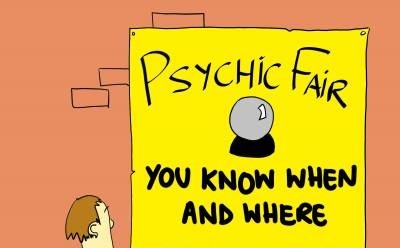
Psychic Fair. You know when and where, just CONCENTRATE.

Yesterday, I hit the Quad Cities Psychic and Paranormal Expo, my third trek to this annual gathering of bioharmonic healers, crystal peddlers, and ghost stalkers. Last year, I went to as many booths as I could and related my experience at each. This time I wanted to choose one to concentrate on and relate the results in greater detail.  With so many purveyors of pseudoscience, alternative medicine, and clairvoyance to choose from, the potential for amusement seemed brighter than the auras that were being read.

At a shaman’s station, the despcriptive posterboard proclaimed that he would remove traumatic imprints and enhance enlightenment centers. But it also noted that these were only half sessions, so presumably my enlightment centers would receive only a truncated improvement and the traumautic imprints would only be partially exorcised. That seemed like paying for half a tonsillectomy or root canal, so I continued to stroll.

I next tried an astrologer, who told me that the time of one’s birth determines which planet will most impact a person’s life. Maybe mine is Saturn, hers is Mars, and the past-lives reader in beads, purple hair, and crescent moon dress at the next booth is Jupiter. Curiously, the one planet that would seem to have the most impact on all of us, Earth, is irrelevant to all this. I asked the astrologer how those who are most affected by Pluto were impacted by its downgrade to dwarf planet status. She seemed uncertain what I was referring to, but I wouldn’t expect Neil Tyson to know the inner workings of Sagittarius horoscopes, so perhaps we can forgive her ignorance of astronomy.

From there, it was onto the mediums, those who claim they can communicate with the dead. This took some time since these were by far the most popular tables and longest lines. People want to think they’re hearing from their loved ones or are having an issue resolved and these nattily-attired ghouls provide these assurances.

They always give the answers the recipient wants, the recipient in turn praises the experience to others, and the cycle continues. I asked the mediums if they could speak with those who had passed on and they all assured me they could. I asked if they could reach my older sister. That I never had an older sister would serve as an immediate, handy test of their abilities. They all said yes, with one cryptically offering, “Whoever brought you here knew to bring you to me.” Well, I brought myself and I knew I was going to seek out mediums to see if they could pass the most basic test, so I guess she was right.

Watching them dream up stuff about a person that never existed would have had comedic value, but not $50 worth so I moved on. I decided to attend a class on intuition that was free and being taught by the woman who arranges and coordiantes the expo.

She identified herself with the moniker Mystical Moonspinner and declared, “I am a psychic medium.” Stepping from beyond the podium, she turned to us Muggles and asked, “How do you know if you’re intuitive?” Hmm, well if it’s real, I would guess your intuition would tell you.

Moonspinner, however, suspected that everyone has intuitive abilities but that they can be repressed.

“Most everyone is born with intuition,” she said. “You will sense things when you are a child. Maybe the imaginary friends aren’t as imaginary as we think.” That’s what I’ve said, too. Of course, I was 6 when I said that.

Moonspinner continued. “We start out completey open to the idea, but as we go though life, we are told that we’re not supposed to see things, we’re not supposed to hear things, we’re not supposed to know things. We start thinking it can’t be real so I shut it down.”

But that changed when she 12, as she started having mood swings and couldn’t figure out why. A good guess would be that she was going through puberty. She had entered a fragile time where developing children leave behind the elementary school mentality of most classmates getting along in order to gravitate toward cliques. It is a time of change and new experiences so it can be simultaneously frightening and exhilarating, and those living it are left with a 12-year-old’s ability to comprehend and process it all. But this is a rational explanation, which the audience had not come for, nor was the presenter prepared to deliver.
 
“I figured out that my empathic abilities were coming back,” Moonspinner told us. “It would take the form of my arm hurting and then finding out the person I was speaking with had had a sports injury in the same place.”
 
These experiences are explained by the Law of Truly Large Numbers. With billions of people undertaking several hundred actions per day, the normal goings on will sometimes lead to circumstances such as the arm story. Events like this happen coincidentally and require no supernatural explanation. Believing otherwise comes from selective memory, as Moonspinner is unlikely to recall a time that she started hurting and there was no nearby injury victim, or the time she was talking with someone who had a pain she wasn’t receiving in phantom form.
 
She will remember only the incident she described, and because it has meaning to her, she assigns a powerful connection to it. This phenomenon known is known as subjective validation.
 
Next, she said spirits of the deceased also tried to contact her, but it scared her so she developed two types of netherworld repellent. “Visualize a bubble and the spirits will flee from you,” she informed us. “Or picture a white light coming down and clearing out your psychic clutter.”
 
Back to how the tween Moonspinner began realizing she had a resurgent talent. “I started knowing things. How many of you guys have thought, ‘I should call my friend Barb’ and then the phone rings and it’s her?”
 
Most of us, I imagine. But we have also have had many more times that we thought of Barb without her calling, and many times when Barb called without us having envisioned her first.
 
But to Moonspinner, it means, “Your brain is telling you, and you have to be aware of those things. I just know things ahead of time.”
 
This prescience did not include knowing who was going to fill the 3 p.m slot at the psychic fair she was coordinating, as that time period was listed as “To Be Determined.”
 
Moonspinner continued to regale us with tales, revealing that she had done a reading eight months ago in which she told a customer something big was going to happen, and it did. “Experiences like this give me validation.”
 
Validation, yes, but only the subjective kind. It seems profound because it had a huge impact on her, but it fails to consider any other factors that could be in play, such as “something big” being vague, or the customer who believed in the psychic taking deliberate or subconscious steps to help fulfill this prophecy.
 
Our psychic then opened the floor to questions and an audience member wanted to know why strangers walk up and tell her their life stories.
 
“Because you were an Indigo child. If we took away your shell of a body, we would be left with a ball of energy and yours flows differently and your force field is attractive to people.”
 
And if Moonspinner’s shell was taken away, she would no longer have the body part from where she just pulled that spiel. Other audience members covered any questions I would have had about dream interpretation or future visions, so I went another route.
 
“Is this a testable ability and, if so, do you know if it’s ever been tested or subject to studies?
 
She replied, “I’m a believer, but I’m a skeptical believer.” I felt like throwing up, but guess my spirit bubble held it back.
 
“I do ghost hunting too,” she continued, “but I’m a skeptic until I can’t prove otherwise.”
 
Of course, this inverts where the burden of proof lies, which is always on the person making the claim. Absence of evidence is not evidence of absence, and negative evidence is no evidence at all.
 
Addressing the lack of studies, she said, “Can you hook me up to a machine and have it proven? Not that I know of.” She then hedged and related, “Well, actually, I was hooked up to an aura reading machine when a customer from a reading I had just finished asked me a followup question. My reader later told me later that my aura had changed when I was answering the question.”
 
Nice anecdote there, one of many she shared in lieu of any data. No, a medium relating what an aura reader had told her is not the type of study I had in mind. Rather, we could try something like this. We could take six subjects, each of whom has one of the following distinctions, all unknown to the psychic: Colorblind, lefthanded, Canadian-born, registered independent, professional fisherman, and hardware store worker. The psychic could spend 30 minutes talking with each person in the presence of neutral observers who would also not know which person had which distinction, making this a double blind study. Afterward, we could ask the psychic to match the person to their distinction. The chance of going 6-for-6 by chance would be one in 46,656, so doing this, especially repeatedly, would be strong evidence for the ability. 
 
So when Moonspinner states, “I have known things that there is no way I could have known, but how do you prove that,” we have the answer.
 
She then moved onto a tale in which she had been thinking about teaching a class, but didn’t know what topic it should be. Five minutes later, she got a call from a fellow psychic who wondered if she would like to teach a class on mediumship. While the audience swooned with this further confirmation of the speaker’s power, I was wondering why two psychics would need a telephone to communicate.
In her final anecdote, Moonspinner told about when her toddler nephew was riding a small motorized 4-wheeler toy. “It could only go about 6 miles per hour, but he is only 3 and I’m overprotective, so I was kind of worried. But his mother said it was OK, so I deferred to her. But after three minutes, I started asking, ‘Where is he? We need to find him now.’ About a minute later, we saw him walking the 4-wheeler back up the driveway with a gash on his knee. He had wrecked it and gotten hurt.”
 
Both she and the audience attributed her insistence that they check on the toddler to her psychic ability and not her overprotective nature. This type of continual communal reinforcement, post hoc reasoning, subjective validation, and selective memory can convince a person that normal occurrences are a gift from beyond, above, or similar preposition.
 
Despite my serious doubt about all this, I didn’t completely shut my mind to the possibility of intuition. Because when Moonspinner asked if anyone had ever had an intuitive experience, I knew I would be the only one not raising my hand.

“Fixing a whole” (Holistic health)

quack

In the late 1980s, the word “explicit” became synonymous with the Tipper Stickers on tapes and CDs. By extension, it came to be associated with foul language. Yet explicit means clear and unambiguous, so words can be explicit without being profane and a person can be profane without being explicit.  

“You’re an asshole” is explicit, but so too is “I love guacamole.” In both cases, there’s no doubt about what the speaker is conveying. By contrast, a rambling, incoherent drunk could pepper his language with a profanity every fifth word and be the opposite of explicit.

“Explicit” bears an unwarranted stigma and another perfectly fine word that has been coopted by the agenda-driven is “holistic.” It essentially means considering the whole picture but has been embraced by pretend-medicine practitioners who claim they take a more complete approach than do their traditional medicine counterparts. They insist their holistic approach takes the entire patient into account, not just his or her symptoms. Like “natural” and “quantum,” holistic is a word with legitimate uses, but one’s quackery alarm should be blaring when hearing it in relation to supposed medicine.

Exactly what practitioners mean by treating the whole person is not exactly, um, explicit, yes that’s the word. I have spoken with several of them and found that even the most basic probing about their methods will produce sputtering and stammering. Most people who approach them are desperate for a fix that is quick, cheap, easy, and painless. So the practitioners are used to hearing, “What can you do for my knee pain,” as opposed to “How do you access the Reiki energy you say would cure my knee pain?”

When I have sought additional information on their whole person claims, I have received these types of replies:

“We look into what negative energy may still be trapped from an earlier trauma.”

“Your sense of well-being has been thrown off and we may need to make an aura adjustment to fix it.”

“We will look to optimize the conditions by which the body will tap into its natural ability to heal itself.”

 “Your mind, body, and spirit are connected and must all be regularly nourished or all three will suffer.”

This is usually followed by them flattening the straw man that they try and turn modern medicine into. They claim mainstream doctors treat only the symptoms, that they fail to consider the underlying reason for illnesses, that they don’t treat a patient’s mind and spirit, and that they don’t give patients the attention they deserve.

None of which is relevant to which of these is more likely to cure or mitigate a condition: A medical doctor grounded in Germ Theory and the Scientific Method, and who has access to vaccines, antibiotics, double blind studies, and prescription-writing privileges; or a naturopath who counters with agile fingers, sandalwood, and intuition.

Furthermore, the self-described holistic healers substantially misrepresent mainstream medicine, which does consider more than the disease, symptoms, and treatment. A medical doctor looks at a patient’s health history, habits, genetics, and state of mental health. He or she will also recommend a regimen based on diet, exercise, and healthy habits like handwashing that will lessen the chance of becoming sick.

Another tact under the holistic umbrella is to ponder why an illness arose in the first place. The correct answer is usually germs or congenital conditions, or perhaps something science is still working to unlock. But the alt-med peddler is inclined to identify the causative culprit as Qi blockage, toxin buildup, or mind-body disconnect.

The alt-med clinician and patient can spend weeks or even years undertaking a wild goose chase for the underlying cause. This plays neatly into the whole person ruse. The practitioner can probe, question, support, praise, amuse, sympathize, support, laugh, cry, and bond with the patient, doing everything for them except identifying a cure. The patient can love the practitioner’s attentive nature so much that they gloss over the fact that they are receiving their 20th aura cleansing, ear candling, or spinal adjustment. This approach might help if the problem is loneliness, narcissism, or hypochondria, but not if it’s shingles, cataracts, or gout.

Finally, alt-med is usually far more narrowly focused than the stuffy old doctors it rails against. There are alternative medicine branches that are tailored solely for the eyes, ears, feet, hands, lungs, head, veins, muscles, spine, chakras, or meridians. And proponents of each will claim that their particular area, and theirs alone, is the key to all health. To be explicit, that’s bullshit.

“Aye, robot” (Artificial Intelligence)

ccm

In high school, my history teacher related that in the 1930s, vehicles rolling down the road averaged 5.2 occupants apiece. Cars were still a relative novelty, families who had them likely only had one, and people knew their neighbors better than today. So everyone piled into one DeSoto or Packard and headed to the dance halls and general stores.

As the Depression gave way to a postwar economy and interstate highways were built, more persons began driving, and the average number of occupants per vehicle went down. That dwindling continued until, by the teacher’s 1985 presentation, the average vehicle had 2.3 occupants. Extrapolating the trend, he deduced that by 2020, the average vehicle would have 0.5 occupants, meaning that every other car would have no one in it.

He delivered this with his usual deadpan manner, causing some in the classroom to think he really believed it. In fact, he was demonstrating how statistics can be misinterpreted by mistake or misused on purpose.

The great irony is that we now have the technology to inadvertently validate his faux prediction. Safety concerns will probably preclude that from happening, although that’s not necessarily logical. Computer cars that don’t get distracted and which have built-in safety features are better than the lunatic who almost ran me off the road this morning.

Driverless cars are a reality, although they always have a person ready to take over the navigating and negotiating of the streets if the system fails. The cars are the result of Artificial Intelligence, which has also given us automated financial transactions, Kasparov-vanquishing Deep Blue, and Semantic Scholar, a search engine for academic research.

Despite these impressive gains, the media’s treatment of AI is less than kind. This has always been the case. While concepts like The Matrix and The Terminator far pre-date Shakespeare, even his brilliant work paints a motif about the omnipotence of providence and royalty. Macbeth and similar tragic characters mess with these designs at their peril. From Frankenstein to The Twilight Zone, and even in real life examples such as the first test tube baby, many persons assume ominous results if humans venture beyond what a god or nature has allotted them. 

Hollywood can largely be forgiven. A movie about AI being used to seamlessly improve a car dealership’s algorithms would likely not be a blockbuster even if you spotted it Alec Baldwin and Renée Zellweger. The mainstream press, however, has no such excuse for its sensationalism. One example of the media going overboard is how it handled an open letter about AI’s future which was penned by the Future of Life Institute. The letter read in part, “Because of the great potential of AI, it is important to research how to reap its benefits while avoiding potential pitfalls.”

According to Popular Science, this measured idea was turned into something more disconcerting. Headlines blared, “Artificial intelligence experts sign open letter to protect mankind from machines” and “Experts pledge to rein in AI research.” Contributing to the angst are Elon Musk and Stephen Hawking, two giants in their fields who go beyond their areas of considerable expertise to warn of AI calamities. That they are speaking beyond their normal fields is not a reason to dispute what they are saying – no genetic fallacies here – but their lack of substantiation and support are the issue.

The panic most often takes the form of contemplating what happens when the machines that Mankind has invented reach the Singularity. This is the moment at which AI is capable of improving itself. This, in terrifying theory, could be used to enslave, destroy, or at least inconvenience us.

But at what point would this be possible, and what precisely is AI? Per the Oxford Dictionary, AI refers to computer systems that are able to perform tasks that had previously required human intelligence, such as visual perception, speech recognition, decision making, and language translation.

The Internet has more information stored in it than the most knowledgeable person ever, by a very comfortable margin. But there is a difference between knowledge and intelligence so the Internet would not by itself by AI, though an Internet that could search itself might be. Also, it can be used to facilitate other AI notions, such as those outlined by Oxford.

But this is getting way, way ahead of ourselves and our technology. Computer scientist Oren Etzioni explained in Popular Science why the Singularity is a long ways off, if it’s even plausible.

“We’ve had some real progress in areas like speech recognition, self-driving cars and AlphaGo,” he said. “But we have many other problems to solve in creating artificial intelligence, including reasoning. For instance, a machine would have to be able to understand that 2+2=4 and not just calculate it. Natural language understanding is another example. Even though we have AlphaGo, we don’t have a program that can read and fully understand a simple sentence. The true understanding of natural language, the breadth and generality of human intelligence, our ability to both play Go and cross the street and make a decent omelet are all hallmarks of human intelligence. All we’ve done today is develop narrow savants that can do one little thing super well.”

Besides being a long ways off, if even possible, we cannot say with certainty that AI would even result in what alarmist headlines suggest. Would reaching the Singularity be detrimental in the form of Asimov-defying robots, would it be beneficial like the Jetsons’ maid, or would it be something neutral, like AI keeping itself entertained because we were too slow to be of interest to it?

The entire concept is predicated on well above average human intelligence being achieved, perhaps even going so far as accomplishing the accumulation of as much intelligence as is possible. As such, AI could resolve conundrums we never considered solvable or even knew existed. This super advanced knowledge could include realizing the benefits of altruism, causing AI to gift us with immortality, beyond warp speed travel, and the ability levitate objects so we can retrieve the Doritos without getting up.

Or maybe none of this happens, good or bad, so for now, there’s no reason to arrest a developing technology.

For the risk to become real, a sequence of ‘ifs’ would have to occur: 1. Scientists would have create a human equivalent of AI. 2. This hypothetical HAL would need to achieve a full understanding of how its inner workings function. 3. The AI would need both the desire and means to improve itself. For instance, it might gain the knowledge of how to build a better version, but lack the requisite appendages to do so. 4. If achieved, this self-improvement would need to be able to be continued until it reached a still-undefined superintelligence. 5. It would need to accidentally or intentionally start using this superintelligence to annihilate us. 6. In the decades or centuries leading up to this, our top scientists and computer programmers would need to have failed to account for this or have an effective safety valve in place.

To be fair, working on the issue outlined in number six is what the alarmists are getting at. But right now we are so far from this that we wouldn’t know how to approach the problem. We don’t know what form a malevolent AI would take or how to start working against it. Science works best when it concerns itself with what is observable, knowable, and testable, and these qualifiers currently allow for no room for plotting a preemptive strike against an invading android army. 

“Tasting the fifth” (MSG hysteria)

msgfear

Before GMO was a term or a thing, before gluten was known to anyone besides dieticians, and when “organic” was a word limited to advanced chemistry classes, MSG reigned supreme in the Field of Food Fears.

While it has given way to other unfounded panics, concern over monosodium glutamate still exists and “No MSG” signs are obligatory adornments to Chinese restaurant storefronts.

Meanwhile, umami is afforded grand status and is considered a staple of the culinary in-crowd. Enterprising chefs have built lucrative careers centered on this fifth taste, which is a darling of the Food Network and similar outlets. When an Umami Burger chain opened in New York City, customers waited three hours for a table.

The fifth taste is treated as the culinary equivalent of finding the Fifth Dimension, while MSG gets kicked out like a fifth Beatle. Yet they are chemically related and umami is detected by the receptors that MSG targets. When the three-hour wait was up, customers began chomping on a burger that contained 2,185 milligrams of glutamate.

The tale began in 1908 when scientist Kikunae Ikeda pondered why a certain Japanese vegetarian soup tasted meaty. In his lab, Ikdea isolated the soup’s seaweed, dried it, and noticed that a crystalline form was developing. Tasting the crystals, he found them to be soup’s mystery flavor. Ikeda deduced that the amino acid glutamate was largely responsible for producing this distinctive flavor. He received a patent for MSG and began producing it. He named this taste umami – essentially Japanese for delicious – and salt, sweet, sour, and bitter welcomed a new member to their fraternity.  

A great flavor revolution had begun, but 60 years later, Dr. Ho Man Kwow wrote in the New England Journal of Medicine that he had experienced numbness, weakness, and heart palpitations whenever he ate at Chinese restaurants. He suggested MSG was to blame. This post hoc reasoning gave way to mass hysteria, and Chinese Restaurant Syndrome was born. Anti-MSG books were published and Chinese restaurants moved to eliminate MSG foods from their establishments.

However, a more measured response took place in the form of double blind scientific studies. And in 1993 a study showed that MSG symptoms occurred at the same rate whether a person was consuming MSG or a placebo. That was followed two years later by a report that concluded MSG is safe when “eaten at customary levels.” Then epidemiologist Matthew Freeman published a review of 40 years of MSG research and concluded that, “Clinical trials have failed to identify a consistent relationship between the consumption of MSG and the constellation of symptoms that comprise the syndrome.”

In fact, the no-MSG trend is a Western idiosyncrasy, so the Chinese would be suffering perpetual fatigue and discomfort if this phenomenon were real. Still, to avoid the MSG label and its unfounded stigma, most persons who target the umami audience will use natural glutamates instead of what Ikeda discovered. But chemically, these are the same.

There is little beyond anecdotes to suggest MSG consumption will result in unpleasant symptoms. These symptoms include headaches and other pedestrian annoyances, but for those who prefer their fears more exaggerated, we have Joseph Mercola, who claims MSG will cause brain damage that leads to ALS, Parkinson’s, and Alzheimer’s.

He bases this on an assertion that MSG is a toxin which instigates a pathological process that damages nerve cells by excessively stimulating neurotransmitters. I could come across no science to support this, a distinction I suspect I share with Mercola.

The blogger Skeptical Raptor noted it’s possible that a microscopic percentage of the population could be at risk of negative reactions owing to the relationship between the glutamate ion and neural transmitters. But even if that were the case, it is supremely unlikely that one could consume enough MSG to cause this.

And even if that could somehow happen, the population as a whole wouldn’t need to avoid MSG any more than everyone should bypass Reese’s Pieces because a few among us have peanut allergies.


“Market snare” (Multi-level marketing)

pyramid

Most persons with a product or service will try to sell it directly to consumers, license it to retailers, or go on Shark Tank. Then we have the world of multilevel marketing, where participants attempt to succeed in business by getting people to compete against them.

That’s not how it’s presented in slick brochures, campy infomercials, and high-pressure seminars, but that’s how it works. The company who makes the product sells it to individuals at an inflated price, and the idea is for those people to recruit more salespersons under them, with a percentage of their sales going back up the line. This is an unsustainable business model and is untenable from a profit standpoint.

It’s possible the company could make money just by selling the product like a traditional business, but they have found it more profitable to have a steady stream of captive customers who buy their product and entice others to do the same.

Among the more common MLM products are panaceas in lotion and potion form. I have dealt with bogus medical and nutrition claims before, but here will focus not on the products’ inefficiency, but on the role they play in multi-level marketing. And that role is to give this charade legal cover. Since a product is ostensibly for sale, it is not considered a pyramid scheme in most jurisdictions.

But make no mistake, “multilevel marketing scam” is redundant. If used as instructed, it will fail. The company makes their money from seminars and from selling the products to distributors at inflated prices. Those persons would then have to resell it for even more, so the idea of consistent profit that way is unrealistic. That leaves recruiting others, who would be under you in this supposed non-pyramid scheme. Distributors are to get a cut from those under them, and the typical model is for an individual to recruit five persons, who themselves all get five more, making 25 persons involved. This will be easier for some than others, depending on one’s networking abilities, number of friends, and personality. But it sounds attainable, and in fact is often attained.

But there are two huge problems with this approach. First is the ridiculous business model of recruiting two dozen people, probably in your town and even in the same circles, to compete against you. And again, just selling the product won’t work because you must buy it at exorbitant prices to begin with.

The second problem is the unsustainable nature of the pyramid. If Sam recruits five salespeople and those five recruits bag five of their own, this could only be repeated seven times in a town of 75,000 before the population was exceeded. And these products are not the type that can be reasonably sold online because the original jacked-up prices will balloon ever higher with shipping costs.

Even if Sam is able to get a group of 25 distributors (who have now become his competitors), he receives no wage from the company. The time and labor he puts into selling the company’s product is uncompensated. His only pay comes from the sales generated by those in his section of the pyramid, and that is almost never enough to break even. Sam is not an employee, so he enjoys no legal protections that would entail, and he has no business assets to liquidate or sell.

Moreover, this scheme can take on a creepy feel. I occasionally quote from other blogs to support my positions, but this is the first time I’m borrowing from an evangelical Christian site, specifically womanofgrace.com. It quoted a man named Stuart Adams, who related that his immersion into MLM was akin to his previous experience as a Latter-Day Saint.

Mr. Adams: “There was a cult-like nature to this group. The meetings involved attendees standing up, giving personal testimonials of how they had been cured of their diseases, and talk of why we should not trust the medical profession when it comes to health care, but instead refer to the teachings of our leader, who was brave enough to rebel against medical conspiracy and bring us all the wonderful cures. They were convinced they were in the true group headed by the true leader.”

This particular product was sold by a former Facebook Friend of mine, who unfriended me after I questioned the legitimacy of the product and its associated conspiracy theory, so I have experienced firsthand the unquestioned devotion this cause and its almighty leader can engender.

Customers enjoy going to the mall, chain retailers, or dime stores and also embrace impromptu purchases. This is much preferable to buying cosmetics, mineral scrubs, or a Tang knockoff from their sixth best friend in his living room. And the Internet has eliminated any demand for a small distributor network that might once have worked in rural areas.

The Consumer Awareness Institute analyzed data published by MLM companies and it showed that less than one percent of participants made money. Even cheerier numbers from other sources reveal that just 10 percent of distributors even recoup the money they put in.

If you want to purchase overpriced drinks that you’ll just end up finishing off yourself anyway, head to Starbucks.