“Cherish the thought” (Critical thinking)

numbers

Time for another critical thinking spotlight, where we will examine some of the logical fallacies that trip up an argument.

We’ll start with MAGICAL THINKING, where one event happens after another other, so a connection is assumed even if there is no causation. It could take the form of, “A black cat crossed my path and, sure enough, an hour later I broke my arm.” This was the logic that blamed hard rock for teen suicides in the 1980s. In a case from 1984, the parents of John McCollum blamed Ozzy Osbourne, specifically the song “Suicide Solution,” after their son took his life. In actuality, the song had an anti-alcohol message, but even if a song glorifies offing one’s self, it is not necessarily valid to draw a connection with listening to the song and acting on it. A teen can become aloof for many reasons and may use music as an escape from an increasingly unsatisfying existence. Unfortunately, some teens commit suicide and attributing it to what is on their iPod list requires magical thinking, AKA post hoc reasoning. These tragedies happened long before the advent of recorded music.

A RED HERRING is attempting to change the subject in order to divert from the real issue. A ticked-off driver examiner might exclaim, “A jayparking ticket?! Don’t police have real crime to worry about?” This reasoning is seen frequently in politics, as in, “The governor is touting the new bridges that opened ahead of time and under budget in order to deflect from his personal scandal.” This would be no more valid than an opponent saying, “They’re just bringing up the governor’s indiscretions because they want to deflect from his success with the bridges.” These are unrelated items and should be addressed individually.

Another way this ploy can be attempted is with the APPEAL TO HYPOCRISY, which is usually a subset of the genetic fallacy. Thomas Jefferson spoke some of the most eloquent words championing freedom, such as, “Our liberty depends on freedom of the press, and that cannot be limited without being lost.” Another gem was, “Eternal vigilance is the price of liberty.” Some say his words are vacuous because his status as a slave owner meant he wasn’t practicing them. He was being hypocritical, but that does not lessen the legitimacy of his statements. In a presidential election year, appeals to hypocrisy are some of the most frequently-sited animals on the logical fallacy landscape. In the wake of the Hillary Clinton e-mail scandal, I have seen liberals point out that Dick Cheney committed similar offenses, and have seen conservatives bring up Clinton when discussing Kim Davis potentially violating Kentucky’s Open Records Act. Cheney, Clinton, and Davis may have all violated the law, but none have anything to do with each others’ cases.

Next, we’ll look at the STRAW MAN, which is fabricating or greatly distorting an opponent’s position in order to have an easy target to attack. American Family Association founder Donald Wildmon said, “The humanist point of view is that man came from nowhere, is going nowhere, and has no responsibility to others.” Wildmon’s opening phrase is presumably referring to the Big Bang, abiogenesis, and evolution, which are documented with strong astronomical, geological, and anthropological evidence, making them the antithesis of nothing. Going nowhere presumably means thinking they are not going to Heaven or Hell, nor even Purgatory or into a reincarnated body. While most Humanists might agree with that part, Wildmon’s insinuation that they lead meaningless existences is nothing he bothers to substantiate. Persons can grow, have valuable experiences, and help their fellow man without religion. The no responsibility line is borderline slanderous, as Humanists engage in robust charity work and fight for the underprivileged. By falsely creating a nihilistic, selfish, aimless opponent, Wildmon has an easy opponent to topple.

While not usually associated with critical thinking errors, we sometimes see the NON SEQUITUR in logical fallacy form. Imagine a homeowner saying, “I have added insulation and installed new windows, but am still feeling a draft, so I need to call in a ghost hunter.” This is fallacious thinking because we would need to first establish there is a ghost and that it is the source of the draft. This example may seem silly, but thinking this ridiculous happens whenever police departments use psychics to try and find missing persons or a murderer. There have been no cases where this has been successful, yet it is a method still sometimes used.

The logical fallacy that I committed most often in my pre-critical thinking days was the SLIPPERY SLOPE, and I was especially guilty of it when discussing potential legislation. I would dream up the worst possible outcome, which sometimes would necessitate anticipating a series of future events in order for this calamity to occur. I should have been able to speak for or against the legislation simply on the merits or drawbacks of it. For instance, Congress made an attempt to censor the Internet in 1996, and the way the law was written, it would have been valid to say, “It could be illegal to e-mail your 17-year-old brother the Birth of Venus.” It would have been a slippery slope fallacy to declare, “If this law is passed this year, it may be illegal to criticize the president the next year, and the year after that we could all be behind barbed wire.”

Like the slippery slope, the FAULTY ANALOGY lacks focus. It relies on two unrelated cases to make a point. Rep. Charles Rose defended taxpayer money spent on telepathy research by saying, “This country wasn’t afraid to look into the strange physics behind lasers and semiconductors.” Lasers and semiconductors were the consequence of steady advances using the Scientific Method, something remote viewing conspicuously lacks. Or someone might say, “Rational thinking and Dilly Bars are both mighty fine. But too many Dilly Bars will rot your teeth and make you fat, so too much rational thinking is bad for your mind.” The most common occurrence of this fallacy asserts that if we sent a man to the moon, we can eradicate drugs (or some other goal that could not be reached by the same methods that were applied in the Apollo missions).

While the previous two fallacies may wind all over the place, the FALSE DICHOTOMY by contrast artificially limits the options. This is where two (or maybe three or four) choices are presented as the only options, with no other choice or middle ground available. An example would be, “You serve either Jesus or Satan.” In fact, one could serve Vishnu, Thor, the Flying Spaghetti Monster, or no one. Another example would be, “You either support the war or hate the United States.” One might very well love the United States and feel that the war is not in its best interests.

With the COMPOSITION fallacy, the speaker incorrectly attributes the properties of one part to the whole. “Hydrogen and oxygen are both dry, so water is not wet.” Its opposite is the DIVISION fallacy, where it is falsely asserted that what is true of the whole must be true of the parts. “This is a great coaching hire. He played for Nick Saban’s Alabama teams, so you know he’s going to be committed and focused.”

Onto the FALLACY OF MISPLACED CONCRETENESS, in which an abstract concept is treated as tangible object. It occurs when declaring war on drugs, crime, poverty, or terrorism. These never achieve victory because they are abstract concepts incapable of surrendering or signing peace treaties. They cannot be shot, bombed, or interrogated for intelligence. A similar mistake is treating a word as equivalent to the act. Moral crusaders sometimes seek to eliminate references to thuggery in song, comic books, and video games in hopes this will reduce crime. This fails because words and deeds are separate.

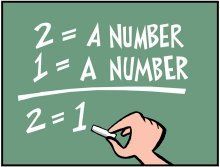
Next, we’ll consider the ARGUMENT FROM NEGATIVITY. This is a frequent ploy of Flat Earthers, geocentrists, and creationists. In these cases, a supposed shortcoming in one aspect of astronomy or geology is considered proof of the alternate position. But even if your opponent is wrong, you might be mistaken as well. If your opponent says 2+2=5, that doesn’t mean your math of 2+2=7 is correct.

This fallacy is closely related is the APPEAL TO IGNORANCE, which is common among conspiracy theorists. In this fallacy, the speaker appeals to a lack of information to prove a point, or argues that since the opponent cannot disprove the claim, it is true. BBC, acting on information from an emergency worker that damage to Tower 7 meant its collapse was imminent, prematurely reported that it had fallen even though it was still standing in the background. 9/11 Truthers assert that since no video exists of the emergency worker saying this to the reporter, that means it never happened, and that BBC was in on the plot.

Finally, we have the ARGUMENT FROM INCREDULITY, where one asserts an argument must be false because of the listener’s inability to understand it. But my ignorance of the intricacies of the internal combustion engine does not mean automobiles won’t run. Similarly, a lunar landing denier’s inability to conceive of how Mankind could have reached the moon doesn’t mean it didn’t happen. Then again, if we didn’t send a man to the moon, maybe that explains why we haven’t eradicated drugs yet.


“Featureless presentation” (Bigfoot)

bigfoot

There are dozens of purported cryptids worldwide, from the relatively small Chupacabra to the behemoth Mokele-Mbembe, from benevolent leprechauns to bloodthirsty Jersey Devils, from aesthetically-pleasing mermaids to revolting Skunk Apes.

But no Champys, Batututs, or Manananngals have managed to penetrate the cryptozoology triumvirate of Yeti, the Loch Ness Monster, and Bigfoot. And among this trio, Sasquatch reigns. This says less about the monster than about those seeking him. Nessie is underwater and the abominable snowman resides in the world’s highest mountain range, but with Bigfoot, anyone in North America can get a gander. Mix this desire with preconceptions, then throw in thick vegetation and an upright bear, and you’ve got a sighting to report.

I have dealt with claims from Bigfoot proponents before, so want this time to focus on some of the lesser-known arguments against the notion of Sasquatch.

First are the alleged Bigfoot vocals. Part of Bigfoot lore are the yelps, shrieks, and wails heard by terrified but excited hikers and campers. Yet these reported sounds are too varied to have come from one creature. No one would mistake a howling wolf for a croaking toad, yet wildly varying sounds are all placed under the Bigfoot vocal umbrella.

A second problem is the absence of tracks. Bigfoot aficionados explain away the total lack of roadkill and other corpses by assigning to Bigfoot extreme stealthiness. Yet even if he were a skilled recluse, he would still need to leave tracks, and even Bigfoot’s most-known investigators, such as Jeff Meldrum, have come up empty. Meldrum is an anthropologist, so he would know where to look and what to look for if stalking a North American bipedal ape. After all, rare mammal tracks are found by expert biologists who know where and when to look.

Many alleged tracks have been reported, of course, but this brings us to the third problem. Bigfoot is supposed to live in forests and on mountains, making his way over rocks, ice, sharp ferns, cockle-burs, rushing streams, and thorns. This should produce feet that are rough, scarred, calloused, broken, and torn. Instead the prints are smooth, almost manicured. They should appear consistent with an animal who has adapted for rugged conditions, but instead are featureless. Additionally, a large, lumbering bipedal primate should have toes that splay apart, as they do in wild primates. Instead, the toes seem neatly placed together. This is all strong evidence against the existence of Sasquatch unless we credit the monster with footwear innovation or the ability to fly.

Finally, Bigfoot DNA in the wilderness should be ubiquitous. Melba Ketchum purported to have evidence that Bigfoot was a cross between homo sapiens and an unknown animal. For maximum benefit, she should have had it being a Roswell alien.

Explaining an imaginary animal by invoking another imaginary animal is obviously unsatisfying. And if Bigfoot were real, scientists would regularly encounter DNA consistent with a North American bipedal ape. Yet this has evaded Ketchum, Meldrum, everyone else. Desire, preconceptions, vegetation, and bears can only get you so far.

“Mindcraft” (Critical thinking)

brainlift

Time again to take a break from posting about tarot card readers who see leprechaun ghosts while giving readings to craniosacral therapists, and to spotlight critical thinking.

Critical thinking entails separating one’s self from biases in order to analyze an issue, then using a series of sound statements free of logical fallacies to support a conclusion. While this requires ongoing effort and can be challenging and complex, there are two simple actions that build critical thinking skills. One is sticking to the point. Most logical fallacies in some way deflect from the issue being discussed. Second, remember that an idea must have supporting evidence. Just throwing something out and expecting it to be accepted on its face is the logical fallacy of Begging the Question, which we’ll address later.

In purporting to prove the existence of God, columnist Matt Barber wrote, “The manifest intentionality and fine-tuning of all creation reveals design of breathtaking complexity.” He assumed creation was a given, then used that assumption to try and prove that’s why we see design in the world. But he had failed to support his conclusion with anything other than the conclusion worded in another way.

Still the most common critical thinking error is the Genetic Fallacy. This is when the counterargument fails to address the points made, but instead focuses on the persons making the argument, or their characteristics. If National Review and Mother Jones both ran columns on whether the minimum wage should be raised, it’s easy to know which side both would come down on. However, if someone wanted to argue against the conclusions, it would be inadequate to say, “That comes from National Review/Mother Jones,” and dismiss it for that reason. The issues raised would still need to be addressed.

A similar tactic is to Poison the Well, where an unrelated characteristic of the speaker is highlighted rather than his or her argument. If a conservative Christian outlined his proposal to stimulate the economy, bringing up his opposition to gay marriage and support of gun rights in an attempt to win over liberals would be poisoning the well. Unrelated stances on other issues should never come into play. “Helium’s atomic number is 2” is an accurate statement whether it’s uttered by a Supreme Court justice, an information technology specialist, or a serial killer.

Also, beware the Ad Populum fallacy. Your mother understood this one when she asked, “If all your friends were jumping off a cliff, would you jump too?” The ad populum attempts to use a subject’s popularity rather than its merits to make the case. In arguing for GMO labeling, Bernie Sanders, said, “All over Europe, we’ve got dozens and dozens of countries which do label GMO products. We should be able to do that in the United States as well.” Nothing in his statement addressed GMO safety or outlined why such products should be labeled.

An opposite approach portrays a position’s unpopularity as proof of the believers’ elite status. This is common among conspiracy theorists, who feel they and their fellow independent thinkers (who swallow everything from the YouTube channels they subscribe to) are vastly superior to brainwashed sheeple.  A third way this fallacy is used is in trying to get a target to believe that a position is the accepted one for a group the listener identifies with. For instance, it is almost de rigueur for Republican presidential candidates to do battle amongst themselves over whose positions most espouse true Christianity.

Related to the ad populum is the Appeal to Tradition, which holds that how long an idea or tactic has been used is related to its merits. But slavery lasted for millennium, while the polio vaccine came along just 80 years ago. The appeal to tradition fallacy is ubiquitous in New Age medicine, where a technique having been used in ancient Egypt, China, or Greece is highlighted to gloss over the lack of double blind studies indicating its efficiency. In most instances, the antiquity claim is also false, but even if true, the number of centuries thyme has been used to cure arthritis is unrelated to whether it will alleviate your aching joints.

This fallacy is sometimes manifested in the mantra, “If it ain’t broke don’t fix it.” But perhaps another approach would improve the situation, perhaps circumstances have changed since the current way of doing things developed, and perhaps new evidence suggests there is a better way.

Going back to the Matt Barber example, when writers claim as evidence for their argument the conclusion they are attempting to prove, they are Begging the Question. Often, the first claim is loaded with the conclusion the speaker has yet to prove. An example would be, “Teenagers are old enough to look out for themselves, so curfew laws should be abolished.” The conclusion assumes that the introductory phrase is correct.

Another fallacy is Appealing to Irrelevant authority. The opinion of experts in their fields should carry weight, especially the closer the expert opinion is to a consensus. The authorities could be wrong, but until that is proven, it is proper to defer to the experts. But this fallacy refers to touting someone as an authority even when they address issues outside their area of expertise. To cite Steve Jobs’ opinion in an argument over the best fuel injectors would be fallacious. The appeal to irrelevant authority frequently occurs when fitness, nutrition, or alternative medicine products are hawked by celebrities.

Speaking of celebrities, Justin Timberlake was the focal point in the use of a logical fallacy by a Grio editor this week. Timberlake tweeted the seemingly innocuous and biologically correct observation that there is only one race, human. This earned the wrath of Blue Telusma, who argued against this proposition because “People of color need their identities and cultures embraced.” However much this may be true, it failed to address the scientific evidence that race is a social construct. Telusma had committed the logical fallacy of the Argument of Consequences, where a position’s possible outcome, rather than its accuracy, is attacked. Telusma further argued that Timberlake’s position was compromised since he was white, which you likely recognize as a genetic fallacy. Curiously, she said nothing about his music, about which there is much to criticize.


“Groundless” (Earthing)

groundless

One day, cable TV executive Clinton Ober was sitting on a park bench when, in the great tradition of scientific discovery, he observed that all people were wearing shoes. He further realized there were many illnesses and disease in the world, and that almost 100 percent of the sufferers wear also wearing shoes. He hypothesized there must be a connection.

Earthing, or grounding, is the idea that achieving and maintaining health requires humans to be literally in touch with Earth. Shoes, as well as floors, tents, tights, red carpets, and stilts, all prevent Earthing and deprive people of crucial health benefits. Ober co-authored the book, “Earthing,” whose subtitle declares grounding to be most important health discovery ever. Take that, Jonas Salk. Up yours, antibiotics.

Of the many logical fallacies this field entails, the most glaring is Special Pleading, as it’s just fine for products sold by “Earthing” authors to come between Earth and your feet.

The book’s description reads, “For most of our evolutionary history, humans have had continuous contact with the Earth. Throughout time, we humans have sat, stood, strolled, and slept on the ground, with the skin of our bodies touching the skin of the Earth. This contact served as a conduit for transferring the Earth’s natural, gentle negative charge underfoot into the body. Reconnecting with the Earth upholds the electrical stability of our bodies and serves as a foundation for vitality, health, and healing.” If there were any Neanderthals left, we could ask them about the results of receiving this constant influx of health benefits.

As to modern day homo sapiens, let’s see what Earthing can do for chronic footwear victims. According to the book, shoes block the constant supply of the free electrons that shield and nourish Earth.

But while electrons are everywhere, the suggestion that the human body alone can manipulate them for our benefit is unfounded. As physicist blogger Clint Orzel explained, “Ordinary interactions with many materials will strip electrons off your body. But that never lasts long, as the doorknob spark illustrates. In the process of shuffling across a carpeted floor, you lose…several billion electrons, but as soon as you touch a metal object, you get them all back. It’s impossible to build up and maintain a significant charge imbalance between your body and the rest of the world because everything we interact with contains electrons, and they move back and forth between objects all the time.”

The book contains the usual alt-med nods to balance, tradition, energy, and anecdotes, but “Earthing” authors do get creative with lines such as this: “Our connection with the earth carries information, helping align us with the greater network of intelligence of our planet.”

“Earthing” is also unusually literal with its appeal to nature fallacy, getting that word in thrice in its description of the technique’s panacea power: “Earthing connects us to Nature and Nature is the ultimate source of health and healing. Earthing is a return to the healing power of Nature and a simple but powerful way to restore your health.” Cheap, easy, painless, natural, buy our product. This thing crosses off all the items on the alt-med checklist.

It also appeals to tradition, specifically the Native Americans and Greeks, besides throwing in the standard Qi reference. Another line lets us know that “Wild animals never get sick,” and indeed, I have yet to see a warthog at the doctor.

Let’s move onto the website earthing.com. In a typical evidence-free assertion, the website’s authors write that, “Earth’s natural energy is foundational for vibrant health. Disconnected from the Earth, we feel fatigued. When we re-connect with the Earth, balance is restored!” In a more specific claim, it asserts, “We know that inflammation is caused by free radicals and that free radicals are neutralized with electrons from any source. Electrons are the source of the neutralizing power of antioxidants.” But skeptic author, Dr. Harriet Hall, notes that, “It’s more accurate to say inflammation causes free radicals. And to neutralize free radicals you need antioxidant molecules, not free electrons.”

Then we have the blog, “The Most Dangerous Invention,” which boasts that, “Standing barefoot on the earth has a wide variety of effects on the human body.” The effects for me are scars, burns, blisters, and insect bites. And as you probably know by now, the most dangerous invention referenced in this blog’s title is shoes. Your enemy may have nuclear weapons, but you can respond with Hush Puppies.


“Frights and sounds” (Electronic voice phenomenon)

GHOST

Electronic voice phenomena are recorded sounds that are interpreted by some as spirit voices. Without exception, this ghostspeak is limited to incoherent hisses in one to three word bursts.

When one can make a phrase out of it, it is likely the result of apophenia, the mind’s tendency to perceive patterns in random stimulus. It is what causes people to see a Face on Mars or Jesus in their Post Toasties. Other factors in hearing spirit voices on recordings are expectation and desire, but the biggest influence is equipment shortfalls.

Sound engineer David Federlein has noted that despite using much higher quality equipment than most EVP researchers, he has “never heard from the dead and I have been listening to tape and hard disc recordings for years. EVP are usually recorded by raising the noise floor – the electrical noise created by all electrical devices – in order to create white noise. When this noise is filtered, it can be made to produce noises which sound like speech. When you factor in other aspects of physics, such as cross modulation of radio stations or faulty ground loops in equipment, you have a lot of people thinking they are listening to ghosts when in fact it is nothing more than a controlled misuse of electronics.”

Indeed, sample rate conversion, vibration isolation, and noise alteration can all cause recordings to assume qualities separate from what they originally picked up. Even meteors can be a factor. While hurtling through Earth’s atmosphere, they leave a wake of ionized particles and electrons that can reflect transmission radio waves. The resultant sound lasts no more than a second, but it can transform a message sent via CB, cell phone, baby monitor, or ham radio into a wail of torment from a 16th Century knight.

As an anti-vax message on the Internet shows, scientific advances can be coopted by anti-science forces. So the advent of film and audio enabled mediums and ghost hunters to bolster their charade. One of the first instances of this was Attila von Szalay in the 1920s. He conducted recording sessions using a microphone in an insulated cabinet connected to an external recording device and speaker. He reported finding sounds on the tape that could not be heard on the speaker when he recorded. He interpreted these extraneous sounds to be voices from the netherworld.

Opening our skeptic toolkit, we find three items. First, von Szalay is employing Tooth Fairy Science, where research is conducted on a phenomenon before establishing that the phenomenon exists. This leads seamlessly to the next problem, the logical fallacy of affirming the consequent. Von Szalay insinuates that if we hear voices, it means ghosts are speaking, and we indeed hear those voices, so voilà. Also crucial is that he never established that any of the equipment could be used for the purpose he was claiming. As an amusing postscript, the ghostly missives included “This is G” and “Hot dog, Art.”

In the early 1980s, William O’Neil constructed an electronic audio device called the Spiricom, which he said could enable him to dialogue with the discarnate. But he committed the same errors as von Szaly and, furthermore, no one was able to replicate his results using the device, meaning either that it didn’t work or only O’Neil had The Gift.

Along the way, Sarah Estep founded the American Association of Electronic Voice Phenomena and put this Tooth Fairy Science on an even grander stage by announcing that the voices came from other planets or dimensions.

It is telling that the only persons who pick up these voices are those that are specifically looking for them, even though EVP researchers use the same type of equipment as sound and video broadcasters, engineers, and producers. The spirits never announce their presence on CNN or NPR. Then again, maybe the discarnate favor the darkened rooms, hushed tones, and frightened hosts that shows like Ghost Hunters employ.


“Of corpse” (Incorruptibility)

SMILECORPSE

Incorruptibility is the notion that someone who is holy enough will not have their body rot away after death. An incorruptible corpse ranks somewhere above a mummy and below a vampire. It can’t get up, walk around, or suck blood and Yoo-hoo. But nor is it stiff, nor does it require care to maintain an appearance of being asleep. Incorruptibility is primarily associated with the Roman Catholic and Eastern Orthodox churches, though it has made cameos in Hinduism and Buddhism.

For a body to resist decomposition, it needs plenty of help. This assistance can take the form of nature and serendipity, which happened to Ötzi, whose corpse spent 5,000 years frozen in an Alps glacier. Or the deceased can be tended to by believers who feel that their all-knowing, all-powerful deity needs some help. In these cases, believers may cover the body in wax and seal it in metal or glass, or use other preservation methods. All bodies eventually disintegrate unless pumped with embalming fluids or waxes, or helped by conditions such as alkaline soil, or a lack of oxygen, bacteria, worms, heat, and light.

Some of the allegedly incorruptible corpses release a sweet odor when exhumed, which is either a divine sign or the result of embalming fluids and ointments, depending on whether one prefers their explanations supernatural or natural.

Like the corpses, claims of incorruptibility wither upon examination. The Catholic Church declared Francesca Romana incorruptible when she died in1440, yet only bones remained when her tomb was opened two centuries later. In another case, Atlas Obscura reporter Elizabeth Harper wrote that Anna Maria Taigi looks incorrupt from a distance when viewed in her coffin at San Crisogono church in Rome. But get closer and one notices that her allegedly wrinkled skin is really made of wax. When Harper asked the man who oversaw San Crisogono’s relics about this, he explained this method was intended to “preserve an honest impression of her the moment she was discovered in her grave.” That’s fine if you work for Madame Tussauds; it’s quite another if you are trying to pass off the corpse as immune to decomposition.

Similar was the case of St. Paula Frassinetti, who died in the 19th Century. She appeared incorrupt when she was moved to a new tomb a quarter century after her death. But this was the result of saintly storage methods. With those methods gone, her body began the normal decomposition, at which point acid was applied as a preservative, which again is fine if one is not claiming a miracle.

In addition to Ötzi, there are other natural examples of somewhat-incorruptibility. Nearly a thousand bodies have been exhumed from the peat bogs of northern Europe, where a combination of cold and chemical processes preserve soft tissue. Peat acid dissolves the bones but leaves the soft tissue rubber-like and with a tanned appearance.

In 1952, a Hindu man was touted as an example of incorruptibility, but he in fact showed nothing unusual for an embalmed corpse kept in optimal conditions. Fifty years later, the body of Buddhist monk Hambo Lama Itigelov was exhumed. His condition was described by eyewitness monks as being akin to someone who had died only two days before. However, a video of the exhumation shows his body more resembled a mummy and a pathologist’s report found the body had been preserved with bromide salts. The lama remains in the lotus at a temple in Russia, either a well-preserved corpse or an immortal in a deep trance experiencing Nirvana.

“Broken record” (Quantum holographic healing)

holodoc

Today we’ll consider the delightful notion that every entity above the molecular level leaves a permanent record of its entire history and, when combined with a gizmo doohickey, will cure what ails you.

Proponents call it “quantum holographic healing,” though we will see that it features none of those things. Quantumholographichealing.com tells us, “Everything in the universe constantly gives off a unique energy pattern that remains for all time and can be read by those who know how. Every word, deed, and intention creates a permanent record.” Putting this into our quackery-skeptic translator,we get: “Quantum holographic healing is a modern-day Akashic Record, accessible by those with psychic means, or rather the ability to pay someone who has these psychic means.”

The website insists that E=MC2 is the key since matter (a hologram) can be converted into energy (magic healing). I hadn’t realized Einstein suggested his equation had panacea implications.

Pseudoscience red flags are sprinkled throughout the website. First, it highlights what is to come, as opposed to what’s been discovered. “It’s how we will experience wellness 50 years from now. There will be wide-spread acceptance of vibrational medicine.” There would be wide-spread acceptance of it today if had been proven effective, as evidenced by penicillin.

A good example of the scientific illiteracy of this site is this line: “Most medical research focuses on chemicals.” As if this were a bad distinction, or even a changeable one. Since all matter contains chemicals, any medicine – traditional, quantum or otherwise – will necessarily have chemicals.

Another pseudoscience flag is offering a fix that is quick, painless, and relatively cheap ($249): “The solutions we are looking for can be easily found utilizing Quantum mechanics.”

Moving onto how it works, well let’s throw some science terms out and see if a coherent thought emerges. “Every particle of matter, every cell, organ, arm and leg, every disease-causing pathogen has an energetic frequency signature. Your body is continually broadcasting what it needs. We can know instantly from hundreds of miles away exactly what it is you need.”

This is the cusp on a great awakening, we are assured. “If you’re not looking at the state of your health from the perspective of your Quantum Hologram, then you’re still living in the Dark Ages of leaches, bloodletting, and swallowing nostrums. We need to leave that antiquated model behind and step into the modern Quantum World.” After brushing aside the superstitions of yesteryear, the author then segues awkwardly into a contradictory appeal to tradition fallacy (red flag number three). “This Quantum World is very similar to world-wide authentic Native Wisdom. Native cultures all shared the same sacred secret being rediscovered in our understanding of the Quantum Hologram.”

The anonymous author hypothesizes, by which I mean throws out a baseless guess, that, “We are living as three-dimensional beings imbedded in a holographic universe of infinite dimensions. We are perceivers of the Quantum Universe and receivers of the information radiating from the Quantum Holograph. Your Quantum Hologram is the blueprint that determines and builds your three-dimensional world. You either feel ill or well depending on what’s stored in your Hologram. Quantum Holographic Healing changes your Quantum Hologram by erasing harmful pathogenic information so that it cannot manifest in your body.”

He then states that this information may reveal a need to improve diet and exercise habits, which of course would make one healthier without having to tinker with a hologram.

Once we start this tinkering, we find that it can be a panacea, which is read flag number four. Hydrocortisone is used to treat eczema because research and double blind studies showed this to be effective. It would never be used to treat a torn tendon. There are no such restrictions on alternative medicine, so “whether it’s fibromyalgia or sudden diarrhea, your issue comes down to a body imbalance that can be identified by interrogating your Quantum Hologram.”

There’s nothing on the site about Germ Theory, genetics, anatomy, biochemistry, or antibiotics. No time for any of that, for it’s time to start “clearing,” without explaining what is being cleared, how it’s done, or why this is beneficial. It does offer that the device accomplishing this will be the Bicom 2000. This is a small rectangular device with short legs and all kinds of gauges, dials, and buttons. It looks like a CB, although the similarities end there since the CB works as advertised.

In describing this device, it’s time for the website to again sound science-y and see what sticks. “The Bicom 2000 is a receiver-amplifier-broadcaster. It works with wave function and frequency information. A therapy vial containing the quantum information needed to clear the particular issue from your body and therefore from your Hologram, is placed in brass input container. The Bicom 2000 reads and captures that information, makes it stronger, and broadcasts it into your blood spot which in turn, through both quantum entanglement and quantum non-locality, broadcasts it to you and to your Quantum Hologram.” The only part of this that makes any sense is the final sentence: “These statements have not been evaluated by the Food and Drug Administration. This therapy and/or information is not intended to diagnose, treat, cure or prevent any disease.”

The website states that a patient’s initial therapy is meant to be balancing (another quack buzzword with no biological or medical meaning). It will also “reset your health field,” another medically meaningless phrase. And, in red flag number five, it will remove toxins from your body, which only the liver and kidneys can accomplish. This hackneyed alt-med claim is taken even further in this instance with the assertion that the technique will prevent future toxins from entering the body.

The author also writes that patients will immediately feel the results, although in the next paragraph he suggests his definition of immediate is “weeks or months.” For while the hologram shift is instantaneous, our lame 3-D bodies take a while to adjust.

Onto red flag number six, which is no peer review or data, but instead anecdotes. Such as one from Stan, who lets us know he has more energy and is feeling great. He adds, “I am now willing to do all you recommend to reach health level 995.” I’m unsure what Bicon 2000 is doing for the patient, but it seems to be getting the doctor unquestioned loyalty.

As to how the practitioner knows hologram healing works, he said his hologram reading revealed this. It has also allowed him to “finally learn my true place in the Universe,” which is presumably to be a pseudoscientific huckster. He also offers that, “Reading energy fields will enable you to distinguish between hard facts and invented stories.” My energy field is letting me know where Quantum Healing lies on that spectrum.

“Not digging it” (Pseudo-archeology)

moai

In an episode centering on the best-known fictional skeptic, Lisa Simpson, Principal Skinner announced, “All honor roll students will be rewarded with a trip to an archaeological dig. All detention students will be punished with a trip to an archaeological dig.”

While Nelson Muntz and Jimbo Jones would have no interest in Crimean vases or Incan jewelry, they might be enthused about skulls of alien-homo sapiens hybrids or death lasers from a lost tribe of Neolithic geniuses. If a real-life Skinner wanted to encourage this interest, he would have many pseudo-archeologists to choose from.

Pseudo-archaeology reaches conclusions about the past while bypassing the methods of gathering data and analysis that define the archeological field. The most defining feature of pseudo-archeology is reaching a conclusion beforehand, then seeking confirming evidence in order to promote an agenda. This was on display in 2012 when apocalyptic meaning was ascribed to Mayan inscriptions and structures.

One of the most prominent pseudo-archeological notions today is that extraterrestrial beings created ancient treasures such as the Pyramids, Stonehenge, and Moai. Other pseudo-archeological explanations credit these sites with mystical powers or with having a supernatural origin. While the ET and New Age explanations both seek to downplay the ingenuity of ancient peoples, an opposite but equally wrong idea is that those early humans managed technology greater than what we have today, but those advancements were lost in places like Atlantis and Agartha.

Religion can also be a factor. Whereas a legitimate archeologist may scientifically deduce that a femur is 150,000 years old, a Christian fundamentalist and his Hindu counterpart may arrive at figures of 5,000 and 5 million years, respectively. They base these numbers not on the evidence, but on their interpretation of scripture.

Similarly, competing pseudo-archeological claims were made when Kennewick Man was unearthed in Washington in 1996. Mormons touted it as evidence for pale-skinned inhabitants of ancient America, while neo-pagans considered it proof that Vikings had made it to present-day Tacoma. In truth, Kennewick Man’s bones showed he had a close genetic tie with today’s Native Americans.

Nationalism is another incentive, from mounds in North America being credited to pre-Columbus Europeans, to alleged pyramids in Bosnia, to asserting that the Irish are one of the lost tribes of Israel. Tamil nationalists even insist that a lost continent called Lemuria stretched from Madagascar to India to Australia, and was the cradle of civilization.

Some pseudo-archeological ideas are blatantly racist, such as conclusions of Aryan superiority arrived at by the Nazis. Others are more subtle, such as the idea than lost tribes from a far-flung locale were responsible for accomplishments of indigenous peoples in America, Africa, and Australia. Not all pseudo-archeology is this nefarious. The idea that there was a single goddess worshipped by persons across the world in the Paleolithic and Mesolithic Eras is not evil, it’s just mistaken, and was arrived at by misinterpreting sites and artifacts.

According to archeologist William Stiebing Jr., such conclusions are arrived at partly because pseudo-archeologists provide simple answers to complex issues. Another regular tactic is noting similarities between various artifacts from disparate cultures and using this this to bolster the idea they indicate a common source. For instance, Ken Ham has pointed out that dragons are featured in art work of ancient cultures in both Asia and North America. He deduces that since artists from these cultures never met or saw each other’s work, it means dragons were real. The dragon drawings actually look quite a bit different, but even if they looked the same, that would speak more to the human creative process than it would to the reality of flying fire-breathers. Other pseudo-archeologists have used Ham’s line of reasoning to argue for the existence of sea monsters, leprechauns, and various cryptids. But we need fossils, not ceramic paintings, to reach such conclusions.

Here’s another reason literature is a poor substitute for site digs and potassium-argon dating. Shakespeare is most revered writer in the English language, but he was unconcerned with historical or geographic accuracy. He was telling tales laden with life lessons. Using Titus Andronicus to support an archeological claim would be silly. Yet pseudo-archeologists do the same with myths from the Greeks, Aztecs, and Native Americans. When deficiencies such as these are pointed out, the ad hominem response from pseudo-archeologists is that they are being persecuted by entrenched scientists and academia. For example, humansarefree.com had this to say about Wikipedia editors disallowing their adjustments on an article about alleged Bosnian pyramids: “The Bosnian pyramids should not exist, so the world’s elites are doing their best to keep them that way. Who are the anonymous persons who are controlling the world’s information? Only Wikipedia insiders know.”

Another thing Wikipedia insiders know is that presenting falsifiable theories and following the Scientific Method, to include peer review, is how someone purporting to do archeology gets taken seriously. Geologists and archeologists analyzed the Bosnian site, its history and excavations, and concluded the hills are natural formations called flatirons. These are steep-sloped, triangular landforms created by the differential erosion of rock over softer strata.

Most persons don’t know squat about archeology, especially concerning other cultures. This makes it easy for pseudo-archeologists to spread misinformation. Whereas few will see the inside of a graduate level archeology course or brush off a chalice in a Minoan dig site, we’re are all exposed to Ancient Aliens and the notion of King Tut’s curse.

While far less known, another example of pseudo-archeology are the Dropa Stones, which allegedly contain first-hand accounts from inadvertent extraterrestrial visitors. Their spacecraft crash landed and we, in good Earthling tradition, slaughtered them.

Whereas some stories have small plot holes, Dropa Stones are more like a plot hole with some small stories thrown in. According to the script, an unnamed archeologist found a tomb in Tibet that featured four-foot skeletons, vaguely humanoid, but with massive heads. They shared this space with smooth, one-foot-in-circumference rounded stones featuring two grooves originating from a hole in the center. These discs totaled the quite specific number 716. They were 12,000 years old, though how this figure was arrived at was, like most of this whopper, unexplained. Also conspicuously absent are the skeletons, the tomb, the discs, the archeologist, and the man who translated the discs from an alien language. In short, everything the story is built on. There are photos of the alleged discs, but they are not one foot in circumference, nor do they have two grooved circles on them. The photos are mostly of jade discs about 5,000 years old.

With regard to the lack of visible alien language on the discs, this is explained away by the markings being so small they can only seen with a magnifying glass. The man who would have held the magnifying glass, Tsum Um Nui, was never photographed or interviewed, and had no known public presentations. We have no confirmation about his appearance, publications, references, education, or favorite Pez dispenser. He is almost certainly fabricated.

Of all the gaping, sucking holes in this preposterous tale, perhaps the biggest is the issue of translating a completely unknown language. Some forgotten languages can be at least partially reconstructed if they have the same root as a living language. But this requires a decade of dedicated work by highly-skilled linguists. In the Dropa Stones case, the tongue of aliens was deciphered by one guy in a few weeks. Sounds like the work of an Atlantis superman.


“The Black Eyed Puh-lease” (Black-eyed children)

blackeyes

Traditionally, the nature of urban legends has precluded them from having traceable origins. Thieved kidneys and DUI victims implanted into a car’s grill were tales passed from person to person for decades, with corroboration impossible.

While the Internet has allowed the proliferation of such tales, it has in some cases made it possible to track down where relatively recent urban legends have come from. A prominent example centers on black-eyed children stopping by for a chilling visit. It’s more than the irises being raven-colored. The eyes seem to have no sclera or pupil, but are just large black orbs between the eyelids. Despite this distinctive feature, these tales usually involve the witness failing to notice it until a few minutes into the encounters.

The genesis of these stories is a first-hand account published by Brian Bethel in a Usenet newsgroup in the summer of 1997. As he told it, two boys wanted to get into his car. Their large black eyes and emotionless voices were unsettling, but they made it clear to Bethel that he would have to invite them into his car, they would not force their way in. Bethel sped away, then looked in the mirror and they were gone in less time that the laws of physics would seem to allow. Tales began streaming in from other anonymous eyewitnesses. This mirrors the sudden rush of stories involving flying saucers that began when pilot Kenneth Arnold reported he had seen a UFO in 1947. Arnold had described the object’s action as akin to a saucer skipping over water. But listeners misunderstood, and thought he was describing the object’s shape, and the flying saucer phenomenon was born.

In subsequent black-eyed children tales, the wanderers are usually homeless or hitchhikers, but the key is, they want in. Like their kindred spirit vampires, they can only come in if invited. They knock at night when the witness is alone because showing up during a birthday party doesn’t make for a spooky story. They usually work in pairs or threes, which means the witness is outnumbered and suggests nefarious plotting. The witness is also hit with a sense of dread. In most recitations, the person is terrified by the monotone delivery, freaky eyes, and repeated requests for entry. So they close the front door or speed off, at which point the duo or trio disappears into the ether. Even with most of the tales taking place since the advent of camera phones, there are no pictures or videos of the unannounced visitors.

There have been a couple of attempts at rational explanations. Some have suggested that juvenile hoaxers with full-sclera contact lenses have had some fun by knocking on doors at night and asking to come in. There’s a good chance someone has tried this, especially in Cannock Chase, England, where there were a spate of reports. But this would fail to explain all of the encounters and does not include the portion of the tale where the knockers seem to disappear. Someone trying to regularly pull this stunt would trip up, get caught, or be photographed before very long.

Others have pointed to mydriasis, or dilation of the pupils, as the cause. This is even less likely than teen pranksters because while it might cause black eyes, it would leave unexplained mysterious raps on stranger doors and repeated requests for admission.

The tales became more frequent in 2013 when MSN ran an article on the phenomenon. The next year, the Birmingham Mail reported that a black-eyed child had appeared in Cannock Chase in 1983. Not coincidentally, a swarm of youngsters with brunette peepers were reported to have then converged on the hamlet. In this British version, the witness is usually alarmed by a screaming child, which ends up being one of the black-eyed tykes. The method of introduction and tone of voice is different from the U. S. tales, but the rest is consistent, including the stories coming from an uncle’s neighbor’s boss or similarly unverifiable source.

With no way to track down these accounts, there is nothing to try and confirm or dispel. There’s no way to tell if the person is telling the story for fun if they believe it. If they do think it authentic, it is likely the result of priming or constructed memories.

Priming is when suggestion is placed in one’s mind and awaits a stimulus to make the connection. Really, really wanting it to happen is another factor. That’s why a large ripple or floating log in Loch Ness becomes a plesiosaur. Those hearing about nearby black-eyed children are expecting them, and are only to happy to see something that confirms this. We can see this power of suggestion in other forms. A garbled unintelligible sound can become “Satan on the throne,” if told to listen for this message in a back-masked song. The same recording can be interpreted as “leave my home” if told it came from a haunted house.

In most U.S. cases, constructed memories are the likely culprit. People hear about pale skin, massive raven eyes, and monotone speakers, then think, ‘Hey, I saw someone like that in my neighborhood eight years ago,’ when it might well have actually been from a TV program featuring aggressive Girl Scout cookie peddlers. The mind can fill in the significant blanks, which can be exacerbated by wanting to believe and communal reinforcement. The tales speak to the notion of corrupted innocence, which most people can relate to in some way. Being children, the perpetrators are seemingly vulnerable, but in fact they are the danger, a theme seen in The Bad Seed, Village of the Damned, and The Omen.

 The stories are terse and without resolution, so many questions are left unanswered, making for an appealing mystery. Where are they from, why are they here, why are their eyes black, why must they be asked to come in? Imagine it were revealed they were from Dubuque, they were here for a school convention, they suffered from mydriasis, and they were being polite. With the mystery solved, no one would be looking for them or caring if they did show up, so reports would likely stop. I mean, now that we know who Deep Throat was, who cares who Deep Throat was? Whether the Chicago Cubs will win the 2016 World Series is making for an intriguing storyline. But if they do, whether the Cubs will win the 2017 World Series will be of exponentially less interest for most of us.

“Summers school” (Worldwide Community of People of the New Message from God)

angelaliens

While there are reasons to question the accuracy of Marshall Summers’ writings, there’s no doubting his drive and determination in cranking them out. For nearly three dozen years, Summers has been busy relaying messages from angelic beings, and filled almost 10,000 pages with visions of doom and a possible escape hatch. Not since Joseph Smith’s heyday has someone been so voluminous in transcribing voices in their heads.

Summers writes of an impending vast darkness, which is contradicted by his having warned about this since 1982. His vague visions of unprecedented calamity are similar to missives from Nostradamus and in Revelation. It also resembles the conspiracy theories which tell of an ultimate disaster which takes place in an Eternal Tomorrow that is always on the cusp of happening yet never quite arrives. The central theme of Summers’ writings is that extreme negative change is imminent, owing to an outside threat, and humans need to prepare for it. After all, it won’t do much good for Summers to print books, press CDs, and make website advertising space available if no one is left to buy them.

For tax purposes, Summers operates under the banner of the Worldwide Community of People of the New Message from God. Summers seems to be alluding to the Biblical deity, using language like angels and creator, but he keeps it generic enough that adherents of other religions or an unspecified spirituality can buy into it as well. Extraterrestrial beings figure prominently in the writings and these beings work with governments, so he’s got the alien and conspiracy crowds covered as well.

In a typical message, Summers relates that we are “at a time of great change, conflict and upheaval,” which describes every period in history. Despite mirroring terrifying prophecies from other religions, Summers claims his is a new and improved doomsday since it includes aliens. He clarifies that only he receives these messages, so ignore any voices in your head you might be hearing.

An interviewer asked Summers how he knew the messages were genuine. He said his certainty of their legitimacy was the proof, a ridiculous non-answer. He offers an equally weak explanation for how others will know he’s revealing the truth, saying they need only to open themselves to the message and it will be revealed. When asked what it’s like receiving these messages, he could only feebly offer, “It can’t be described.” Likewise, when pressed for evidence of his claims, he said, “The evidence is all around us.”

He insinuates that no explanation will suffice for those who are doubtful, which is rubbish. If a satisfactory explication were made using sound science and it met the demands we ask of any other unsubstantiated claim; if he got his angelic presence on speed dial to help him with the James Randi Challenge; if he made a public series of specific predictions that consistently came true, he would win millions of new converts, including members of the skeptic community.

Instead, Summers expects his readers to unquestionably accept notions such as a species of advanced, enlightened aliens who wish to do us harm. Not ray-gun zapping or kidnapping for slave labor, but by being superficially cordial in hopes of gaining our allegiance for unspecified future plans that will increase their power.

Summers commits perhaps the most comically literal circular reasoning I’ve ever seen. Consider this example from an interview :

“What is Wisdom?”

“Being able to live with knowledge.”

“What is knowledge?”

“Living with Wisdom.”

He has a more direct answer about what people can do to prepare for the alien invasion: Buy his stuff.