“Faraway lies” (Lyndon LaRouche)

CN

With Lyndon LaRouche’s passing last week, the world has lost a far-left, far-right, far-out conspiracy theorist whose enemies were an ever-changing gumbo. Over the years, he made eight spectacularly unsuccessful bids for the presidency. But while the results were the same, his message changed.

LaRouche initially embraced Marxism, to the point of launching Operation Mop Up, wherein his followers swung fists, bats, and chains at members of the Communist Party and others on the extreme left. His intent was to establish dominance over likeminded groups, similar to how Hitler considered organizations other than Nazis – even if they agreed with the National Socialists on every issue – to be his enemies.

Unlike Hitler, LaRouche failed in this hegemonic attempt and within a few years, he had swung 180 degrees and became politically aligned politically with the Ku Klux Klan and Liberty Lobby. But his paranoid conspiracy theorist mindset continued unabated, as he blamed environmentalists for the Iranian Revolution, leveled charges that Walter Mondale was a Soviet agent, and suggested AIDS patients be quarantined. This was accompanied by megalomaniacal claims, such as LaRouche alone being the one who could broker Arab-Israeli peace. 

He considered Henry Kissinger, Queen Elizabeth, environmentalists, and Satanists to be the forces behind the drug trade and much more. While he loathed many persons and organization, he had a particular disdain for all things British, thinking that their Empire never actually withered and they still controlled the world. He considered The Beatles and Harry Potter to be part of the nefarious plot. What the bloody hell, bloke?

When not making paranoid pronouncements, LaRouche stated a goal of militarizing nearly every aspect of society. He also wanted to exorcise Brits and their culture and create new super-race. While his viewpoints changed, the common thread was a doomsday ending via a worldwide economic collapse that only his proposed financial strategies could prevent. Along the way, he served five years for mail fraud and tax evasion, temporarily sharing a cell with Jim Bakker. Hard to say which party got the worst end of that deal.

In the 1990s, LaRouche tried to cozy up to a wide variety of groups, including those in the timber, ranching, and mining disciplines. His overtures were rejected, causing him to copy from the conspiracy theorist textbook and consider the lumberjacks, et al, to be part of the plot, one controlled by British libertarians and Milton Friedman lackeys.

By the 1990s, he abandoned the far right for the mushy middle and offered support for President Clinton, labeling his impeachment a right-wing attack and suggesting Monica Lewinsky was a Likud agent who had infiltrated the administration.

Such ideas are no more, unless his death is just a British hoax.


“Traffic cops” (Human trafficking hysteria)

HK

From communists to drugs to terrorists, the US has had its share of panics. While each of those entities existed, the putative cure often brought additional ailments and instead of fixing the problem, exacerbated it. We are seeing the same drawback today with the focus on human trafficking. Alarmist language, stereotyping, and relying on those without expert training are leading to the same problems we saw with the other panics.

Elizabeth Nolan Brown, writing for Reason, profiled how hotel giant Marriott, in a now-deleted Tweet, boasted that its employees are trained to “spot an escort, to “keep an eye on any women who are traveling alone,” and to “not allow some women to drink at the bar alone.” Certainly, no decent person would want human trafficking anywhere and it’s easy to understand a business being vigilant about making sure it never took place on its premises.

But the deleted Tweet insinuates that a woman cannot be trusted to be by herself or to be left to her own devices. Not that men get a free ride, either. Some airlines conspicuously move adult males seated next to an unrelated minor and some men have even been accused of having an underage concubine at a hotel when the teenager was actually his daughter. None of these measures are eradicating human trafficking.

Often, the paranoia takes on racial overtones. Cindy McCain, co-chair of the Arizona Governor’s Council on Human Trafficking, made a minor news splash when she contacted airport police about seeing a woman and toddler of different ethnicities together. She recalled, “Something didn’t click with me. She was trafficking that kid. She was waiting for the guy who bought the child to get off an airplane.” 

This overzealous effort to foist a kidnapping turned out to be nothing more than McCain inconveniencing and embarrassing a mother and her child. Terry Firma at Patheos wrote, “A passion for or against a movement or a great cause often leads people to look for, and then to see, examples of their bugbear everywhere.”

McCain was likely unaware that 14 percent of the population is biracial, and with surrogacies, adoption, and remarriage, mixed race families are common. Also, about 20 percent of women keep their maiden name when getting married, and this can result in immediate family members having different last names. But these changing demographics are ignored in favor of alarm at airports, bus stations, and hotels.

One example cited by Reason involved an Asian woman and a Puerto Rican man sharing an orange juice, with this being touted by an airline employee as one sign that something wasn’t quite right. Another time, members of the Korean band Oh My Girl spent 15 hours detained at LAX on suspicion they were being trafficked. Keeping with the ethnic stereotyping, hospitality industry personnel are trained to consider references to massage parlors and Southeast Asia as potentially being a trafficking tipoff.

Like other panics, this one encourages citizen spying, which is now augmented by enhanced digital surveillance capabilities. Traffic cameras, indeed. Employees are cautioned to be on the lookout for travelers who seem fatigued or sleep deprived, even though these are common and expected conditions for someone who has spent hours on the road. Also under suspicion are guests with little luggage, with pornography, with multiple phones and computers, or who decline to have their room cleaned. Other signs are said to be: A waiting woman who is picked up by a man (especially if she’s scantily clad and he’s older); a car parked with its license plate away from the door; multiple rooms booked under one name; and having too many condoms. Even shabby clothes, sunglasses, and an oversized hat can be considered evidence of wrongdoing.    

For all this hyper-vigilance, we are seeing no uptick in trafficking convictions, and in fact, this nightmare seldom occurs. Firma wrote, “Sex trafficking is so rare that an experimental court in Delaware, set up to fight it, had to close for lack of victims. In the UK, the biggest ever investigation of sex trafficking failed to find a single person who had forced anybody into prostitution in spite of hundreds of raids on sex workers in a six-month campaign by government departments, specialist agencies and every police force in the country.”

Police, specialized agencies, and prosecutors are finding very few human trafficking victims. It’s hardly fair to expect flight attendants, bus drivers, and hotel housekeepers to manage it.  

“Pilot episode” (Reincarnation)

BABYPILOT

Reincarnation tales are almost always from people remembering their past lives as brave knights, Russian empresses, or trailblazing scientists. We never hear from someone reminiscing about their former experiences as a plumber, vagabond, or serial killer.

One of the more prominent tales in recent years centered on James Leininger. By the time he was 2, James had memorized the names of many airplane models and he also had recurring nightmares in which he piloted a crashing Corsair.

His precocious abilities and terrifying nighttime visions were fused by his parents to create an implausible tale that James had lived a past life as a heroic Allied fighting ace who met his demise at Iwo Jima. In fact, he had merely had a normal childhood interest and an overexcited mother and father.

The mom, Andrea, looked into other tales of past lives, while his father, Bruce, pored over narratives of World War II aerial battles. James, after much prodding, and receiving praise for giving appealing answers, learned how to give the “correct” response. All supposed evidence for his past life is, of course, anecdotal and are explained away as confirmation bias and cherry picking.

There’s no telling how many inconsistencies had to be dismissed or how many undesirable answers had to be ignored for his parents to arrive at their “conclusion,” which clearly was crafted ahead of time. They also had an accomplice, a self-described past lives therapist named Carol Bowman. The trio plugged in sizable gaps in James’ “recollections” and inferred what they wanted to from the sessions and after filtering discomfiting information. Eventually, they cobbled together a consistent narrative, which they presented as fact.

Bowman encouraged the parents to continue James’ fascination with World War II planes, and to let him know he was a reincarnated pilot. This notion hadn’t come from the toddler, who would have no idea what reincarnation, death, or rebirth were. Being a toddler fixated on airplanes, he naturally relished a fantastic tale where he played the role of a heroic pilot. And like most youngsters, he sought approval from adults in general and his parents in particular.

ABC ran a shamelessly credulous profile of the story, with the blogger Skeptico outlining the selective memory and reporting that it entailed. For example, Mrs. Leininger showed her son a toy plane and pointed out what she presumed to be a bomb. James told her it was instead a drop tank. She acted as though there was no way a child his age could know this. However, per the Pittsburgh Daily Courier, the Leiningers had visited flight museums, including ones that featured World War II aircraft with drop tanks. That he would remember this detail is much more likely due to his being a young boy obsessed with airplanes than it is because he is a reincarnated fighter pilot.

“Not my type” (Cancer cure)

CANAN

Last month, the Israeli company Accelerated Evolution Biotechnologies announced it would be revealing a cancer cure within a year. Company president Dan Aridor told reporters, “Our cancer cure will be effective from day one, will last a duration of a few weeks, and will have no or minimal side effects at a much lower cost than most other treatments on the market.”

For veteran skeptics, immediate red flags went up. First, there is the extravagant claim. Since there are hundreds of cancer types, the idea of a panacea wiping them all out is unrealistic. One reason there is no common cold cure is because, like cancer, the cold takes many forms. There are many distinct viruses. The signs and symptoms of the more than 200 types are indistinguishable from each other, but since each virus is its own, a solution that takes care of them all is highly unlikely. The same is true with a cancer cure.

As Dr. Steven Novella of the Yale Medical School explained, “Different cancers involve different tissues, different mutations, and different behaviors and features. While some treatments are effective against a variety of cancers, there is no one treatment effective against all cancers, let alone a cure for all cancers.”

Also, the idea that it would be relatively cheap and painless – two distinctions noticeably absent from current cancer treatments – increases the implausibility.

Second, even if this were a more measured claim – such as wiping out one type of cancer, mesothelioma – it was still broadcast to the media rather than presented to a peer-reviewed journal. Nor did the company release the results of any clinical trials. The number one sign of pseudoscience is bypassing peer review and clinical trials in order to take one’s claims straight to the press or public.

Which leads to the third red flag, the lack or replicability. Peer review is an essential part of the scientific process, but the process continues from there. Researchers look at the findings and see if they can replicate or falsify them. Because Accelerated Evolution Biotechnologies workers have yet to explain their findings and show how they reached their conclusions, other scientists have no chance to test the ideas for soundness.

Finally, the assertion is not that all cancer has been cured, but that it will be. This is similar to claims of water-fueled vehicles, cold fusion, and perpetual motion machines, where a major breakthrough is always tantalizingly close yet never quite arrives. This provides a means to lure investors on a pseudoscientific wild goose chase. The only thing perpetual about one of those motion machines is the cash that self-aggrandizing promoters continue to rake in.

If a cancer panacea ever is achieved, it will likely be the result of slow, incremental progress, not a sudden leap from pipe dream to reality. Novella wrote it is “very unlikely that one lab will make all of the necessary advances by themselves. The basic science would likely be a collaboration of many labs, publishing over years, leaving a paper trail that any expert could follow. There would be presentations at meetings, and the basic science would be discussed in the community. So any claim that would require not just one step, but multiple steps, happening largely in secret in one lab over a relatively short period of time, stretches credulity.”

Now let’s take a closer look at the specifics of the Israeli laboratory’s claim. Its researchers say they can attach a toxin only to cancer cells and kill them, no matter the type of cancer. This coming cure is said to be based on phage display technology.

Frankly, I had never heard of phage display prior to looking into these claims, so I will defer to Novella: “Phages are viruses that attack bacteria, and can be made to display antibodies on their outside. AEB claims that they can use this technology to instead display small peptides. With this they create what they call multi-targeted toxins. They have three peptide toxins on one phage, each of which targets an aspect of a cancer cell without targeting healthy cells, and further they can target the cancer stem cells to prevent recurrence. This all sounds fine, a reasonable basis for cancer research. The problem is extrapolating from the basic idea to implausible clinical claims.”

Or, as noted by American Cancer Society Chief Medical Officer, Dr. Len Lichtenfeld, “Phage or peptide display techniques, while very powerful research tools for selecting high affinity binders, have had a difficult road as potential drugs.”

Consider how ignoring this and jumping right to the trumpeting of a cure impacts those with cancer and their loved ones. It fills them with false hope during a vulnerable time where they will cling to anything.

One of the clingers, profiled in Forbes, was Facebook user Lisa M., who posted, “So many negative comments on something potentially so amazing. Try optimism once, I promise it doesn’t hurt.” Nor does it help. How credulous or doubtful someone is about a treatment will have no impact whether it works. A person may genuinely believe that lemongrass water infused with peppermint spray will regrow their missing leg, but this blind faith will not make them once again bipedal.

How one reacts to the coming cancer cure news reveals more about the person than the supposed remedy. We have the naïve in the previous paragraph. We have the skeptics. We have confirmation bias from those with a religious bent; Facebook user Rebecca A. asked rhetorically, “Does anyone else find it interesting that a country and people that are favored by God comes up with a cure for a disease that afflicts the world!?”

Then there are those who believe, but add a sinister twist. Such as Facebook user Keven L., who warned, “These guys better get some serious security, because big pharma isn’t going to allow this if they can do something about it.” Another panicky prognostication came from Denise B., who ominously informed her followers, “Big pharma will never allow it. They won’t get the FDA approval here in the states. Too much money to be made ‘treating’ cancer.” Meanwhile, Ana E. gave us this chilling vision: “And then they somehow die in a horrible accident or go missing or become an enemy of the state.”

So when this cure in fact does not come out, it will be cited by these persons as evidence it has been repressed. In conspiracy theory circles, the lack of proof is the proof.  


“Blue it” (Project Blue Beam)

DINOUFO

Project Blue Beam refers to a purported plan that will use NASA technology to usher in the antichrist. This will be done in the most ostentatious manner imaginable: A worldwide, visually-stunning, thunderous announcement from the skies that an almighty entity is usurping all power. This will place all religions under one tightly-controlled umbrella and all governments will be subservient to our new overlords.

This idea was the brainchild of the late journalist Serge Monsat. Proponents allege that his heart attack death was actually an assassination to keep the plot secret. Like all good portents of certain doom, Blue Beam has a sliding timeline. First it was going to happen in 1993, then 1995, then 1996, then 2000. Similar to doomsday evangelicals like Jack Van Impe and John Hagee, Monsat cast a wide net, ensnaring disparate events and cramming then into his sinister scenario.

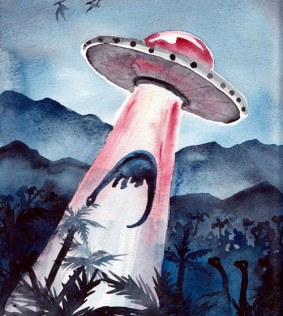
For, example, alleged UFO abductions are actually test-runs of devices that will simulate the Rapture. Jurassic Park was also part of the plot, as it included an implied endorsement of evolution. Indeed, the Blue Beam theory maintains a focus on high-tech and sci-fi films. Believers assert these entertainments are used to inure persons to fantastic visions and to prep them for hostile takeovers via advanced science. In fact, Blue Beam largely mirrors a shelved Gene Roddenberry work about a flying saucer which dispatches beings who pose as prophets. And like most conspiracy theories, Blue Beam takes advantage of fear of the unknown, specifically cutting-edge technology.

There are all kinds of issues with these grand accusations, such as how an image in the sky would be able to be seen by persons anywhere on Earth. There is also the sizable obstacle of convincing the most hard-core Muslims, Christians, Jews, Hindus, and atheists that there is now one true religion and all that you have thought before must now be jettisoned. This also presupposes that no one could see through this mirage or question if it were a hoax, power grab, or other fabrication.

There is no real reason to tag NASA as the perpetrator, as opposed to Rothschilds, Bilderbergers, Reptilians, the Illuminati, or Bohemian Grove members. The agency was likely picked because the ruse involves space technology, but to hopelessly understate the case, there is no evidence to tie NASA to a plot involving a religion made up for the purpose of world dominion.

This nefarious plot goes through four stages. The first focuses on the disintegration of accumulated archeological knowledge. The plan is to stage earthquakes that reveal long-lost artifacts and writings from the One True Religion. This will include explanations of how all other religions have gotten it wrong. Again, this requires getting the likes of Fred Phelps, the Ayatollah, and Hindu terrorists to all concede that their faith is, in fact, a false one.  

Stage Two is where NASA begins to earn its money (presumably a lot of it) by fabricating a spectacular show in the night sky. The viewings will be suited to the culture, with the images depicting how the dominant deity in the region is most often portrayed. It will feature 3-D holographic laser projections that can be seen by anyone anywhere. Except for the blind, I guess, although maybe there’s a more advanced stage of this theory where they are miraculously given sight. At the end of this light show, the deities merge to form a type of super-god like the one Jim Croce sang about.

Since the images are to be seen worldwide, this necessitates that enemy nations work together. This scheme also requires that countries where state and religion and inseparable, such as Saudi Arabia and Vatican City, would agree to take action meant to wipe out their faith and means of control.

Even if such a logistically overwhelming, worldwide spectacle were managed, there are still the issues of getting everyone to fall for it and of convincing them to worship this technologically-created divinity. Monsat had no issue with this premise, writing that the images would “set loose millions of programmed religious fanatics on a scale never witnessed before.”

As unlikely as Stage Two is, it at least involves modifications and improvements on existing technology. Stage Three takes Blue Beam to a more unhinged level by using extreme low frequency radio waves and somehow, magically, using them to telepathically communicate with persons and make them think the message is coming from the smorgasbord super-god.

Stage Four involves convincing the duped populace that an imminent onslaught will wipe out the planet and its inhabitants. In the ensuing mass panic, persons grow desperate enough to swear a loyalty oath to their almighty enlightened leader. This brings about the New World Order. The few resisters will be used as slaves, concubines, or medical experiment subjects.

As implausible as the whole scenario is, it is now even more unlikely to succeed since, if real, it has already been exposed.


“Putz of speech” (Reverse speech)

tb

Reverse speech is an alleged form of cryptic communication which arises from the subconscious. Its primary (if not lone) proponent is David John Oates, who considers unconscious thoughts to be a repository of repressed truths, unvarnished honesty, and secret meanings. He asserts that the unconscious mind sends out backwards messages to the conscious mind every dozen seconds or so. Then the conscious mind straightness out the reverse message, filters it, and delivers it. To grasp the real meaning of speech, Oates says, we must tape it and play it backwards. If Oates has any peer-reviewed articles, written either forward or backward, to support these claims, he has yet to make them public.

Among his many unsubstantiated assertions is that toddlers learn to speak backwards before they learn to speak forward. He thus interprets babbling as being profound thought from the unconscious mind of a 2-year-old. Like pet psychics, Oates alone would be the one who could say whether it’s working or not and so he always has cover.

He likewise insists that since “reverse speech is the voice of truth, if a lie is spoken forward, the truth may be spoken backwards.” He adds this could help police learn where evidence is stashed or the name of criminal accomplice. This would be of limited value if the place or person were palindromic. 

These ideas seem worthy of a toilet, and indeed, according to his biography, Oates gained this breakthrough knowledge after accidentally dropping a tape recorder in his outhouse or similar locale. After that, the recorder would only play in reverse and he took this unintended new toy to ridiculous heights. First, his interest was in finding Satanic messages in music. But devilish digeridoos are ever so trite, so he expanded his empire and deduced that with the right training (provided by him at a hefty cost), anyone could learn to detect the true message of forward communication. With no way to test or falsify this, Oates’ claims remain unproven, but this also provides him with a convenient out whenever challenged. He’s the only one who knows how it truly works, so who can question him?

Other Oates claims include: 95 percent of our thoughts are subconscious; Reverse speech can unlock hidden memories, reveal physical health, and show personality and behavior traits; Reverse speech can even touch the soul. But this is trying to explain one unknown, unproven entity by employing another. Further, it is an instance of Tooth Fairy Science, where one attempts to decipher how something without first ascertaining that it exists.

One of Oates’ bigger tricks is saying that reverse speech can be metaphorical or symbolic. This allows him to twist meaning into any utterance. And like psychics or mediums, he tells customers what they want to hear. If the person says they killed JFK, Oates can reassure them that it means they metaphorically killed their American History exam.

Of course, all this is backed no neurological evidence or brain science. His notion that reverse speech occurs in the right brain has no studies or brain scans to support it. As the Skeptic’s Dictionary noted, “If the right brain were a source of reverse speech functioning, one would expect to see brain activity in the right brain just prior to the activity in the left brain when speech occurs.”

There is also the sizable matter of what evolutionary benefit there would be to reverse speech. When humans gained the ability not just to communicate but to formulate a language, it ranked up there with fire-making, wheel-inventing, opposable digits, and bipedalism as traits that put us on top. But there would be no value to the species if the true messages remained garbled and were a mishmash mess that would only be solved 100,000 years later by a 20th Century pseudoscientist. 

Oates cheerfully plays the Galileo Gambit, wondering, “Have we not yet learned from the lessons of history? Many of our great discoveries have come from outside the mainstream. Einstein, for example, was a high school dropout.” This is majorly wrong. Einstein was booted from a school for nonacademic reasons before earning his Ph.D. The larger point, however, is that just because a person was ridiculed in the same manner as Newton or Galileo or Wegner was, that doesn’t mean the person shares any other trait with members of this trailblazing trio. (For a further critical thinking lesson on this, look up the Composition Fallacy). It was these geniuses’ use of the Scientific Method that eventually validated their ideas. If Oates wants the same recognition and vindication, he needs to follow the same path. 

According to reversespeech.com, “If human speech is recorded and played backwards, mixed amongst the gibberish at regular intervals can be heard very clear statements.” This is a real stretch, though if one is inclined to listen to backward speech, one will occasionally be able to hear sounds that vaguely resemble known words, although most of it is completely unintelligible.

For the parts that might seem more like real speech, the power of suggestion and auditory pareidolia can come into play.  Oates offers no reason why only a small percentage of the speech would reveal secrets, nor does he offer any rationale for how all this would work.

While mostly comical, this highly creative interpretation of auditory gobbledygook can have tragic consequences. Writing for Skeptical Briefs, Mark Newbrook told the tale of a woman who interpreted her infant daughter’s backward babbling to be an accusation of child molestation against the father.

Newbrook further writes that the reverse speech hypothesis is fraught with “major methodological and theoretical problems.” For example, Newbrook states that Oates tries to make a distinction “between genuine Reverse Speech and phonetic coincidence, (which is) the accidental occurrence of very short sequences which are almost the same” forward and backward. Yet Oates is not consistent as to which sequences count as coincidental reversals.

A similar issue, Newbrook continued, is when “the reversal of the forward speech sequence yields another equally possible sequence,” such as would happen with the words “say” and “yes.” Oates considers such instances to not be reverse speech, but this is based on convenience, not empirical evidence. As Newbrook explained, “It is very important for him to exclude such sequences, because his theory implies that different speakers may produce different reversals of the same utterances, depending on their often covert attitudes.”

All in all, this makes for a backwards idea.


“Unidentified Lying Object” (Alien visitors)

ufocow

There have been countless reports of alien visitors and the crafts which bring them to Earth. So far, however, none of the accounts have included a verified living creature, nor have we been able to examine their means of transport. No known extraterrestrials live among us, nor are any flying saucers housed in the Smithsonian.

Most putative alien beings are described as somewhat akin to us – bipedal, four limbs, eyes, some semblance of a nose and mouth. But others are said to look like robots and one even resembled a giant blue grasshopper. Despite these varieties, some people conclude that they all mean we are not alone. Like the ETs, the vehicles they pilot also have varying descriptions: A saucer, triangle, ball, lighted orb, and even a floating building.

There have been UFO sightings for millennia and how they have been perceived depended on the time and culture.  More than 2,000 years ago, Roman historian Livy considered them to be phantom ships. In the First Century, Roman soldiers thought they were seeing armed angels riding chariots. Stargazers in Shakespeare’s time concluded that unexplained floating lights were fairies, angels, leprechauns, or incubus. By the time humans themselves were taking to the sky, the same unexplained phenomenon had transformed into highly intelligent alien life.

Most believers go with this interpretation, though others consider the creatures to be interdimensional beings, ghosts, or demons. Then there are those, such as your blogger, who think the answer lies with human error and misperception. The number and diversity of sightings, combined with still no verified contact, suggests psychology is more in play than intergalactic travel. The mind tries to figure out what it can’t understand, and because of our aversion to randomness and preference for pattern, we plug into the gaps whatever explanation we can finagle. With UFOs, those answers have evolved with the time.

If aliens were making regular treks here, professional astronomers, whose job is to use the world’s best telescopes to study the skies, would be witnessing the great majority of such visits. Instead, almost all of putative encounters are reported by those without training in astronomy, atmospherics, aeronautics, physics, or optometry.

Moreover, sightings are influenced by the conditions in which they are observed. Bright stars and planets may become UFOs due to their being watched from a moving car, making it seem they are keeping pace with the vehicle. However, to  determine the size, speed, or distance of a presumed craft, one needs to know at least one of those variables. If all are unclear, the viewer is reduced to groundless speculation.

Additionally, a star or planet’s apparent ability to dart, wobble, or zigzag, and to change color rapidly is explained by a natural, involuntary jerking eye movement called auto-kinesis. Also a factor is scintillation, which are variations in the apparent brightness or position of a faraway luminous object. This effect is more pronounced when looking through binoculars or telescopes. It is caused by refraction of different wavelengths, which make an eye or lens think there are changes in motion or color.

Besides seemingly-moving stars and planets, the Identified Flying Objects known as airplanes can take on a saucer shape if viewed head-on and can be misinterpreted as alien craft. They can also move side-to-side, climb vertically, descend, and quickly change direction, which can make the plane take on otherworldly appearances under the right circumstances. Additionally, rows of anti-collision lights on the wings blink sequentially, which can create an illusion of rotation.  

Then there are meteors, balloons, satellites, searchlights, flares, and ball lighting, all of which can also be taken to be an alien transport system, due to the auto-kinetic effect, scintillation, psychology, human error, and ignorance.

Planets, stars, meteors, and ball lightning are all fascinating enough by themselves that there’s no reason to fabricate awesomeness about them. And satellites, balloons, airplanes, and telescopes were the result of persons being inspired enough by reality and what was possible that they used this as a drive to further Mankind. With enough of that spirit, maybe someday instead of inventing tales of piloted space travel, we will be doing it.

“Unholy cow” (Science and religion)

scirel

When it comes to the conflict between science and religion, I argue that, on linguistic grounds, there is none. That’s because a conflict indicates there are two hostile parties. Yet here, the assault is unilateral. No biologists are trying to force churches to teach evolutionary science. No cosmologists are calling for equal time in Sunday School class. By contrast, some activists with a religious agenda make unceasing attempts to foist mandatory creationism and Bible study classes onto public education students.

A second reason why there is, in a strict sense, no conflict is because science and religion are concerned with separate questions. Religion concentrates on rituals, dogma, and attempts to solve moral dilemmas.

As to science, it is a process that attempts to explain the natural world and those who inhabit it by following this method: 1. Define the question; 2. Develop a hypothesis; 3. Make a prediction; 4. Test that prediction; 5. Analyze the results using proper statistics; 6. Attempt to replicate findings; 7. Submit findings for peer review; 8. Share data. The process doesn’t end there, as other scientists use the same method to further test if the conclusions are sound or mistaken.

Religion has its literal sacred cows, while there are no figurative ones in science. The field goes where the evidence leads and positions its thinking accordingly. University of Chicago biology professor emeritus Jerry Coyne writes that, “Religion adjudicates truth not empirically, but via dogma, scripture and authority – in other words, through faith, defined in Hebrews 11 as ‘the substance of things hoped for, the evidence of things not seen.’ In science, faith without evidence is a vice, while in religion it’s a virtue.”

One problem with relying on faith is that different religions make competing claims. Without witnessing the claims in action, without examining them, without testing them, without experimenting on them, and without utilizing the Scientific Method, it’s impossible to assess their validity.

There are up to 4,200 religions to choose from, and these are forever dividing like cells that some of those religions are probably denying the existence of. There are 37 varieties of Baptist and more than 100 offshoots of Mormonism, which itself an iconoclastic take on Christianity. Judaism ranges from the ultraorthodox, whose adherents hold dim views of gays, women, and other religions, all the way to reform denominations, which emphasize individual autonomy, pluralism, and evolved ethics, and which reject strict beliefs and practices. In between those extremes are orthodox, conservative, and liberal Jews, with each of these categories being broken down to even more specific strains.

Likewise, there are many schools of Buddhism, from saffron-robed, shaven-headed monks who believe in assorted deities and the power of prayer, to Phil Jackson’s form of Zen, which is little more than a leadership and success philosophy served with a side dish of meditation. The massive problem, then, with deciding things on faith is that one has to presuppose that their specific religious view – which they likely were instructed from preschool to adopt – is the correct one.

Yet, no religion has proven or disproven the existence of any god, goddess, demigod, angel, demon, miracle, or fulfilled prophecy. Coyne asks, “How many gods are there? What are their natures and moral creeds? Is there an afterlife? Why is there moral and physical evil? There is no one answer to any of these questions. All is mystery, for all rests on faith.”

Meanwhile, were it not for successful employment of the Scientific Method, you would not be reading this right now. Science has also yielded benefits in the form of medicine, food quality, safety, transportation, and so much more.

Still, some persons chide science for previous errors, but this is to misunderstand the scientific process. It is a means of continually questioning its findings, trying to disprove itself, with an end goal of increasing our knowledge of how things work. It is a self-correcting process. These detractors might, as one example, belittle science for once thinking that asbestos was safe. But these folks are inadvertently admitting that science works because it was through the trial-and-error method which defines the field that we came to know asbestos is dangerous.

Additionally, admitting errors and adjusting a position as justified by the evidence is admirable. That’s a much better response than being proudly stationary and unbending, and remaining incapable of being moved by any evidence, reason, or persuasion.

While some on a religious bent criticize science, they are selective in this derision, as they will latch onto a point if it seems to further their religion. Science blogger Bob Seidensticker told the story of Catholic priest and cosmologist Georges Lemaître, who suggested that the universe is expanding and formulated what became the Big Bang theory. When strong evidence for the Big Bang emerged, Pope Pius VII noted Lemaître’s Catholicism and declared the Big Bang to be affirmation of Genesis 1:3, “Let there be light.”

Lemaître responded by calling it a poor strategy for Christians to intermingle science and religion. Because to be consistent, they would also have to embrace science when it contradicted their faith. Such as what happens when one considers the geologic column in light if Genesis, which if taken literally, teaches that fully-formed animals were spoken into existence in their present form 5,000 years ago.

The Dalai Lama said if science and Buddhism collide, you have to go with the science. From the reasonable, supple positions of Lemaître and the Dalai Lama, we venture 180 degrees to find Christian apologists such as Ken Ham, William Lane Craig, Lee Strobel, and Frank Turek. Cosmic background radiation and the amount of light elements provide strong evidence for the universe being 13.4 billion years old, yet even that amount of time would be insufficient for Ham to make the same concession about his religion that the Dalai Lama made with Buddhism.

Ham and the rest have zero interest in the truth and are only interested in furthering an agenda. As Seidensticker noted, “The last thing they would do is say, ‘If you show my scientific claims to be false, then I will no longer believe.”  Ham admitted as much in his debate with Bill Nye. They arrive at their conclusion first, seek out confirmatory evidence, and dismiss anything that disproves their idea.

Craig, Strobel, and Turek are not submitting work for peer review, are not increasing our understanding of the natural world, and are not collaborating on papers with biologists, astrophysicists, and chemists. Instead, they pose questions that might make for intriguing parlor games, but whose answers rely not on experiment or evidence, but on faith.

One example would be the Kalam Cosmological Argument. The gist of this logic is: 1. Whatever begins to exist had a cause; 2. The universe began to exist; 3. Therefore, the universe had a cause; 4. The god I believe in was that cause. Other instances are the fine tuning and design arguments, which assume things could only have turned out this way if given a supernatural boost. This is the begging the question fallacy and fails to satisfy even the first step in the Scientific Method. It neglects to even define the question and jumps to the conclusion that the Christian god did it.

The earliest humans invented and rationalized supernatural beings as a way of trying to explain the world around them. It provided a handy answer for wind, lightning, and natural disasters. Later, it might have been used to answer why there was disease, death, or misfortune visited on a tribe or village. As science explained more, there was less need for a deity, and gods were relegated to increasingly-shrinking gaps. Religious believers still issue challenges as to how the first living being came to be or how humans acquired a sense of right or wrong. They insist that if science has yet to find the solution, the challenger’s favored god must be squeezed into the equation. So far, however, neither magic nor the supernatural has ever proven to be the answer.

“Snakes and blathers” (DNA in ancient artwork, India anti-science)

hindusnake

Today, we will examine a pair of claims floated in the past year that were presented as furthering human knowledge, but which were supported with almost no evidence. One is secular, the other religious, but our concern here is not with any spirituality or lack thereof, but with the truth.

The first example comes courtesy Jordan Peterson, a somewhat eclectic and iconoclastic Canadian psychology professor. While not a religious extremist like those in the other example, Peterson maintains friendly ties with the Christian right and on the rare occasions he has spoken about atheists, has had nasty things to say. In this instance, however, his claims don’t have a religious bent. He has periodically proclaimed, with inconsistent degrees of certainty, that entangled serpents in ancient artwork depict DNA strands.

Short for deoxyribonucleic acid, DNA is a molecule that contains a person’s hereditary blueprint and decides which amino acids are embedded in certain proteins and in what order they lie. As to its shape, Skeptic blogger Emil Karlsson writes that strands in a DNA double helix run anti-parallel, or in a head-to-toe fashion. The double helix also has a major groove and a minor groove, which are formed by the DNA molecule’s backbone.

A winding staircase would more resemble DNA than entangled snakes in artwork. The suggestion that disparate ancient people had all acquired knowledge of a structure that scientists only became aware of during the nascent years of rock and roll is grandiose claim, one which Peterson fails to support with evidence beyond suggesting a similar appearance.

There are better explanations than long-lost knowledge for why ancient artists would have employed twisting snakes in intimate positions. First, snakes entwine themselves when mating, so the images may represent reproduction, creation, or childbirth. In other cases, the serpentine symbols may depict a culture’s deities. They could also represent fear, as snakes fascinate many of us in a macabre sense. Some are venomous and they have striking differences from humans, with no arms, legs, eyelids, or visible ears, and having a narrow, forked tongue. It’s easy to see why an artist would consider them to be striking subject matter.

Peterson makes the point that intertwined snakes existed in ancient art from places as far apart as China, Egypt, Mesopotamia, Australia, and India. The insinuation is that the artists were drawing from a common source. Such thinking is a frequent error committed by Young Earth Creationists, ancient alien aficionados, and cryptozoologists. They think because lookalike images crop up in cultures that never intermingled, the characters existed in real life.

But this more accurately speaks to the commonality of the artistic process. Besides, the supposedly similar creatures usually don’t look that much alike. With snakes, the similarity is there, but that’s because humans know what the slithering reptiles look like, which is not the case with dragons, Yetis, and Andromedans. This leads to another strike against Peterson’s hypothesis: The ubiquity of snakes. Snakes existed in all these places, so their portrayal in artwork requires no extraordinary explanation.

Perhaps the most important point is that entangled snakes in ancient artwork have only negligible resemblance to DNA. Karlsson pointed out the substantial differences. First, the snakes do not mirror the DNA strands’ anti-parallel positioning. If the snakes were depicting DNA, they should run in opposite directions from each other, not be head-to-head. Second, the art does not include any structure resembling nucleotides, which run horizontally in DNA strands and which would connect the snakes is the artist was modeling DNA. Next, there are no structures akin to 5 carbon sugars, the part of DNA which resembles Tinker Toy assemblies. Finally, the snakes are without grooves.

Moving on to the second example, a trio of speakers this month at the Indian Science Congress made shocking claims that attribute relatively modern developments and ideas to writers of ancient Hindu scriptures and they deities they crafted.

Chemist and university vice-chancellor, Gollapalli Rao, cited an ancient Indian poem as proof that stem-cell research and test-tube babies existed in India thousands of years ago. And anyone with an in vitro fertilization appointment at that time could have flown there on one of the airplanes the country had been blessed with by Ravana, a deca-headed demon-god. Rao based this claim off his reading of the Hindu epic Ramayana.

Such claims always run in one direction. A religious person might try to bolster a favorite theological text by extracting a supposedly scientific interpretation from it. By contrast, no scientist ever tries to strengthen a peer-reviewed article by pointing out its consistency to a 4,000-year-old religious tract.   

Meanwhile, paleontologist Ashu Khosla credited dinosaurs as the work of Brahma. But at least he didn’t deny the behemoths’ existence, and Rao affirmed the science behind in vitro fertilization and flight. Much worse was speaker Kannan Krishnan, who contested the theories of Einstein and Newton because of Krishnan’s interpretation of Hindu scripture.

Fortunately, this highly-creative science was limited to three persons out of hundreds of attendees. In another piece of cheering news, event organizers promised that next year they will vet the speakers. So I’m guessing we won’t be hearing from Jordan Peterson and his snakes.

“Scar of David” (Zionist conspiracy)

superjewe

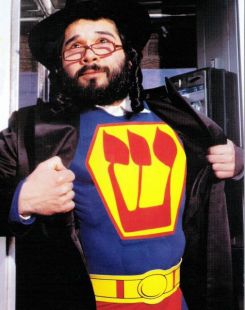
For the past few thousand years, there have been incessant accusations leveled at the Hebrew people. They are said to be crippling society, spreading disease, running a shadow government, running the real government, manipulating currency, weakening the white race, undermining the church, and plotting to swipe your grilled cheese.

They do all this as either communists, Free Masons, the Illuminati, Bohemian Grove leaders, Rothschilds, New World Order perpetrators, or Reptilians.

While anti-Semitism is most associated with the Nazis, Hitler and his monstrous minions were merely the most searing and extreme instance of illogical hatred toward Jews. In Persia, Xerxes ordered the extermination of all Jews within his jurisdiction. Roman emperors, Greek kings, and Spanish rulers have all given the same genocidal dictate. During the Dark Ages, panicked Europeans blamed Jews for the Plague. Pogroms have been regular features on the continent, as well as in western Asia, and there has also been legally-mandated discrimination, segregation, violence directed at synagogues, and cartoons that portray Jews in grotesque caricature.

Czarist Russia had anti-Semitism woven into its official policy since Jews were accused of fomenting a revolution from within. When the regime collapsed in 1917, it occurred without much Jewish involvement. Hitler used a similar tact, accusing Jews – who were less than one percent of the German population – of committing traitorous acts that cost the country victory in World War I. This alleged power out of proportion to Jewish numbers is typical of charges leveled at the people.  

These charges have been sustained for many centuries, from Jews being accused of slaughtering babies for their blood during Passover in the Middle Ages, to their descendants engineering the 9/11 attacks. One myth associated with the latter is that Jews employed at the World Trade Center stayed home that day.

All this is led by an elaborate hierarchy. Sometimes names are given – a Soros, an Eisner, a Bloomberg – but many more unknown persons are assumed to be allies and lackeys in this quest for world dominion and subjugation of decent folk.

Even by the loose standards of this conspiracy theory, one of its more preposterous manifestations is in portraying The Protocols of the Elders of Zion as the Jews’ diabolical playbook. This has long since been exposed as a hoax, as it is a nearly-identical copy of The Dialogue in Hell Between Machiavelli and Montesquieu. This work was a satirical work centering of Napoleon III plotting to conquer the world. For Elders of Zion, Large sections were plagiarized, with “Jews” replacing “Napoleon III.”

Skeptoid’s Brian Dunning has identified three primary types of anti-Semitism. The first kind couches itself in a veneer of superiority. Just as a Klansman might consider Hispanics to be lazy, dirty, and justifiably destitute, there is an anti-Semitism that sees Jews as lowlifes, worthy of scorn but not to be feared except as criminals. This was the overwhelming type of anti-Semitism for millennia, but is the rarest type today.

The second kind rests at the opposite end of the spectrum and paints Jews as residing in a pit of avarice and cruelty, where they assume positions as our dark overlords who control the banking system and direct perpetual warfare for their benefit. Closely related to this is the belief in a Zionist-Occupied Government, where Jews make the law and institute policy, either for real or by proxy.

Finally, we have a religious anti-Semitism practiced by Christians and Muslims. Islamic distrust of Jews has been sustained for a millennium and a half and continues unabated. The practice of usury – oft times necessitated since Jews were forbidden to own property or run a business – was traditionally one of the reasons. That’s still the case, though the Israeli-Palestinian conflict is a much larger factor.

Christian disdain for Jewry was far more common 100 years ago. The Hebrew people were seen as messiah-denying, hell-bound heathens who slaughtered the savior. We don’t see this brand much anymore, as most American evangelical fundamentalists are convinced that blessings from the Abrahamic god will flow proportionally to the level of obsequiousness the U.S. displays toward Jerusalem.

However, there are some outside the Christian mainstream who prefer a more conspiratorial flavor to their worldview and who feel the end times will be ushered in by a Jewish anti-Christ. Additionally, there are some bigots without a religious bent who insist immigration is a Jewish plot to destroy the white race – a curious goal for a people who themselves are conspicuously light in melanin.

In an attempt to bolster their case, proponents of these conspiracy theories may point to the inordinate Jewish influence in business, the news media, and entertainment, but this is committing the affirming the consequent fallacy. It is failing to consider correlation and causation and other factors that can explain Jewish success in these areas. Also, this success does not mean it is used to realize a nefarious agenda.

Like other gloom-and-doom scenarios, the anti-Semitic one collapses under the weight of its extravagant claims. The fruition of those ghastly goals takes place in an Eternal Tomorrow, always on the cusp of happening, yet never quite arriving. To hear anti-Semitic conspiracy theorists tell it, there exists an incomprehensibly malevolent, highly-organized cabal of geniuses with supreme power and authority; It has at its disposal every means of manipulating commerce, trade, and militaries; It clandestinely pull the strings of legislatures, monarchies, industries, and the press. The end state is to solidify this power and bring the rest of us to our collective knees. Yet this has been said to have been the case for thousands of years and it never happens. These completely evil, supremely powerful people have had the means and desire to complete this dastardly deed, yet they all keep dying without it being accomplished. With those deaths, the theory should perish as well.