“Scream of the crop” (GMO fears)

GMOKID.jpg

Anti-GMO extremists are known for their macabre corn men masks, memes of fruits taking bites out of children, and vehicles topped with tomato-fish hybrids. None of this has any relationship with reality. Online activists frequently employ ad hominem attacks in the form of evidence-free shill accusations, while also accusing posters of being Monsanto employees, whom they compare to Joseph Goebbels.

One of the more infamous anti-GMO crusaders, Nassim Taleb, contributes little to the dialogue beyond personal-attack Tweets. He refuses to discuss the issue with any adversaries, blocks anyone who disagrees, and never offers any science. I once attended an anti-GMO seminar in which the speaker claimed the USA’s enemies will eventually be able to stroll in and take over the country without firing a shot because GMOs will turn us into non-thinking zombies.

But even among the more measured anti-GMO types who do not foment these irrational fears, there are still misunderstandings of the process. However, there are no risks with genetically modified crops that do not occur with conventional breeding methods.

The latter can even pose more risks, and this is ironically more likely when countries ban genetically modified crops. That’s because when this happens, agricultural companies may develop new strains though mutagenesis, which requires subjecting plants to radiation or dousing them with toxic amounts of chemicals in order to randomly move genes in the hopes of producing new traits.  

Contrast this to genetic modification, where scientists take a gene that yields a desired trait then insert it into a crop that may lack this distinction. Mutagenesis is much less precise than genetic modification, yet remains unregulated, widely used, and unchallenged by Taleb, Vandana Shiva, Vani Hari, and other self-appointed guardians of food safety.  

One falsehood is that GMOs are more susceptible to producing allergens. In fact, genetically modified foods are required by regulatory agencies to be tested for their allergen presence. Any genetically-modified crops that are shown to have one cannot be sold or distributed. Meanwhile, crops that are known to be allergens to some, such as peanuts, are not subject to this regulation.    

There are also accusations that GMOs are prone to uncontrollable spread. But GM crops are produced by managing a small, precise change to a plant, making spread unlikely. Meanwhile, conventional breeding mixes thousands of genes from parent plants, then recombines them to produce mutations that could potentially increase the potential to spread.   

Perhaps the most frequent criticism is that heartless corporations are controlling GMOs. Yet large companies and conglomerates, heartless or otherwise, have their hands in all food production methods.  Whole Foods, which specializes in organic produce, brings in more than profit than most of companies Food Babe demonizes for making money off GMOs. Besides, farmers are free to use non-GM seeds, to buy seeds from corporations that sell exclusively conventional crops, to buy locally, or to form a co-op.

A similar argument centers on patents, and concern over this is wrong for the same reason as above. The supposed idea is that malevolent Monsanto, satanic Syngenta, and detestable Dow will horde seeds and control the world’s food supply. Yet conventional crop variants can also be patented and corporations that work with conventional breeding will sue anyone who violates the patents.

Then we have an alleged increase in use of pesticides. But GM applications usually match a specific toxin to a certain crop, meaning that genetically-modified crops use fewer pesticides. Additionally, there are charges that genetically-modified foods will negatively impact bees and butterflies. But because these crops rely mostly on pesticides that target a specific pest, they will not impact other insects. In fact, bugs are more likely to be killed by broad-spectrum insecticides that are used in traditional farming.

Finally, there are fears expressed about genes moving between species. First, GM crops do not always involve the use of a transgene. They can also remove genes that would otherwise produce a toxin, or they can change genes to give the crop a desirable trait it might lack. And again, conventional crops also involve moving of genes between species. Emil Karlsson cited these examples on the website Debunking Denialism: “The conventional crop triticale is a hybrid between wheat and rye. Also, horizontal gene transfer between bacteria and plants occur in nature all the time and well-documented examples include the common sweet potato.” Yes, nature has produced a genetically-modified organism. Now there’s something for Taleb, Shiva, and Hari to freak over.

“Trippin’ over Sasquatch” (Cryptozoology)

BF

There are some people who delight in past mistakes made by scientists. They enthusiastically repeat these tales of science failures by posting them on the Internet or texting them into a cell phone, all while living in a world with airplanes and without smallpox.

What they fail to understand is that science is a process, not an end point. This process includes attempts to falsify and recalibrate, and test again. When mistakes are made, they are acknowledged and corrected. Moreover, such mistakes don’t prove competing notions, despite the assertions made by proponents of alternative medicine, creationism, and cryptozoology.

In my skeptic experience, science-loathing crypto lovers are relatively few in number. A majority of those intrigued by the concept of discovering a giant new beast present the search as part of a continuing effort to expand zoology. Now, I’ve never been much impressed by this rationale. There are a gazillion undiscovered insects out there, and if increasing our knowledge of the animal kingdom were the goal, those on Finding Bigfoot would instead be pursuing a graduate degree in biology while using their vast entomological knowledge to find new creepy crawlies. They wouldn’t be looking for Bigfoot, they’d be looking for the little critters he might snack on.

Since less-intense members of the cryptozoological community advertise themselves as broadminded and merely considering the possibly these creatures exist, this means they are at least ostensibly open to the possibility that there are no monsters under the bed, on the mountaintop, or in the jungle.

Then there are those who offer no pretense of open-mindedness. Many conspiracy theorists offer self-congratulation for being able to think for themselves and see through media accounts. But they then quaff however much speculative and poorly-substantiated tripe the conspiracy websites can offer them. Similarly, crypto fanatics say they are the ones who are advanced enough to realize these creatures exist and excoriate anyone who questions this. Consider their reaction to skeptic Benjamin Radford’s essay on 10 reasons Bigfoot was supremely unlikely.

On the site cryptomundo.com, one fervent believer called Radford a nihilist, another said he was an attention-seeker, while a third said debating skeptics or proffering evidence was a waste of time since “they wouldn’t consider the possible existence of Sasquatch even if they tripped over one.”

Our purpose here today is to demonstrate this claim’s falsity. First, a definition. A cryptid is a proposed animal based on anecdotes, lore, and eyewitness accounts. However many known animals there are in the world, that’s how many have gone from undiscovered to discovered, so it has happened for millennium and will continue to occur. This includes a few animals whose existence seemed unlikely, but then was validated. However, these are not triumphs for cryptozoologists because these new creatures were not found by cryptomundo.com, YouTube regulars, or MonsterQuest producers. They were discovered and examined by anthropologists, zoologists, or biologists using the Scientific Method.

Most important, confirmatory evidence was embraced, not shunned or suppressed, despite claims of the cryptomundo crowd. Insinuations of science being unbending and perhaps even covering up newly-discovered truths are frequent among pseudoscientists. They also play the Galileo Gambit, which is what a cryptomundo regular calling himself Hapa did. He wrote, “Plate tectonics were laughed at and was without peer review yet now is as accepted as gravity and atomic theory.” But validation of plate tectonics does not mean that Bigfoot also being ridiculed and unsupported by peer review is proof of its existence. In critical thinking circles, that is known as the false equivalence fallacy.

Further, ridicule and lack of peer review could be overcome. Consider the platypus, a venomous, egg-laying mammal with a duckbill, otter-like feet, and a flat tail.  Another odd distinction it holds is being one of only two known mammals to hunt by means of electroreception. Many in the West presumed the platypus to be a fraud. To be sure, it is such a hodgepodge animal that it could be used as a rejoinder to the crocoduck challenge issued by confused creationist Ray Comfort and his sidekick, Kirk Cameron.

While scientists viewed the platypus with suspicion, that’s different from being closed-minded. They asked to see the evidence and it was presented. By contrast, this is not possible with Bigfoot, Yeti, or the Loch Ness Monster. There is no evidence to see, nothing to analyze, nothing to put under the microscope, no body part to test, no findings to submit for peer review.

But with the platypus, there was a corpse to consider, and George Shaw, keeper of the British Museum’s department of natural history, examined the find. The Aussie animal was so quirky, and coming in the era of P.T. Barnum and the Fiji mermaid, Shaw had to consider the animal to be a potential hoax. But after careful reviewing the evidence and following the Scientific Method, Shaw became convinced. He wrote, “I can perceive no appearance of any deceptive preparation, nor can the most accurate examination of expert anatomists discover any deception.”

Despite the claims of the cyrptomundo aficionados a few paragraphs back, scientists embrace newly-confirmed evidence. If Hapa and his cronies ever produce a Sasquatch specimen that shows itself to be genuine under the protocols Shaw used on the platypus, Bigfoot will be acknowledged, given a scientific name, and categorized.

Similarly, the giant squid for centuries was thought to be in the purview of exaggerated sailor stories. The aquatic beasts were referenced by Aristotle and Pliney the Elder, but it wasn’t until the mid-19th Century that note was made of carcasses washing up ashore. These were examined and, through science, the giant squid went from a kraken-like myth to a verified reality.

Other examples of confirmed cryptids are the mountain gorilla and komodo dragon. There is also the okapi, whose discovery and confirmation doubled the size of the Giraffidae family. Nineteenth-Century Europeans had heard tales of an elusive forest beast known as the African Unicorn and this was confirmed when the British governor of Uganda, Sir Harry Johnston, came into possession of an okapi skull and hide. These are examples of the third strongest piece of evidence when looking for new animals, after a live specimen and a complete corpse. When the okapi remains were confirmed as authentic, science classified it.

Cryptozoologists sometimes use such finds to bolster support for the existence or Chupacabra, Sasquatch, Nessie, or Yeti. But these so-far mythical beasts lack the proof that moved the other animals from suspected to confirmed. Fuzzy photos, wide-eyed witnesses, and ad hominem attack on skeptics are not evidence.

It is understandable why a giant squid would be hard to find and the large terrestrial mammals that Western scientists were only able to verify in the 19th Century lived at a time when getting from England to Africa or Australia was much more arduous, time-consuming, and expensive than today. Also, these were solitary animals living in remote locations, such as a dense forest, nearly insurmountable mountaintop, or Australian outback.

By contrast, Nessie is said to reside in an enclosed area, there are now regular treks up the Himalayas, and Washington state forests have been visited by outdoors enthusiasts and vacationers for decades. No Sasquatch has been killed by a hunter or vehicle, no hiker or camper has stumbled onto its remains. Then there are the untold hours spent by persons using video equipment, bait, and night vision devices to search in the precise location where sightings have been alleged, and none have come away with so much as a hair or tooth fragment that might belong to the sought-after cryptid.

If Finding Bigfoot lands its prey, I will announce this as a major cryptozoologist victory, and will do so standing on my head for good measure. But so far, the platypus, giant squid, mountain gorilla, okapi, and komodo dragon, and every other confirmed creature were discovered by scientists. This shows why measured inquiry, careful investigation, and verified evidence is valued over hearsay, speculation, and desire.


“Interpretive dunce” (Creationism)

RECORDS

A claim one occasionally hears from creationist camps is that they and scientists have the same evidence, it’s just being interpreted differently. This is meant to establish that one should be open-minded and consider various viewpoints. But just because multiple interpretations exist doesn’t make them all reasonable, nor does it follow that each has strong support.

Further, if creationist leaders really believed we should consider competing ideas about the origin of Earth and mankind, they would hold that the Zoroastrian and Lakota creation tales should also be espoused and given equal time in debates and public school science classrooms.

As to reasonable dialogue and analysis, some creationists are up for it, but the most well-known one, Ken Ham, is not. He tries to dismiss evidence by saying that scientists and Young Earth creationists have different worldviews. While this might be a rare Ham accuracy, it is a genetic fallacy and irrelevant to the legitimacy of the conclusions that each camp draws.

Consider how those conclusions are reached. Scientists go where the evidence leads. Creationists start with the conclusion that Genesis is a literal account, then try and finagle around discomfiting evidence, either shoehorning it in or rejecting it. Ham has said that evidence doesn’t count if it contradicts his interpretation of the Bible. Similarly, the Institute for Creation Research website lists these among its principles:

“Space, time, matter, and energy were supernaturally created by a transcendent personal creator.”

“Each of the major kinds of plants and animals was created functionally complete from the beginning and did not evolve from some other kind of organism.”

“The record of Earth’s history as preserved in the crust, especially in the rocks and fossil deposits, is primarily a record of catastrophic intensities of natural processes.”

Only after signing a statement agreeing to these planks and promising to promote them is one allowed to work for this institute, which makes the “research” in its title fraudulent.

Contrast this with how a geologist, biologist, or astronomer operates. A blogger at Logic of Science wrote about how research on lake bed layers helped prove Earth’s age. Called varves, these layers alternate between patterns of light and dark, and between fine and course, and are the result of seasonal change.

The blogger further explained, “We can verify that these correlate with seasons because we see varves form today, and at some lakes, we find algae in the dark layers, but not the light layers since algae only blooms in summer. Varves in the center of the lakes only accumulate one layer each year. In the center of some lakes, we have millions of sets of alternating layers.”

Therefore, geologists deduce that the lakes are millions of years old. This logical deduction flows from observed and verified results. No interpretation is needed, nor is it necessary for the scientist to have had a “naturalist” or “humanist” worldview at the outset to reach this deduction.

Now let’s see examine a creationist’s take. John Morris of ICR writes that while there is no explanation for these millions of layers, “Research is continuing and we can be certain it won’t be solved by the sterile uniformitarian thinking of the past. However, reasoning from the standpoint of the great Flood of Noah’s day and its aftermath holds promise.”

So, through some undiscovered mechanism, the flood managed to create and sort these deposits at a rate of 20 per minute instead of the one per annum that has repeatedly been observed.

The Logic of Science blogger writes that such conclusions “are in no way an interpretation of data. It is a complete and total rejection of the data. The creationists’ ‘interpretation’ completely ignores the facts and proposes an unknown and completely absurd mechanism.”

He added that if we issue creationists a license to explain away proof with evidence-free ad hoc reasoning, then almost unlimited interpretations are possible. Zoroastrians could point out that their creation story holds that Ahura Mazda created light and darkness, and that this is consistent with the light and dark nature of varves. Or the Lakota could relate how the only survivor in the tribe’s flood tale, Kangi the Crow, asked the Great Spirit to give him a new world. Granting this request, the spirit sent animals to retrieve a lump of mud from beneath the flood waters. This could be considered the origin of varves, and since each animal got a turn, that would explain why there are millions of layers.

But it would only be possible to arrive at these positions if one went in determined to get there. If the varve evidence was shown to someone with no knowledge or preconceived ideas about Earth’s age and origin, the examiner would never conclude varves to be the result of an invisible creature in the sky sending forth torrents of rain that set in place a magic mechanism that caused the layers to form at a rate 10 million times faster than what scientists have ever observed.

To see how science really works, let’s consider evolution. In On the Origin of Species, Charles Darwin predicted the existence of intermediate fossils before they were known to exist. Since then, scientists have unearthed many transitional fossils, which show evolution from fish to amphibians, from amphibians to reptiles, from reptiles to birds, from reptiles to mammals, and from early apelike creatures to hominids.

Creationists look at those fossils and consider them part of a divine creation plan. This intelligent design, by the way, has seen 99.9 percent of its creatures go extinct. Ham and the rest craft an ad hoc rationale that the intermediate fossils are of separately created animals that no longer exist. The seemingly gradual transition of the fossils, located in the precise place in the geologic column one would expect to find them if evolution were true, is coincidental.

Again, no neutral party would come to such a conclusion. It is only possible if one goes in with an unbending mindset, such as this one displayed by the Discovery Institute: “The universe and living things are best explained by an intelligent cause, not an undirected process such as natural selection.”

If geologic digs repeatedly revealed the sudden appearance of, say, ostriches, zebras, and rhinos, with no intermediary fossils before or after; if there was no similarity in DNA between different creatures; if there were no vestigial traits; if there were no strikingly similar anatomies between some species; if no creatures unique to isolated locales like Tasmania, Iceland, and Mauritius were ever found, then Darwin would be the scientific equivalent of Freud – a giant in his time, still recalled somewhat fondly, but one whose major ideas have been rejected. The lack of evidence would ensure that.

Now let’s look at how Ham’s Answers in Genesis deals with the complete lack of evidence for its position that man and dinosaurs lived together. In an essay, AIG’s Bodie Hodge proffered two reasons. One, everybody went as high as possible to escape the flood, leaving the terrible lizards way down below. Second, humans would have been avoiding dinosaurs anyway because they are scary.

You interpret that however you want, but I would have considered The Flintstones to be better evidence.

“You don’t know HAARP” (Weather control)

better

On this blog, we sometimes address positions that encourage potentially lethal or harmful behavior, such eschewing vaccines, prohibiting importation of genetically modified foods into drought-stricken areas, or treating lymphoma with tree bark.

Then there are issues which are serious but pose no danger to public health, such as evolution denial, taxpayer-funded anthropologists chasing Bigfoot, or multi-level marketing scams. Finally, there are the silly notions, such as a flat Earth, ancient aliens carving the Nazca lines, or “grounding,” the idea that walking barefoot on grass will enable one to can access unspecified energies for multitudinous health benefits.

Suspecting that HAARP is a nefarious undertaking would seem to fall into the latter category, but last year we saw how even seemingly innocuous issues can have serious consequences.  

In October 2016, two Georgia men who fervently believed the HAARP conspiracy theory traveled to Gakona, Alaska, equipped with firepower, maps, and deadly intent. Alex Jones and Nick Begich had convinced the would-be attackers that HAARP controls our weather and minds. I’ve always found the last part of that claim self-defeating. If we KNOW they are controlling our minds, the control isn’t working. And if minds are being controlled, it’s not by top secret government technology, but rather by YouTube narrators with foreboding voices. Most of the blame for this lies on Begich, who wrote a book with contents almost as horrible as its title, Angels Don’t Play This HAARP.

The Department of Defense began the High Frequency Active Auroral Research Program in 1992 to study the upper reaches of Earth’s atmosphere. The resulting research has advanced deep underwater communication with nuclear submarines and has assisted with the detection of underground military facilities.

Some do not accept this disappointingly mundane reality. Ironically, most HAARP conspiracy theorists are right wingers who are ostentatiously pro-military, want unbending loyalty to the current White House occupant, and are generally OK with the expanse of government police power. Yet they bristle when seeing what they think are the results of this blank check being cashed.

This includes the federal government having the ability to modify the weather. One unwritten rule of conspiracy theories is that the intent must be malevolent. So rather than creating a typhoon to target North Korean leaders or siccing a sandstorm on ISIS, HAARP overlords are responsible for this year’s rash of Atlantic and Gulf Coast hurricanes and California wildfires, as well as various tornadoes and earthquakes.

However, there is nothing classified about HAARP. No security clearance is needed to tour the facility and there is an annual open house. Skeptoid’s Brian Dunning did a Google Earth search which revealed four cars in a small parking lot. There were no security barriers and there was no blurring of the imagery as happens when one does a Google Earth search for classified areas.

That’s because there is no reason to hide what HAARP is doing. Most of the year, its activities consist of university and government scientists conducting ionosphere research. HAARP has an observatory and adjacent large field with 180 high-frequency antennas. The program has no potential to impact weather since the frequency emitted by HAARP instruments are incapable of being absorbed by the troposphere. That is the lowest point of Earth’s atmosphere and the level at which almost all weather conditions occur. One must go all the way to our atmosphere’s top level, the ionosphere, before HAARP’s transmitted energy can be absorbed, and that is much too high to impact weather.

So why does haarp.net dub the project a “military research laboratory to build new machines for their killing fields”? It stems from some haphazard, if not deliberate, misinterpretations.

ARCO Power Technologies constructed the HAARP facility. A scientist for one of the company’s subsidiaries, Dr. Bernard Eastlund, owns the patent for a “method and apparatus for altering a region in Earth’s atmosphere, ionosphere, and/or magnetosphere.” Eastlund’s method would require a location near the poles, where the lines of the Earth’s magnetic field are roughly perpendicular to the surface, and where there is thought to be natural gas reserves.

This is unrelated to the work done at HAARP, but theorists have finagled a connection. Known inaccurately as the HAARP patent, Eastland’s invention is regularly presented in conspiracy circles as being the method by which Uncle Sam unleashes his unnatural disasters.

In truth, the patent involves using natural gas to generate electricity in order to create electromagnetic radiation. Again, this would take place far too high to affect the weather. The idea that Eastland’s invention could be used to unleash hail and other plagues from on high is unfounded.

What’s more, Eastlund’s patent is for a speculative device, not for a completed invention. This hypothetical object would be about one million times more powerful than anything HAARP has unleashed. None of his patent’s drawings resemble anything present at the HAARP site. Dunning noted, for example, that HAARP’s antenna array measures about 1,000 feet on a side, while Eastlund’s imagined device would have to be spread over 14 miles.

There is also the issue of mechanism. Theorists believe HAARP controls the weather by heating up the atmosphere. But they never explain how warming a small area above Alaska would cause tectonic plates under California to collide, or make Atlantic waves and winds form a rapidly rotating storm system.

“Err supply” (Food control)

CARROT STICK

One tenet of the anti-GMO, selectively anti-corporate crowd is that evil, powerful groups are controlling the world’s food supply. I’m generally not much on conspiratorial thinking, but this time, the accusation is correct.

But it comes with a substantial caveat. That’s because those making the accusation and those committing the act are the same. For it is anti-GMO activists that are corruptly manipulating the food marketplace. It is not being done, as they claim, by food technology companies through patents and seed ownership. Rather, anti-GMO activists manage to artificially constrain GMOs through a three-pronged approach of regulatory control, making threats to corporations, and exerting pressure on food importers.

The result is that only 10 crops have ever been approved for genetic modification even though the technique can reduce the chance of a crop being afflicted by drought, disease, or pests. Anti-GMO victories have included preventing the distribution of Vitamin A-rich Golden Rice to Third World countries, which would prevent some instances of childhood blindness.

When anti-GMO forces have failed and farmers have been given the chance to grow biotech crops, they embrace them. Genetic modification allows for the development of traits that provide economic benefit, make for sturdier corps, and carry less risk. But only a small percentage of the world’s fruit, vegetable, and grain producers enjoy this biotechnology option.

One of the more prominent successes of anti-GMO forces was the politically-driven decision by several European nations to disallow biotech crops to be cultivated in all or parts of their countries. A related win was the required labeling of genetically-modified foods. Most companies avoided such products since the labels are accompanied by harassment from activists.

These activists frequently employ the ad populum fallacy and consider the number of countries that have banned the cultivation of genetically-modified foods to be evidence of their nefarious nature. But nearly 2,000 studies attest to GMO safety, meaning the restrictions are based on fear and threats, not science and reason. Just how much of a problem this can be was highlighted in a 2014 Guardian article. From the story:

“More than 20 of the most eminent botanists and ecologists in the world warn that it is time to put fears of genetic modification aside and begin widespread field trials. They call for a ‘fundamental revision of GM regulation’ which, they claim, is based not on science, but on politics. Professor Jonathan Jones says British scientists are creating world-changing crops, but they are being blocked by Europe. Jones has developed a blight resistant potato which would avoid the need for farmers to spray crops 15 times a year. Blight is the number one threat to the six million tons of potatoes produced in Britain each year and was responsible for the Irish Famine of the 1840s. But European approval is needed for commercial cultivation and so far the Council of Ministers has vetoed every application.”

This entrenched opposition has extended to other continents. African farmers are denied access to genetically engineered seeds that would improve resistance to insects and drought, and which would make the food they produce hardier, brighter, better tasting, and less susceptible to failure.

Beyond legislation, a second strategy is to threaten corporations with demonization. An insect-resistant potato was developed in 1996 and agricultural scientist Steve Savage reported that he “interviewed many potato growers in the first few years the trait was available and they were extremely happy to have a solution to their most damaging insect pest.”

But after anti-GMO activists threatened McDonald’s and Frito-Lay with boycotts, protests, and ad campaigns if they used this scientific advancement in their products, the companies caved and announced they would not be buying the crop. No small potatoes indeed, as with the two biggest potential customers backing out, the idea fizzled.

This tactic has hobbled other crop developments as well. Savage wrote, “I am aware of projects that have been started or were planned for bananas, coffee, grapes, tomatoes, lettuce, strawberries and apples,” but these were also torpedoed by activists who relied on threats, not data.

The final strategy is to threaten importers from countries which mandate GMO labeling. Savage explains how this derailed a herbicide-resistant wheat strain. “Once again, I had the opportunity to interview many wheat growers to assess their interest in these options,” he wrote. “Most already had positive experiences growing biotech soy, corn or Canola, and they were keen to try the new wheat options. They never got that chance. Major wheat importers from Europe threatened to boycott all North American wheat if any commercial biotech varieties were planted in the U.S. or Canada.”

European bread and pasta producers shied away from having to label their food because they knew this would subject them to activist pressure, so they declined to let the wheat in. The decision was based not on safety or supply and demand, but on the activists’ ability to create marketing issues for food companies that import.  

The activists have yet to get mandatory labeling in the United States. The pro-GMO camp continues to fight this, in part because “If they’re safe, why not label them?” will become, “If they are safe, why are they labeled?” 


“Image subconscious” (Rorschach test)

TEST

Dracula is such an iconic character that even people who have never read Bram Stoker’s book or seen the 1931 Bela Lugosi classic or ever had any interest in vampires knows exactly who he is and could likely rattle off half a dozen characteristics he possesses.

I see the Rorschach Inkblot Test as the Dracula of psychology. Persons who have never taken the test or been in a psychology class or read a psychology textbook know what it is and how it’s used. Also, it endures long after it should have been buried with a stake in its heart.

The ink blots are said to have the abilities to provide a psychological diagnosis, uncover deep personality traits, and predict a patient’s future behavior. But a more measured analysis shows it to be little more than a form of cold reading and no empirical data suggests it works as advertised.

Swiss doctor Hermann Rorschach devised the test, taking the idea from his childhood hobby of klecksography. This consists of dropping wet ink onto a paper then folding it in half to form two mirror images. Players then grab a pen and  complete whatever the image suggests to them.

In the 1960s, Dr. John Exner consolidated various forms of the test and standardized the scoring method. He produced 10 cards, which are still uniformly used by all psychologists who employ the Rorschach.

Those who use the test consider it a projective technique. This refers to when subjects are given an ambiguous stimulus and asked to interpret it. After the patient’s initial description, the psychologist probes for more detail to determine why the patient saw the images that they did. This is actually considered the key part of the assessment. It is not the initial epiphany of a splattered image resembling a flying insect that test proponents consider revealing. Rather, it is the more involved explanation of those object’s qualities and how they relate to the patient’s psyche that is most relevant. The distinctions of a flying insect are assumed to be the patient’s self-projection.

But open-ended queries about ambiguous stimuli mean that an accurate self-assessment is not a terribly likely result. As Brian Dunning at Skeptoid noted, “An artistic serial killer may speak at length about the beauty of the butterfly he sees, while a dull but harmless accountant may say it looks like a knife.”

Proponents consider the Rorschach test to be capable of unlocking a person’s deepest secrets, of providing a window to their soul, and of being able to capture the subconscious springing forth. But the techniques used and results claimed are similar to what we see with fortune tellers and mediums, though a psychologist has more admirable intent than does a ghoul cashing in on grieving relatives.

Still, a seemingly effective Rorschach analysis can be made using cold reading techniques employed by the likes of Tarot card readers and astrologers. This is even easier since a patient is in a therapist’s office precisely to open up. From this patient input, the listener gets a good idea about the client’s education level, background, interests, family members, fears, and dreams. All this information can eventually be woven by the therapist into what seems like an accurate analysis.

The examiner may also assign to the patient general attributes and circumstances that would apply to many persons and situations. The analysis may even be contradictory, further increasing the chance that at least part of it applies to any given person. In the end, the clinician ends up with an analysis that can be interpreted to exactly match the client’s case.

So while something accurate about the patient may be revealed in the sessions, attributing it Rorschach inkblots is a correlation/causation error. Anytime a subject answers complex questions and offers observations and reasoning at length, ample insight into that person will be revealed. So the test “works” because the psychologist has learned the patient’s history and personality. It’s not because an idiosyncratic pondering of ink blots provided a deep dive into the psyche or the  ability to scour hidden recesses of the mind.

So when I examine the blots, they look like a misinterpreted phenomenon whose value as a psychological tool has been greatly overblown.  

“Eye doubt it” (Third Eye)

thirdeye

The stigma attached to ignorance is, often and ironically, a result of that condition manifesting itself. It is ignorant to think that a lack of knowledge is all bad. Recognizing the shortcoming and the subsequent desire learn more is what drives progress.

The blogger Skeptophilia wrote, “Ignorance is the inevitable condition if you study anything scientific. Scientists are always pushing the edges of our knowledge, which means they have to be keenly aware of the fact that there are a lot of questions for which we simply don’t have answers.” He also quoted Neil Tyson, who noted that scientists “are always back at the drawing board. If not, they’re not making discoveries and they’re not doing science.”

So this thirst for more knowledge is good, and without it I would not have a word processor to write this, nor even a quill and ink. What’s bad is when a lack of knowledge is filled in with whatever wild conjecture one finds most attractive.

This faux knowledge is often bolstered with a dismissive attitude toward intellectualism. Creationists, alternative medics, anti-vaxxers, and ancient alien aficionados are fond of declaring, “Scientists have no answer for this,” or “Science has been wrong many times before.” They then segue into a fabricated explanation that involves no testing, peer review, clinical trials, or laboratory studies. They conclude with a begging-the-question position that God/aliens did it, that jasmine and sage can combine to cure rosacea, that insulin causes diabetes, or some similar stance with no scientific backing.

Consider some creative interpretations of the pineal gland’s function. Within our lifetimes, this organ has from being considered a vestigial trait to one that physiologists have a rudimentary understanding of. They now know the gland produces melatonin, which helps regulate our circadian rhythm. But scientists are unsure precisely how it manages this and don’t know if it has still other uses.

To the rescue comes Dr. Google. Here, persons who purport to tolerate no gap in human knowledge will turn around and accept assertions that the gland serves as a soul repository, a spiritual antenna, or conduit to a mystical plane. Most popular is the idea that the pineal gland is the gateway to the Third Eye.

Similar to halfhearted conspiracy theorists who portray themselves as broadminded chaps only interested in considering various viewpoints, persons who view the pineal gland in esoteric terms pose a series of questions ostensibly meant to be stoking curiosity, but which really insinuate that “they” are hiding something, whether “they” refers to Illuminati agents or scientists.  

Skeptophilia cites a few examples of these questions, such as, “Is the pineal gland the evolutionary remnant of a literal third mammalian eye that moved into the center of the brain and changed functions from gathering light to entraining rhythms in accordance with information gathered by the retina?” Skeptophilia provided what I imagine would be an unsatisfying answer to the questioner: “No. No vertebrate has three eyes.”

Another query was, “Is there a connection between the spiritual promise of the pineal gland, which is shaped like a pine cone, and the Pigna, the colossal bronze pine cone statue of ancient Rome which now sits in a courtyard in the Vatican?” Yes, the connection is that both are the result as painting with the broadest brush possible in order to fill a gaping hole with the vague idea that all can be wonderful and magical if one embraces the poorly-explained notion of a Third Eye.

One final question: “Why is the pineal gland the only organ in the human body that calcifies and solidifies with age and why is it that pineal gland decalcification results in a heightened spiritual experience?”

Again, Skeptophilia: “Your pineal gland is not the only structure in your bodies that calcifies with age. Your cartilage does the same.” Further, “heightened spiritual experience” is not a testable condition and its existence is being asserted without satisfying the requisite protocols.

Meanwhile, the Gaia website combines science and poppycock in one paragraph without acknowledging the abrupt transition: “The pineal gland is a pea-sized gland shaped like a pine cone and located in the vertebrate brain near the hypothalamus and pituitary gland. Also known as the Third Eye, it is a revered tool of seers and mystics and considered to be the organ of supreme universal connection.”

Gaia also plays to the appeal to antiquity fallacy, claiming the notion of a Third Eye appeared in “every ancient culture,” though it only specifies the ones New Agers hold in highest esteem, those in Egypt and India. Specifically, it cites Hinduism’s anja chakra and the Eye of Horus, which had its heyday during the time of the pharaohs.  

The ajna chakra does bear some similarity to the Third Eye concept of modern times, but the Eye of Horus was seen as a symbol of protection, power, and health. Its only resemblance to the Third Eye is that both involve peepers. The supposed connection is fabricated so as to appeal to New Agers.

Speaking of which, Gaia explains that, “Developing the Third Eye is the doorway to telepathy, clairvoyance, lucid dreaming, and astral projection. A blocked Third Eye leads to confusion, uncertainty, cynicism, jealousy and pessimism. The calcification of the pineal gland is common if the Third Eye is not being used or as a result of diets rich in fluoride and calcium. Radiation from cell phone use and electric and magnetic fields may have negative impacts on the pineal gland as well.”

These claims are high on extravagance, low on evidence. And while believing that opening the Third Eye will be a magical mystery tour, Gaia does extend a branch to the more conspiratorial minded of its followers. It suggests that fluoridated water and USDA encouragement to get adequate calcium may be ruses to blind the Third Eye.

Also urging caution is an online entity going by the moniker Tapoos. He, she, or it warns that opening the Third Eye will cause senses to become enhanced and that this can be undesirable. It could make tastes more bitter, high-pitched sounds more jarring, and chapped skin more sensitive. Another danger is that the experience could be so wonderful that it will cause the subject to ignore suddenly humdrum stuff like relationships, bills, and community service.

Tips on how to open the third eye are quite varied, which is typical of unscientific gobbledygook. Some involve understood activities, such as meditation, dancing, chanting, yoga, and prayer. Others suggestions are puzzling, such as “cultivate silence,” “hone intuition,” “nurture creativity”, and “become grounded.” These unspecified tasks take an unclear concept like Third Eye and make it ever more muddled.

A vegan diet is another alleged way to pry open this portal. But I have been vegan at various points and my excess consumption of tomatoes and avocadoes led to no heightened state of awareness, nor did it grant me new insights. It either didn’t work or I was born with my Third Eye already open.

For those who do risk the opening, Tapoos writes that it may  “introduce you to a whole new world filled with amazing experiences. This new awakening can guide you on the path of consciousness not only about this world but the spiritual realm as well. The pineal gland isn’t some imaginary, magical eye that is going to appear on your forehead. You can think of it as a meta organ that is naturally present in all human beings. This meta organ includes your mind and all of your other senses working together simultaneously to become a single, supreme organ.”

This passage refers to a legitimate biological entity, plus throws in words like gland and organ, but mixes this with decidedly unscientific notions such as supreme organ and the gland being the “seed of the soul.”

Besides there being roughly similar ideas in Hinduism, the concept is found in some Taoist schools and occasionally in neo-gnostic Christian offshoots which consider the Third Eye the means by which Revelation seers were given their visions.

There is also a tangential Tibetan Buddhist connection. The Third Eye idea was championed by a man identifying himself as Lama Lobsang Rampa. But Heinrich Harrer hired a private investigator who learned Rampa was really an Irish plumber named Cyril Hoskin. Upon being busted, Hoskin spun the greatest religious yarn since Joseph Smith.

In that instance, Smith was claiming to be translating inscriptions of golden plates to Martin Harris. Harris’ wife got ahold of the first 116 pages and challenged Smith that if he had translated the golden tablets once, he could do it again. Smith then received a warning from that God not to retranslate these pages because Satan had Earthly minions who would alter the pilfered manuscript, then use the inconsistencies between the two versions to discredit the developing Book of Mormon.

In the more recent case, Hoskin conceded that he was indeed an Irish plumber, but that the spirit of a Tibetan lama had leased space in his soul long enough to pen religious tracts. However many eyes I have, they were all rolling upon hearing that explanation.

“Nobel pursuit” (Odic Force)

NOBEL

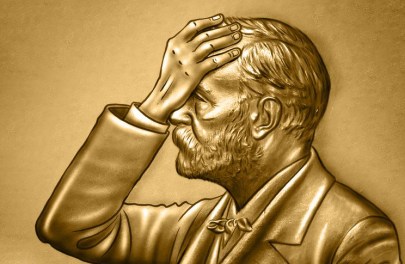
Baron Dr. Karl Ludwig Freiherr von Reichenbach had a better name than you or me. And unless I have assembled supremely erudite readership, he was more intelligent as well, having won the Nobel Prize for chemistry. It was the most prestigious of his many honors received for numerous discoveries of chemical products with economic use.

Regrettably, he tarnished his good and distinctive name by spending his final 30 years researching his pet project. He was convinced of the existence of an unproven field of energy that emanated from all living things, similar to qi, prana, and other “life forces” of alternative medicine infamy. The baron called this mysterious phenomenon the Odic Force, a name almost as ridiculous as the idea attached to it.

Despite my dismissive nature, I must concede that his having initially pondered the notion might be understandable. At one time, somebody had to be the first person to contemplate Earth being round, to speculate on the existence of atoms, to ponder rocket travel, and to consider if diseases could be arrested through a process we came to call vaccination.

Further, Nobel Prizes are given to those who conceive of and then confirm an original idea. They are awarded to forward thinkers who either expand on or shatter existing knowledge. It requires sizable fortitude and the ability to endure ridicule to publicly put forth an unproven notion. Having sustained this ridicule to take home the most revered honor in science, it’s understandable why the recipient would again ignore derogatory comments and persevere through failed experiments.

But in rare cases, perseverance turns into denial and we see the Nobel Delusion, where an elite scientist grows fixated on his or her idea regardless of whether it can ever be validated. This unfortunate phenomenon has taken place about a dozen times. Examples include Pierre Curie championing the medium Eusapia Palldino, Linus Pauling touting Vitamin C as a panacea, Brian Josephson endorsing the concept of psi, and Kary Mullins expressing a belief in astrology, while throwing in climate change and HIV denials for good measure.

With the baron, his obsession centered on persons he called Sensitives, whom he was convinced were the only ones who could detect the Odic Force. Here, von Reichenbach committed the affirming the consequent fallacy. He declared that if someone said they can feel the force, that means it exists. But with no means of measuring the force, with no way to detect what type of energy it was, and with no explanation of what mechanism was transmitting it, his descriptions were merely unsubstantiated assertions. They also involved special pleading because he asserted that the force emanated from all living beings, yet any test subject who reported feeling nothing was dismissed as not being one of the Sensitives.

Yet another of the baron’s logical fallacies was ad hoc reasoning. In a controlled test not overseen by von Reichenbach, subjects were placed in a completely darkened room to see if they could detect the presence of a magnetic current, which was activated half the time. After the Sensitives performed no better than chance, von Reichenbach attributed the failures to the magnetic force reacting upon the Odic current and confusing the Sensitives.

The baron came up with the concept of Sensitives while doing unrelated research on sleepwalking. He came across the idea that those who take somnambulistic strolls are allergic (or sensitive) to something that rides in on the moonlight. Rather than examining this claim, perhaps starting with seeing if day sleepers also walk, he extrapolated this notion into being the Odic Force, a powerful omnipresent entity which controlled sleepwalking and much more.

Earlier, von Reichenbach was investigating how the human nervous system could be affected by various substances and he conceived of an undiscovered force that combined electricity, magnetism, and heat, and which radiated from most or all substances. He thought such a force, if it existed, might impact the nervous system.

So far, so good. Making an observation, then developing a hypothesis based on it are the first steps in the Scientific Method. But he failed to include adequate controls in his testing and instead assumed the existence of Sensitives who can harness this mystery power, which he also just assumed to exist.  

The baron tried to establish a scientific tie by saying the Odic Force was associated with biological electromagnetic fields, as well as incorporating magnetism, electrify, heat, and light. These were pseudoscience ploys that might make the idea seem more plausible, but he failed to substantiate any of this through controlled studies or peer review.

While never explaining what type of energy it was, nor having no established a means of accessing it, nor inventing any machine to gauge it, von Reichenbach nevertheless thought the Odic force could explain dozens of phenomena, such as hypnotism, dowsing, the Northern Lights, and magnetism. He was even an early proponent of Feng Shui, cautioning churches to not place altars at the east end, lest worshippers be placed in an “an Odically unfavorable position.” I imagine this phrase was his Jump the Shark moment from which there was no chance of his returning to the application of rigorous scientific principles. Additionally, this was all Tooth Fairy Science, as he had yet to establish that the Odic Force existed.

His infatuation with the notion extended to associated personal habits, which would more accurately be called rituals rather than scientific protocols. On “research” days, the baron maintained a strict regimen of rest and diet and refrained from touching metals. For the experiment, he would hold a Sensitive’s hand and record the subject’s report of what was being transmitted. This included revelations that the mystery force was positive, negative, or neutral, or that the Sensitives saw glimmers of colored lights, which could have been a precursor of aura silliness.

As the Baron sadly demonstrated, expertise in one field does not confer authority in an unrelated area. Because they think it bolsters their cause, alt-med and anti-science types love to highlight iconoclastic Nobel winners who embrace unfounded ideas. But this is the appeal to authority fallacy since these Nobel Prize winners are not speaking to their area of expertise. Of course, it is possible to accurately speak about a field one is not an expert in, but such claims must be backed by credible evidence, and that’s not what’s happening here. There exists no empirical evidence for a life force which can be detected by select individuals, and an insistence from a Nobel Prize winner with a splendid name that it’s real doesn’t make it so.

“Tall tail” (Jersey Devil)

DEVIL

Even by the lax standards of cryptozoology, the Jersey Devil seems an unlikely creature. It is less biologically plausible than a bipedal ape, a modern-day plesiosaur, a Himalayan half-hominid, or a canine-reptilian hybrid. Descriptions of the Devil more resemble a chimera. His serpent body stands about four feet high, he has an equine head, cloven hooves, two small, mostly useless arms with talons, a forked tail, and it takes to flight utilizing leathery wings reminiscent of a bat’s.

This Devil’s tale is split into two periods. The latter started with a glut of sightings around 1909. The first stretches back another three centuries. That legend centers of the offspring of Daniel Leeds, an English immigrant and historical footnote who published the American Almanack in days or yore when they spelled almanac that way.

In the story, Leeds’ wife, Deborah Smith, gave birth to her 13th son in 1735. Different versions exist as to what happened immediately after. One story is that Smith or her clergyman cursed the newborn; others say it was horribly deformed (not sure what other kind of deformity there is); the least believable version is that the infant transformed into a monster who killed his mother, then escaped up the chimney. A less macabre version excludes the matricide, but still has a Devil being unleashed into the Pine Barrens of New Jersey.  

Biographical records, however, show that even mundane elements of this tale are in error. Leeds died in 1720, 15 years before the diabolical birth. And he was married to Ann Stacy, then Dorothy Young, but never to a Deborah Smith.

Leeds’ writings and the foreboding locale in which he penned them likely contributed to this legend. He started as a Quaker, but had a falling out with the church and a long-running feud was born. His former church dismissed his work as a blasphemy for attempting to blend Christianity with occultism or science. For example, he would use astronomy to try and gain a deeper understanding of the nature of God, a technique that got Giordano Bruno burned at the stake. Leeds suffered a fate nowhere near that excruciating but Quakers were forbidden from reading his work, and church leaders were only too happy to point out that the Leeds family crest featured a dragon, and indeed, later descriptions of the Jersey Devil corresponded with the animal on the Leeds crest.

Meanwhile, the foreboding appearance of the Pine Barrens made them a natural stomping ground for a creepy creeping cryptid. There are close to a thousand legendary animals said to exist worldwide, but I know of none who have an urban industrial district or strip mall as their place of origin. Nay, to be mysterious and captivating, a beast need arise in a deep loch, underground cavern, enchanted forest, foreboding windswept mountaintop, impenetrable jungle, time warp, or outer space.

Besides the Jersey Devil, several ghosts are said to haunt the Pine Barrens, including Captain Kidd’s. In Leeds’ time, the barrens were home to highwaymen, fugitives, poachers, moonshiners, deserting soldiers, escaping slaves, and others from society’s outskirts, so this also makes it fertile ground for satanic spawn.

References to the creature before the 20th Century normally refer to it as the Leeds Devil, but by the spate of 1909 sightings, few knew who Leeds was, so the name Jersey Devil was assumed.  

Some of the sightings may have been of the Sandhill Crane, a large slender bird capable of standing tall and spreading its two-meter bat-like wings. Its footprints can also be said to slightly resemble cloven prints. It’s likely that a majority of the sightings, though, were of other animals, or persons dressed in black, or even of rustling tree branches, all interpreted by persons wanting to be part of the hot new craze.

An attempt was made to monetize the hysteria through the beast’s “capture” and display. This was shown to be a fraud wherein hucksters had affixed artificial wings to a kangaroo, then used a harness to control its movement in order to make it seem menacing. From the rear of the cage, a stick was used to elicit shrieks or whatever sounds captive marsupials make when being prodded for purposes of cruel entertainment.

Reports of the flying fiend happen far less frequently than they do for the Big Three of cryptozoology: Bigfoot, Yeti, and Nessie. But Devil sightings do feature the same unverified accounts and complete lack of bone, hair, or skin samples. There are hundreds of purported sightings of a menacing, bouncing beast who seems only too willing and able to mutilate those he stalks, yet can never get around to finishing the job. While most tales feature anonymous witnesses, Napoleon Bonaparte’s less territorially-ambitious brother, Joseph, claimed a sighting. And a naval hero, Commodore Stephen Decatur Jr., allegedly shot a cannonball at the fleeing beast, with less success than he had targeting Barbary sailors.

Even most who believe in the Jersey Devil reject the original tale of his demonic nature. But without immortality and supernatural powers, a sustained existence seems hopelessly remote. The Jersey Devil being real would necessitate a sustainable population existing for 400 years with none of its eggs being discovered, with it never being a victim of hunters or motorists, and with its remains never having been found by hikers, campers, or anglers.

There have been hundreds of reputed sightings, but the plural of anecdote is not data. Sightings are weak evidence and these hundreds do not combine to from one strong piece of evidence, such as carcass or at least a body part. There is a group called the Jersey Devil Hunters, but the only place they will ever make a capture is in a hockey arena.  

“The means to justify the end” (Doomsdays)

ENDNEAR

The third week of September will be a busy one in cataclysmic circles. End of the world pronouncements happen at least every other year anymore, but as summer rolls into fall, we will be treated to two doomsdays in 72 hours. There is a day in between, but it’s doubtful it would be a constructive one, being sandwiched between two iterations of the planet being ripped asunder. No rest for the wicked, indeed.

Two doomsayers are going with a Sept. 23 date, with last month’s eclipse being the impetus for our finale. Unlike the Mayan Calendar or Harold Camping predictions earlier this decade, this prognostication is more vague on what will happen that day, with adherents insinuating it might only be the beginning (or middle) of the end. The lack of certainty is why this portent of doom is not receiving near the publicity of Camping and Mayan prognostications. Always remember, if wanting to get significant attention to you coming calamity, be specific on what will happen and when.

Because he didn’t do so, most of you have never heard of journalist Gary Ray. In the publication Unsealed, he wrote that the eclipse was one of several astronomical signs that the rapture is approaching: “The Bible says a number of times that there’s going to be signs in the heavens before Jesus Christ returns to Earth. We see this as possibly one of those.”

Of course, eclipses happened before the First Coming of Christ and have continued unabated in predictable patterns ever since, so there’s no need to assign special significance to last month’s, or think it means the Second Coming is in the offing.  

Ray is even more interested in an astronomical event that will follow the eclipse. He draws attention to a passage in Revelation which describes a woman “clothed with the sun, with the moon under her feet and a crown of 12 stars on her head,” who will give birth to a boy whose fate is to “rule all the nations with an iron scepter.

Ray interprets this Tolkienesque imagery to be a prediction of the night sky on Sept. 23. Then, the constellation Virgo, postulated by doomsayers to represent the woman in Revelation, will be clothed in sunlight in a position over the moon and under nine stars and three planets. The planet Jupiter, which will appear from our vantage point to be inside Virgo, represents an in utero child. As Jupiter moves out of Virgo, this symbolizes birth.

Even if we concede his analogies to be on point, there is the issue of this stellar alignment being not terribly uncommon. For one thing, the sun being in Virgo happens every year for about a month. Second, on the moon’s orbit of Earth, it ends up at Virgo’s feet once a month. These two arrangements come together once or twice a year.

Now onto the crown comprised of three planets and nine stars of Leo. The issue here is that there are several dozen stars in the constellation. The nine Ray references burn brighter than the rest, but it still requires special pleading to substantially reduce the number of stars in Leo to make the scenario work.

While much less frequent that the alignment mentioned two paragraphs back, multiple planets being at Virgo’s head while Jupiter is at her center and the moon at her feet is a circumstance that happens at roughly 300-year intervals, and all such occurrences have been Apocalypse-free.    

If Ray’s prediction flops like the 8,240 doomsdays that have preceded it, he will recover quickly. He has already postulated that this year’s eclipse may be the start of a seven-year tribulation that will end when another eclipse comes in 2024. Carbondale, Ill., which sits in the center of the “X” formed by the two eclipse paths, will presumably be transformed into Armageddon.  

Ray wrote, “It makes a lot of sense. There are a lot of things that really point us to that.” In truth, it makes no sense and nothing points to a period of horrors. He has merely taken astronomically observable and predictable data and turned it into a baseless assertion that a cataclysm is coming.

If preferring a more secular mass extinction event, we have the latest Nibiru hypothesis. The idea that a rouge planet will end life on Earth got a very late start compared to the Armageddon Industry. But in just 40 years, Nibiru proponents have moved into second place behind the Christian doomsayers in the End Times sweepstakes, and their panicky prognostication pronouncements make frequent Internet splashes.

There have been three prominent failures of Nibiru to annihilate the Earth since 2004. Undaunted, a fresh promise of destruction comes in a 2017 book by David Meade. Like Ray, he cites Sept. 23 as probably just a beginning of the end date, and this mistake is why you likely haven’t heard of his book either.

While not overtly religious (though it does cite Revelation when needing to have a point bolstered), the work does demonstrate a faithful fervor. For example, Meade declares, “The existence of Planet X is beyond any reasonable doubt, to a moral certainty.” Meade is equally convinced that the planet’s existence means we are doomed.

Earlier this year, he claimed that such disparate elements as the position of celestial bodies, Biblical verses, and Pyramid inscriptions have combined to reveal that Planet X and its accompanying apocalypse are imminent. His interpretation is that Nibiru will first be seen in the sky on Sept. 23, then will slam into our planet the following month.

His tortured analysis fixates on the number 33. “When the eclipse begins on Aug. 21, the sunrise will be dark, just as Isaiah predicts. The moon involved is called a black moon. These occur about every 33 months. In the Bible, the divine name of Elohim appears 33 times in Genesis. The eclipse will start in Oregon, the 33rd state, and end on the 33rd degree of Charleston, S.C. Then 33 days after the eclipse, the stars will align exactly as the book of Revelation says they will before the end of the world: 9/23/17. Such a solar eclipse has not occurred since 1918, which is 99 years.”

Since that deviates from the “33” pattern, he finagles that to read “33 x 3.” Besides this special pleading, Meade also demonstrates how simple it is to cherry-pick numbers when trying to prove a point. It took me about 33 seconds to come up with ideas that the run counter to what Meade is peddling. Lucifer, given the astronomy-friendly nickname Morning Star in the Bible, is mentioned in scripture more than 33 times; the number of states the eclipse passed through was less than 33; the biggest astronomical event to occur in the States before the eclipse, Haley’s Comet, took place 31 years prior, not 33. Any number can be arrived at, cited, and said to mean something if the adherent is allowed to choose from every historical event, date, and person.   

But at least Meade sticks with 33. By contrast, the numeral-happy website heavenlysign2017.com  considers dozens of numbers to have sacred, prophetic meaning. Worse, it presents its conclusions in an annoying centered-text format. Author Steven Sewell combines dates for Rosh Hashanah, Christ’s crucifixion, Kepler discoveries, Israel’s founding, Saddam Hussein threats, the Dead Sea Scrolls being made public, Trump attacking Syria, the United States entering World War I, and much more. Out of this gobbledygook emerges an end of the world date of Sept. 21, 2017.

He incredulously asks, “Could all this be a coincidence?” I’m not calling it a coincidence. I’m calling it leaching onto whatever historical events, dates, or persons one feels like manipulating, then twisting and tossing them into a gumbo that results in an idiosyncratic version of evidence.