“Hide the lightning” (Tesla cult)

TESLA

The universe is amazing and captivating enough that there’s no reason to fabricate the fascinating. But some want still more, which is one reason there are champions of pseudoscience, the supernatural, and the paranormal. But the stories they create are still less captivating that what is really happening.

For example, last year astronomers landed a satellite on a comet. How much cooler is that than the landing and all other NASA and cosmonaut missions being hoaxes to enrich Jesuits, Free Masons, or Bilderbergers?

Or think about the mechanics and engineering that went into crafting the castles and great houses of Europe. How much more appreciation should there be for the architects than for the beeping ghost-chasing device being bandied about these grand structures by the host of a schlocky TV unreality program?

Also, consider also fascinating aspects of the animal kingdom. The North American opossum has evolved a built-in antivenin that offsets any venom injected by bees, scorpions, or snakes. This defense mechanism has even proven effective against predators from other continents that the opossum would normally have no contact with. Traits like this bring an appreciation of animals that renders unnecessary the imagining of a Chupacabra or Skunk Ape.

All this creativity does show that pseudoscientists are an indefatigable lot. Flat Earthers have already launched preemptive ad hoc strikes against any Elon Musk space tours that may take place. They haven’t come up with any definitive answers yet since the question hasn’t been asked. But my guess is they will say that instead of seeing space and astronomical bodies through rocket windows, passengers are instead seeing simulated computer imagery in a rocket attached to gears and levers that moves it a la an amusement park ride, and that no one ever left the ground.  

Musk named one of his more terrestrial pursuits, Tesla, Inc., after the Serbian-American electrical engineer genius. Also inspired by Nikola Tesla has been a conspiratorial cult that, like the pseudoscientists and paranormal investigators, takes something that is impressive and tries to turn it into something better without regard to reality. Members of the Tesla cult ostensibly praise his genius and accomplishments, but these distinctions are actually bit players in a tale where his inventions and visions have been suppressed, purloined, and used for malevolent ends.  

Tesla has enough of a hold on the public imagination that a quarter century before Musk named one of his companies after him, a 1980s hard rock band did the same. That group was referred to as the “no image” band, a description that was repeated often enough that it paradoxically became their image. One of their tracks, Edison’s Medicine, made reference to a coordinated suppression of Tesla that often benefited the Wizard of Menlo Park. It was a catchy enough track, but spotty at best historically and it underlies the myth that surrounds the man. The song has plenty of company in that regard and another example is the photo showing him working in his lab while simulated lightning bolts emanate from Tesla coils. That picture is the result of double exposure, a precursor of today’s PhotoShop trickery.

Like comet-landing satellites, opulent residences, and marsupial defenses, there is much about the real Telsa to admire. He spearheaded the practical widespread distribution of electricity via the alternating current (although he did not discover it, as is commonly misperceived). He was awarded more than 300 patents and had blueprints for many other potential inventions. He made his first splash by illuminating the 1893 World’s Fair with AC and he keyed the creation of the Niagara Falls power plant. But this is inadequate for those who prefer a narrative drenched in deception, plotting, and plundering.

One accuracy from conspiracy theorists is that the U.S. government did seize Tesla’s papers through probably extralegal means. He died in January 1943 and government agents, having heard rumors he created or was working on a death ray, used a law enacted during the Constitution-shredding heyday of World War I to pilfer about his home. The law allowed an entity called the Alien Property Custodian to seize the assets of any enemy during wartime, with the custodian given authority to unilaterally declare someone a combatant. In this case, the enemy was a recently-deceased inventor who specialized in electromagnetics. The custodian’s office found little of use because much of Tesla’s later work was speculative and he made few notes of it. The government report of what was seized revealed that “his thoughts and efforts during the past 15 years were primarily of a speculative, philosophical, and somewhat promotional character often concerned with the production and wireless transmission of power; but did not include new, sound, workable principles or methods for realizing such results.”

This bland sentence, almost literally, describes nothing. Tesla had done pioneering work early in his career but was sidetracked due to a lack of funding in the Great Depression and he spent his last several years finalizing few inventions while possibly spiraling into madness or at least showing signs of what would become known as Obsessive Compulsive Disorder. This speaks to some unfulfilled potential and is a sad ending for a great man, but nothing terribly extraordinary is going on here. But conspiracy theories don’t become such by strict adherence to facts, investigation, reason, and Occam’s Razor. So a tale was hatched whereby government agents or other authoritarians complete the work begun by a mad genius and use it to control the world. That would make for a B movie and is an even worse conspiracy theory.  

The most widely-spread myth is that Tesla discovered the AC current, even though this was done 25 years before his birth. He is also credited by his enthusiasts as having been rooked out of receiving credit for taking the first X-ray photo. The truth here is a little more complicated. While photographing his companion Mark Twain, Tesla used an early form of fluorescent tube light called a Geissler tube. Unbeknownst to Tesla or anyone else, the tubes emitted X-radiation, so this innovation was unintentional, not repressed.

The invention most associated with a supposed theft and cover-up is the radio. Tesla did predate Marconi in demonstrating wireless communication and Tesla posthumously won all patent disputes.

But the controversy was the result of normal competition among scientists in an emerging field. Tesla and Marconi were both using and improving on theories and experiments of scores of inventors stretching back nearly 100 years. Patents for various wireless communication apparatuses had been filed beginning in the 19th Century and by the mid-1890s inventors on three continents were giving demonstrations of radio prototypes. Tesla made substantial contributions to the field but he borrowed ideas and techniques from others (and they from him), and this was all part of an explosion in knowledge related to the workability of wireless communication.

There are competing winners for the inventor of many devices. Edison, for example, was far from the first person to get heat to flow through a coil wire with illuminating results. But he was the first to devise a light bulb that lasted long enough and could be manufactured easily enough for it to be commercially viable. There was never a cover-up to deny Tesla credit for the radio, nor was that the incentive in giving Marconi the Nobel Prize. While the radio is the one invention most associated with the conspiracy theory, from a conspiratorial viewpoint it makes the least sense. That’s because the government that supposedly contributed to the repression recognized him as the inventor in a Supreme Court ruling the year he died.

There are several other purported Tesla inventions or accomplishments that are said to have been covered up and/or stolen. This includes his causing a field of light bulbs 26 miles away to illuminate wirelessly. This supposedly happened during the two years Tesla lived in Colorado Springs. But he kept detailed records of his time there and no such experiments are referred to in his papers. Photographs exist of his experimenting with this idea on a small scale in his lab but there is no evidence he took the idea any further.   

There has also been speculation that he had created artificial ball lighting. Portions of his notes taken out of context make it seem like he is describing having done this, but a more careful perusal of his writing and speeches reveal no such claims. But it does serve to heighten the myth, as Tesla is presented as a real-life Thor who can create and direct lightning at will.

One of his more ambitious pursuits was to transmit wireless power worldwide. But his only movement toward this goal was to partially constructing one tower. Another claim is that he had learned how to draw electricity straight from the atmosphere, but was silenced to protect energy companies. There’s no telling if he ever had this idea, but in any case, many of his proposals stayed in the embryonic stage.

That these devices were never seen by the masses, along with the government having seized his notes, fuels the conspiracy theory that his inventions are being used, but are being kept hidden. One example is the assertion that HAARP is Tesla’s worldwide wireless power grid in action. There is nothing at HAARP that even vaguely resembles a worldwide power grid, but to the theorist that appearance is all part of the cover up that keeps Tesla’s inventions in the hands of Rothschild Reptilians. 


“Free spirits” (Quad Cities Psychic and Paranormal Expo)

FAIR

Each year, the Quad Cities Psychic and Paranormal Expo rolls into town. Another tradition is me having 86 cents in my expendable income account. That has kept me from paying for any paranormal products or psychic services, but I have some magic of my own and always come away from these events having gotten something for nothing.  

My first stop this year was at an essential oils table, where I was assured the merchandise was “100 percent certified pure therapeutic grade, with nothing synthetic.” When it comes to the only oil I ever buy, motor, synthetic is a good thing, so I’m curious what this is all about.

I asked the two women what they could tell me about the oils and they inquired if I had any aches or pains. Indeed, my head was hurting so they referred to their chart that recommended peppermint. Later, I checked other essential oil businesses and websites for their headache cures and among those listed were lavender, eucalyptus, rosemary, spearmint, roman chamomile, magnesium, turmeric, frankincense, wintergreen, birch, jasmine, sage, marjoram, bergamot, ginger, and basil. By the time I tracked all those down it would be way past the four hours my headaches normally last and it would be gone anyway.   

As to these ladies’ recommendation, per their instruction, I put a couple of drops on my fingertip and lathered up my forehead and the back of my neck. This caused a pronounced burning sensation, meaning the pains on the inside of my head were now matched by ones on the outside, so I at least had symmetry going for me.

Brushing off the unpleasantness, I asked if the oil had healing properties. Assured this was the case, I asked if they knew the science behind it.

“There’s lot and lots of science. Our company is all about science.” What they lacked in specifics, they made up for in enthusiasm and assurance, so I continued.

“If there’s an active ingredient in it, is there a chance you could use too much of it?”

“Other companies, yes, but not ours. This is 100 percent pure.”

“But if it has healing properties, I would think there would be a danger of overdose. If you take a bottle of Excedrin, you’d be dead.”

“But that’s not all-natural.”

“Natural could still do you in. Hemlock is natural, too. So with the peppermint oil, is there a way to determine the proper dose?”

There is a look I get from psychic and paranormal fair merchants when I start lobbing anything beyond remedial inquiries at them. They are used to being asked, “What can craniosacral therapy do for me,” not, “Can you explain the mechanism behind craniosacral therapy?” Questions about the science are answered with “lots and lots” as opposed to providing examples of peer-reviewed articles and double blind studies.

I got that look, which they then turned on each other. They traded stammers before one of them offered that I should start with a drop or two and work up to what works for me. Of course, if no amount worked, I would keep going until I overdosed, which is what I was trying to avoid.

I was about to make this point when one of them changed the subject by offering me oil-infused chocolate chip cookies. I can’t ask probing questions if I’m chewing on confectionaries. To wash it down, they handed me water with lemon oil added.

“What does this do for you?”

“It helps with dehydration.”

Water helps with dehydration. Really glad I’m not paying for this information.

Glancing at the comparison chart that recommends oils in lieu of over the counter medication, I asked, “So for body aches, instead of Tylenol, I should take chamomile?”

“That’s right.”

“Why not just take Tylenol?”

“Because ours is pure.”

Oh, that’s right, you told me that. I need to look and see what oil helps with memory.

I then made my way to another table, where I asked a middle-age bespectacled woman with shoulder-length blond hair what she was offering.

“Readings, Reiki, and energy clearing.”

“What’s a Reiki healing?”

In a dreamy voice she intones, “Oh it’s wonderful. I love it. It holistically heals you from the inside. A week ago I got arthritis real bad and had Reiki done and I haven’t had it since.” There have been about 10 million such anecdotes in Reiki’s favor, none of them accompanied with an explanation for the mechanism behind it.  An eternal optimist, I hoped to be the first to track this down.

 “How does it work?”

“It’s spiritual. It’s the universe. It’s the angels. It’s the spirit guides and all the energy they use to heal you.”

“What type of energy does it use?”

“Well, we’re all made of energy. The Earth is made of energy, you, me, all living creatures, that type of energy.”

So someone would take my energy then give it back to me. Again, glad I’m not paying for these services.

Turning the subject to another of her offerings, I asked, “What’s energy clearing?”

“That clears away the energy we pick up from other people as you’re walking around or you’re living with them.”

“But that kind of contradicts the Reiki healing. Wouldn’t the energy clearing cancel out the Reiki energy you received?”

“No, it’s not connected. The energy that’s been cleared is low level. Depression, for instance, does not have a high vibration. The session helps to clear the clutter that builds up from negative thoughts and actions,” she told me. “Have you ever been talking to someone that just makes you sad for what the world has come to?”

Boy, she nailed that one. Why isn’t she manning the mindreading booth?

Moving on, I found a merchant who focused on a haunted house south of Buffalo, N.Y. He owns the house, he told me.

“Do you live in it?”

“No.”

“Does anyone live in it? Besides the ghosts, I mean?”

“No, I’m fixing it up.” He’s probably using sub-contractors for the various tasks, like remodeling, wiring, and ghostbusting.

He further explained, “I’ve researched the spirits in this house and its history. There was a failed exorcism there, another guy died there. Some people left after two months. Another family got out quickly and left all their stuff behind. People have tried to live there but it’s hard.”

I tried living in upstate New York for a while, I know what you mean.

“How do you research it?”

“There’s lots of scientific ways of researching it. Then there’s the personal, the feelings you get when you’re there.” So he bases it on science and feeling, and I have a feeling he’s exaggerating the science part.

This fellow was giving a free (there’s that key word again) presentation about this, so I followed him into the speaking room. Wonder if all this makes me a paranormal investigator investigator.

Once there, he enthralled audience members (well, with one exception), telling tales about these spooky surroundings. He assured us, “There’s definitely a dark entity there.” I imagine that’s called nightfall.

His talk contained the phrases, “something’s holding the spirit there,” “there’s a portal in that room that can’t be closed,” and “spirits are crossing a threshold.” There was talk about “an Indian chief” and “a woman in white at the pond,” both of whom he reported capturing on film. He also related a story about how a K2 meter stayed lit when he attempted to contact a former resident. “There was no explanation for it,” he said.

That’s because he didn’t ask me. The K2’s purpose is not to enable the dead to communicate via beeps and flashing lights as you walk up creaking stairs. Its function is to detect electromagnetic radiation and indicate the radiation’s strength and direction. There is no evidence deceased homeowners have the ability to leave this radiation behind.

When I asked if the K2 meters were designed to chase ghosts, he said no but added, “When your body dies, energy can’t be created or destroyed. There’s still that energy somewhere. If you ask a question and it flickers, perhaps it’s paranormal.” And perhaps it’s from the cell phones, video cameras, and computers you brought in.

Other audience members asked questions like, “Are you worried about driving off the friendly ghosts and leaving only behind the evil entities,” and “If the house burned down, would the spirits go back out the portal?” Meanwhile, I got in a second question, about why ghosts in his photos would still be wearing clothes. He answered that they did that somehow, some way, so that people in the present could recognize them. By this point, I realized the peppermint oil wasn’t helping any and my headache had gotten worse.


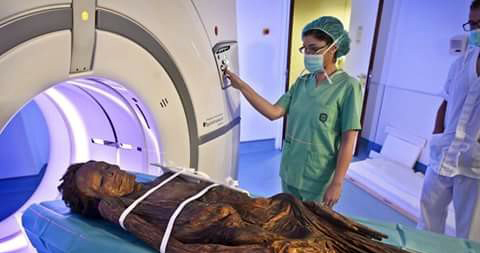
“Squawk like an Egyptian” (Man-made cancer)

MUMMY

A popular myth in anti-doctor and anti-pharmaceutical circles is that cancer is man-made. The idea is that the disease either didn’t exist or existed very rarely thousands of years ago, but has increased exponentially due to persons being bombarded with artificial toxins. Even more tenuous proclamations blame GMOs, vaccines, WiFi, or whatever other entity one wishes to demonize.

The idea of man-made cancer stems primarily from a study by professors Rosalie David and Michael Zimmerman. The researchers examined nearly 1,000 mummies and found just one who had developed cancer. The professors therefore concluded that the disease is of recent origin. They went so far as to claim that cancer is “limited to societies that are affected by modern lifestyle issues, such as tobacco use and pollution resulting from industrialization.” Officials from the University of Manchester lauded the study in a press release that stated, “Finding only one case of the disease in the investigation of hundreds of Egyptian mummies, along with few references to cancer in ancient literary evidence, proves that cancer was extremely rare in antiquity.”

It’s true that the cancer rate in ancient Egypt, as well as in Rome and Greece, was much less than it is today. But that’s because cancer is predominantly a senior disease. According to Dr. Lesley Walker of Cancer Research UK, 75 percent of cancer hits persons 60 or over, a demographic that includes just 18 of the population. In men, 90 percent of cancers occur in those over 50. If the average lifespan were to hit 125, virtually all men making this milestone would develop prostate cancer, but this would be due to drastically longer lives, not because a futuristic nefarious agent will have perfected a way to commit microbial misdeeds. Conversely, in times and societies where hitting 50 was as noteworthy as making 100 today, it would be expected for cancer to be rare.

The David-Zimmerman study said that besides environmental factors, lifestyle also has an impact. It’s true that lifestyles make a difference in the likelihood of developing cancer. Smoking, drinking, overeating, forgoing sunscreen, and being sedentary all make cancer more likely. But these are choices, meaning persons can do something to positively impact them. Cancers that would result from these activities are the result of poor decisions are not evidence of society being awash in a carcinogenic wave. True, there are some pesticides and industrial solvents that could can cause cancer with prolonged, concentrated exposure, but these are responsible for a tiny fraction of the disease, and steps can be taken to reduce the risk, such as the exposed person wearing protective equipment.

The authors are correct that pursuing a more active lifestyle and eating a balanced diet can help stave off cancer. And their point about cancer being rare 3,000 years ago is true, though this was accompanied with a correlation-causation error that blamed industrial developments, not increased lifespans, for the disease’s surge.

So at this point, we have one truth and one probably unintentional misuse of numbers. But they jumped the analytical shark with an absurd claim that would delight Gwyneth Paltrow, the Food Babe, and Doctor Oz. David wrote, “There is nothing in the natural environment that can cause cancer.”  The (literally) most glaring error here is failing to consider the sun. Ultraviolet radiation, after all, is the number one cause of skin cancer.

Going to much smaller examples of nature, carcinogens exist in bacteria and viruses. These infectious agents are responsible for up to 25 percent of cancers, including the human papillomavirus. And one of main reasons stomach cancers are less prevalent than 100 years ago is because of refrigeration and improved living conditions.

Then there’s radon, a natural product of granite. In gas form, it is responsible for about 10 percent of lung cancers. Additionally, there are chemicals found naturally in foods and produced by molds or plants that can cause cancer. Even soot and smoke from fire contain carcinogens that could result in cancer with prolonged exposure.

But at least David and Zimmerman conducted original research and submitted their findings for peer review. We will now transition to those unencumbered by scientific protocol. These types attribute cancer to whatever modern development they find most intolerable.

Some anti-GMO types point out that genetic modification has been going on for about 30 years and cancers have gone up over time, so, voilà. Even a rudimentary critical thinker would recognize this as the post hoc fallacy, where because one event comes before another, a connection is assumed without offering evidence and without considering other possible causes.

A seemingly more reasonable position is to blame GMOs for cancer because of reports that both bacillus thuringiensis (which is incorporated into insect-resistant plants during genetic modification) and glyphosate (a herbicide used on some GM crops) will, when applied to cells in a petri dish, cause some cells to experience abnormal growth. But University of Florida horticulturist Dr. Kevin Folta noted that cells in a petri dish behave differently than cells in a human body, and he added there is zero evidence consumption of GM foods would cause the change that cells in a petri dish undergo.  

Another alarmist camp blames WiFi for cancer. But WiFi operates in the microwave portion of the electromagnetic spectrum and the risk of cancer only begins at the high end of ultraviolet light. A similar slander targets cell phones and accuses them of causing brain cancer. However, the ubiquitous nature of these devices and the lack of corresponding brain cancer pandemic show this to be an unfounded fear.

Smart meters are another modern development forced to stand in a police lineup of suspected carcinogenic agents. This is based on the misuse of a fact, specifically that ionizing radiation can break the bond that holds molecules together and possibly have carcinogenic results. But this danger does not extend to low-frequency fields, which is where smart meters operate.

And what pseudoscientific scaremongering would be complete without pinning unwarranted blame on vaccines? The horribly-misnamed website Truth About Cancer notes that most vaccine inserts contain the phrase, “This vaccine has not been evaluated for its carcinogenic potential.”

The website then issues an alarm about today’s vaccine schedule being thrice as long as what it was 40 years ago, leaving out that there are 95 percent fewer antigens injected now than then. It then joints the post hoc parade with, “Coinciding with the ever-increasing vaccine schedule are soaring rates of chronic illness in children, including cancer, which has skyrocketed and is now the leading cause of death by disease in children past infancy.” Yes, especially now that no babies in the West are dying from polio or smallpox.

The website next rails against formaldehyde without mentioning that the compound occurs naturally in the human body in greater amounts than what vaccines contain. Finally it recommends avoiding vaccines altogether in favor of eating fruits and vegetables, getting enough rest, sunshine, and exercise. There’s nothing wrong with doing all that and also getting vaccinated. I do love my bananas, sleep, 70 degree days, and time on the treadmill. But my joy from those pursuits would be greatly curtailed if I indulged in them while enduring Whooping Cough.


“The nuclear option” (Nuclear power fears)

NUKESMILE

In the rare times that the left and right are in agreement, it’s usually because both sides are getting something from the deal. But in the case of nuclear power, the objections from a mix of liberals and conservatives are ironically stifling an innovative, pro-environment, pro-business resource. That’s because nuclear power’s efficiency, safety, and low-carbon status are three strong reasons to adopt the technology.

Liberals who object are self-styled environmentalists who embrace the positions of the IPCC and IEA when it comes to climate change. Yet they reject nuclear power, which those organizations call one of the primary solutions to global warming.

Meanwhile on the right, objections seem to be based on oil and coal industry titans potentially seeing their salaries dip into the seven figures if nuclear power becomes too prevalent. So the best way to win over conservatives would be to point out to how much money a real-life C. Montgomery Burns could make.

As to trying to convince those on the left, the key point is that all energy sources contain risks and that nuclear is among the least concerning. I find nuclear power akin to airplanes. They are both the safest method of doing what they do, but the failures are spectacular, widely publicized, and most remembered.

But there are more chilling dangers from air pollution and the burning of fossil fuels. According to the criminally underappreciated blogger Thoughtscapism, even wind causes more deaths per kilowatt than nuclear power does. She also cites climate scientists James Hansen and P.A. Kharecha, whose paper on nuclear powered concluded that the technology has saved two million lives by producing energy that had previously come via coal.

According to evolutionary and environmental blogger J.M. Korhonen, even when the full lifecycle is considered – uranium mining, accidents, and waste spillage, nuclear energy is still one of the safest energy sources.  She also wrote that, when compared to sources that require burning, energy produced from nuclear power is responsible for much less harm to people and the environment. The same conclusion was reached by the EU-funded External Costs of Energy study.

Additionally, Friends of the Earth commissioned an independent research review that deduced, “The overall safety risks associated with nuclear power appear to be more in line with lifecycle impacts from renewable energy technologies, and significantly lower than for coal and natural gas.”

OK, so nuclear power is efficient and the risk of uranium mining is the same as unearthing similar minerals used in renewables, but what about the notorious accidents at Three Mile Island, Chernobyl, and Fukushima? These get the headlines, any loss of life is tragic, and environmental damage is always disconcerting. Yet in more than 50 years, just 75 persons have died directly or indirectly as the result of nuclear power accidents, all but a handful of these at Chernobyl. This is far fewer than from coal, according to an assessment conducted by the University of Stuttgart. The study concluded that the 300 largest coal plants in Europe cause 22,000 deaths per year.

Beyond safety advantages, another plus of nuclear power is reduced carbon output. For example, the lowest emissions among European countries occur in those nations who use the most nuclear and hydrological power. Moreover, the Intergovernmental Panel on Climate Change and the International Energy Agency both have the position that no single solution will bring sufficient reduction in Earth’s net carbon output. Nuclear power is needed to help make that happen.  

Fossil fuel use is still rising and the IPCC estimates that reliance on the fuels needs to be reduced 40 percent and replaced with nuclear power to have a sizable reduction in carbon reduction by 2030. Meanwhile, the IEA holds that nuclear use must double over the next three decades if humanity is to halt Earth’s rise in average global temperature. We also need bioenergy, wind, power, hydroelectricity, reforestation, solar radiation management, lifestyle changes, and other strategies, but we are losing a valuable resource by failing to embrace nuclear power.  

“Scream of the crop” (GMO fears)

GMOKID.jpg

Anti-GMO extremists are known for their macabre corn men masks, memes of fruits taking bites out of children, and vehicles topped with tomato-fish hybrids. None of this has any relationship with reality. Online activists frequently employ ad hominem attacks in the form of evidence-free shill accusations, while also accusing posters of being Monsanto employees, whom they compare to Joseph Goebbels.

One of the more infamous anti-GMO crusaders, Nassim Taleb, contributes little to the dialogue beyond personal-attack Tweets. He refuses to discuss the issue with any adversaries, blocks anyone who disagrees, and never offers any science. I once attended an anti-GMO seminar in which the speaker claimed the USA’s enemies will eventually be able to stroll in and take over the country without firing a shot because GMOs will turn us into non-thinking zombies.

But even among the more measured anti-GMO types who do not foment these irrational fears, there are still misunderstandings of the process. However, there are no risks with genetically modified crops that do not occur with conventional breeding methods.

The latter can even pose more risks, and this is ironically more likely when countries ban genetically modified crops. That’s because when this happens, agricultural companies may develop new strains though mutagenesis, which requires subjecting plants to radiation or dousing them with toxic amounts of chemicals in order to randomly move genes in the hopes of producing new traits.  

Contrast this to genetic modification, where scientists take a gene that yields a desired trait then insert it into a crop that may lack this distinction. Mutagenesis is much less precise than genetic modification, yet remains unregulated, widely used, and unchallenged by Taleb, Vandana Shiva, Vani Hari, and other self-appointed guardians of food safety.  

One falsehood is that GMOs are more susceptible to producing allergens. In fact, genetically modified foods are required by regulatory agencies to be tested for their allergen presence. Any genetically-modified crops that are shown to have one cannot be sold or distributed. Meanwhile, crops that are known to be allergens to some, such as peanuts, are not subject to this regulation.    

There are also accusations that GMOs are prone to uncontrollable spread. But GM crops are produced by managing a small, precise change to a plant, making spread unlikely. Meanwhile, conventional breeding mixes thousands of genes from parent plants, then recombines them to produce mutations that could potentially increase the potential to spread.   

Perhaps the most frequent criticism is that heartless corporations are controlling GMOs. Yet large companies and conglomerates, heartless or otherwise, have their hands in all food production methods.  Whole Foods, which specializes in organic produce, brings in more than profit than most of companies Food Babe demonizes for making money off GMOs. Besides, farmers are free to use non-GM seeds, to buy seeds from corporations that sell exclusively conventional crops, to buy locally, or to form a co-op.

A similar argument centers on patents, and concern over this is wrong for the same reason as above. The supposed idea is that malevolent Monsanto, satanic Syngenta, and detestable Dow will horde seeds and control the world’s food supply. Yet conventional crop variants can also be patented and corporations that work with conventional breeding will sue anyone who violates the patents.

Then we have an alleged increase in use of pesticides. But GM applications usually match a specific toxin to a certain crop, meaning that genetically-modified crops use fewer pesticides. Additionally, there are charges that genetically-modified foods will negatively impact bees and butterflies. But because these crops rely mostly on pesticides that target a specific pest, they will not impact other insects. In fact, bugs are more likely to be killed by broad-spectrum insecticides that are used in traditional farming.

Finally, there are fears expressed about genes moving between species. First, GM crops do not always involve the use of a transgene. They can also remove genes that would otherwise produce a toxin, or they can change genes to give the crop a desirable trait it might lack. And again, conventional crops also involve moving of genes between species. Emil Karlsson cited these examples on the website Debunking Denialism: “The conventional crop triticale is a hybrid between wheat and rye. Also, horizontal gene transfer between bacteria and plants occur in nature all the time and well-documented examples include the common sweet potato.” Yes, nature has produced a genetically-modified organism. Now there’s something for Taleb, Shiva, and Hari to freak over.

“Err supply” (Food control)

CARROT STICK

One tenet of the anti-GMO, selectively anti-corporate crowd is that evil, powerful groups are controlling the world’s food supply. I’m generally not much on conspiratorial thinking, but this time, the accusation is correct.

But it comes with a substantial caveat. That’s because those making the accusation and those committing the act are the same. For it is anti-GMO activists that are corruptly manipulating the food marketplace. It is not being done, as they claim, by food technology companies through patents and seed ownership. Rather, anti-GMO activists manage to artificially constrain GMOs through a three-pronged approach of regulatory control, making threats to corporations, and exerting pressure on food importers.

The result is that only 10 crops have ever been approved for genetic modification even though the technique can reduce the chance of a crop being afflicted by drought, disease, or pests. Anti-GMO victories have included preventing the distribution of Vitamin A-rich Golden Rice to Third World countries, which would prevent some instances of childhood blindness.

When anti-GMO forces have failed and farmers have been given the chance to grow biotech crops, they embrace them. Genetic modification allows for the development of traits that provide economic benefit, make for sturdier corps, and carry less risk. But only a small percentage of the world’s fruit, vegetable, and grain producers enjoy this biotechnology option.

One of the more prominent successes of anti-GMO forces was the politically-driven decision by several European nations to disallow biotech crops to be cultivated in all or parts of their countries. A related win was the required labeling of genetically-modified foods. Most companies avoided such products since the labels are accompanied by harassment from activists.

These activists frequently employ the ad populum fallacy and consider the number of countries that have banned the cultivation of genetically-modified foods to be evidence of their nefarious nature. But nearly 2,000 studies attest to GMO safety, meaning the restrictions are based on fear and threats, not science and reason. Just how much of a problem this can be was highlighted in a 2014 Guardian article. From the story:

“More than 20 of the most eminent botanists and ecologists in the world warn that it is time to put fears of genetic modification aside and begin widespread field trials. They call for a ‘fundamental revision of GM regulation’ which, they claim, is based not on science, but on politics. Professor Jonathan Jones says British scientists are creating world-changing crops, but they are being blocked by Europe. Jones has developed a blight resistant potato which would avoid the need for farmers to spray crops 15 times a year. Blight is the number one threat to the six million tons of potatoes produced in Britain each year and was responsible for the Irish Famine of the 1840s. But European approval is needed for commercial cultivation and so far the Council of Ministers has vetoed every application.”

This entrenched opposition has extended to other continents. African farmers are denied access to genetically engineered seeds that would improve resistance to insects and drought, and which would make the food they produce hardier, brighter, better tasting, and less susceptible to failure.

Beyond legislation, a second strategy is to threaten corporations with demonization. An insect-resistant potato was developed in 1996 and agricultural scientist Steve Savage reported that he “interviewed many potato growers in the first few years the trait was available and they were extremely happy to have a solution to their most damaging insect pest.”

But after anti-GMO activists threatened McDonald’s and Frito-Lay with boycotts, protests, and ad campaigns if they used this scientific advancement in their products, the companies caved and announced they would not be buying the crop. No small potatoes indeed, as with the two biggest potential customers backing out, the idea fizzled.

This tactic has hobbled other crop developments as well. Savage wrote, “I am aware of projects that have been started or were planned for bananas, coffee, grapes, tomatoes, lettuce, strawberries and apples,” but these were also torpedoed by activists who relied on threats, not data.

The final strategy is to threaten importers from countries which mandate GMO labeling. Savage explains how this derailed a herbicide-resistant wheat strain. “Once again, I had the opportunity to interview many wheat growers to assess their interest in these options,” he wrote. “Most already had positive experiences growing biotech soy, corn or Canola, and they were keen to try the new wheat options. They never got that chance. Major wheat importers from Europe threatened to boycott all North American wheat if any commercial biotech varieties were planted in the U.S. or Canada.”

European bread and pasta producers shied away from having to label their food because they knew this would subject them to activist pressure, so they declined to let the wheat in. The decision was based not on safety or supply and demand, but on the activists’ ability to create marketing issues for food companies that import.  

The activists have yet to get mandatory labeling in the United States. The pro-GMO camp continues to fight this, in part because “If they’re safe, why not label them?” will become, “If they are safe, why are they labeled?” 


“Image subconscious” (Rorschach test)

TEST

Dracula is such an iconic character that even people who have never read Bram Stoker’s book or seen the 1931 Bela Lugosi classic or ever had any interest in vampires knows exactly who he is and could likely rattle off half a dozen characteristics he possesses.

I see the Rorschach Inkblot Test as the Dracula of psychology. Persons who have never taken the test or been in a psychology class or read a psychology textbook know what it is and how it’s used. Also, it endures long after it should have been buried with a stake in its heart.

The ink blots are said to have the abilities to provide a psychological diagnosis, uncover deep personality traits, and predict a patient’s future behavior. But a more measured analysis shows it to be little more than a form of cold reading and no empirical data suggests it works as advertised.

Swiss doctor Hermann Rorschach devised the test, taking the idea from his childhood hobby of klecksography. This consists of dropping wet ink onto a paper then folding it in half to form two mirror images. Players then grab a pen and  complete whatever the image suggests to them.

In the 1960s, Dr. John Exner consolidated various forms of the test and standardized the scoring method. He produced 10 cards, which are still uniformly used by all psychologists who employ the Rorschach.

Those who use the test consider it a projective technique. This refers to when subjects are given an ambiguous stimulus and asked to interpret it. After the patient’s initial description, the psychologist probes for more detail to determine why the patient saw the images that they did. This is actually considered the key part of the assessment. It is not the initial epiphany of a splattered image resembling a flying insect that test proponents consider revealing. Rather, it is the more involved explanation of those object’s qualities and how they relate to the patient’s psyche that is most relevant. The distinctions of a flying insect are assumed to be the patient’s self-projection.

But open-ended queries about ambiguous stimuli mean that an accurate self-assessment is not a terribly likely result. As Brian Dunning at Skeptoid noted, “An artistic serial killer may speak at length about the beauty of the butterfly he sees, while a dull but harmless accountant may say it looks like a knife.”

Proponents consider the Rorschach test to be capable of unlocking a person’s deepest secrets, of providing a window to their soul, and of being able to capture the subconscious springing forth. But the techniques used and results claimed are similar to what we see with fortune tellers and mediums, though a psychologist has more admirable intent than does a ghoul cashing in on grieving relatives.

Still, a seemingly effective Rorschach analysis can be made using cold reading techniques employed by the likes of Tarot card readers and astrologers. This is even easier since a patient is in a therapist’s office precisely to open up. From this patient input, the listener gets a good idea about the client’s education level, background, interests, family members, fears, and dreams. All this information can eventually be woven by the therapist into what seems like an accurate analysis.

The examiner may also assign to the patient general attributes and circumstances that would apply to many persons and situations. The analysis may even be contradictory, further increasing the chance that at least part of it applies to any given person. In the end, the clinician ends up with an analysis that can be interpreted to exactly match the client’s case.

So while something accurate about the patient may be revealed in the sessions, attributing it Rorschach inkblots is a correlation/causation error. Anytime a subject answers complex questions and offers observations and reasoning at length, ample insight into that person will be revealed. So the test “works” because the psychologist has learned the patient’s history and personality. It’s not because an idiosyncratic pondering of ink blots provided a deep dive into the psyche or the  ability to scour hidden recesses of the mind.

So when I examine the blots, they look like a misinterpreted phenomenon whose value as a psychological tool has been greatly overblown.  

“Eye doubt it” (Third Eye)

thirdeye

The stigma attached to ignorance is, often and ironically, a result of that condition manifesting itself. It is ignorant to think that a lack of knowledge is all bad. Recognizing the shortcoming and the subsequent desire learn more is what drives progress.

The blogger Skeptophilia wrote, “Ignorance is the inevitable condition if you study anything scientific. Scientists are always pushing the edges of our knowledge, which means they have to be keenly aware of the fact that there are a lot of questions for which we simply don’t have answers.” He also quoted Neil Tyson, who noted that scientists “are always back at the drawing board. If not, they’re not making discoveries and they’re not doing science.”

So this thirst for more knowledge is good, and without it I would not have a word processor to write this, nor even a quill and ink. What’s bad is when a lack of knowledge is filled in with whatever wild conjecture one finds most attractive.

This faux knowledge is often bolstered with a dismissive attitude toward intellectualism. Creationists, alternative medics, anti-vaxxers, and ancient alien aficionados are fond of declaring, “Scientists have no answer for this,” or “Science has been wrong many times before.” They then segue into a fabricated explanation that involves no testing, peer review, clinical trials, or laboratory studies. They conclude with a begging-the-question position that God/aliens did it, that jasmine and sage can combine to cure rosacea, that insulin causes diabetes, or some similar stance with no scientific backing.

Consider some creative interpretations of the pineal gland’s function. Within our lifetimes, this organ has from being considered a vestigial trait to one that physiologists have a rudimentary understanding of. They now know the gland produces melatonin, which helps regulate our circadian rhythm. But scientists are unsure precisely how it manages this and don’t know if it has still other uses.

To the rescue comes Dr. Google. Here, persons who purport to tolerate no gap in human knowledge will turn around and accept assertions that the gland serves as a soul repository, a spiritual antenna, or conduit to a mystical plane. Most popular is the idea that the pineal gland is the gateway to the Third Eye.

Similar to halfhearted conspiracy theorists who portray themselves as broadminded chaps only interested in considering various viewpoints, persons who view the pineal gland in esoteric terms pose a series of questions ostensibly meant to be stoking curiosity, but which really insinuate that “they” are hiding something, whether “they” refers to Illuminati agents or scientists.  

Skeptophilia cites a few examples of these questions, such as, “Is the pineal gland the evolutionary remnant of a literal third mammalian eye that moved into the center of the brain and changed functions from gathering light to entraining rhythms in accordance with information gathered by the retina?” Skeptophilia provided what I imagine would be an unsatisfying answer to the questioner: “No. No vertebrate has three eyes.”

Another query was, “Is there a connection between the spiritual promise of the pineal gland, which is shaped like a pine cone, and the Pigna, the colossal bronze pine cone statue of ancient Rome which now sits in a courtyard in the Vatican?” Yes, the connection is that both are the result as painting with the broadest brush possible in order to fill a gaping hole with the vague idea that all can be wonderful and magical if one embraces the poorly-explained notion of a Third Eye.

One final question: “Why is the pineal gland the only organ in the human body that calcifies and solidifies with age and why is it that pineal gland decalcification results in a heightened spiritual experience?”

Again, Skeptophilia: “Your pineal gland is not the only structure in your bodies that calcifies with age. Your cartilage does the same.” Further, “heightened spiritual experience” is not a testable condition and its existence is being asserted without satisfying the requisite protocols.

Meanwhile, the Gaia website combines science and poppycock in one paragraph without acknowledging the abrupt transition: “The pineal gland is a pea-sized gland shaped like a pine cone and located in the vertebrate brain near the hypothalamus and pituitary gland. Also known as the Third Eye, it is a revered tool of seers and mystics and considered to be the organ of supreme universal connection.”

Gaia also plays to the appeal to antiquity fallacy, claiming the notion of a Third Eye appeared in “every ancient culture,” though it only specifies the ones New Agers hold in highest esteem, those in Egypt and India. Specifically, it cites Hinduism’s anja chakra and the Eye of Horus, which had its heyday during the time of the pharaohs.  

The ajna chakra does bear some similarity to the Third Eye concept of modern times, but the Eye of Horus was seen as a symbol of protection, power, and health. Its only resemblance to the Third Eye is that both involve peepers. The supposed connection is fabricated so as to appeal to New Agers.

Speaking of which, Gaia explains that, “Developing the Third Eye is the doorway to telepathy, clairvoyance, lucid dreaming, and astral projection. A blocked Third Eye leads to confusion, uncertainty, cynicism, jealousy and pessimism. The calcification of the pineal gland is common if the Third Eye is not being used or as a result of diets rich in fluoride and calcium. Radiation from cell phone use and electric and magnetic fields may have negative impacts on the pineal gland as well.”

These claims are high on extravagance, low on evidence. And while believing that opening the Third Eye will be a magical mystery tour, Gaia does extend a branch to the more conspiratorial minded of its followers. It suggests that fluoridated water and USDA encouragement to get adequate calcium may be ruses to blind the Third Eye.

Also urging caution is an online entity going by the moniker Tapoos. He, she, or it warns that opening the Third Eye will cause senses to become enhanced and that this can be undesirable. It could make tastes more bitter, high-pitched sounds more jarring, and chapped skin more sensitive. Another danger is that the experience could be so wonderful that it will cause the subject to ignore suddenly humdrum stuff like relationships, bills, and community service.

Tips on how to open the third eye are quite varied, which is typical of unscientific gobbledygook. Some involve understood activities, such as meditation, dancing, chanting, yoga, and prayer. Others suggestions are puzzling, such as “cultivate silence,” “hone intuition,” “nurture creativity”, and “become grounded.” These unspecified tasks take an unclear concept like Third Eye and make it ever more muddled.

A vegan diet is another alleged way to pry open this portal. But I have been vegan at various points and my excess consumption of tomatoes and avocadoes led to no heightened state of awareness, nor did it grant me new insights. It either didn’t work or I was born with my Third Eye already open.

For those who do risk the opening, Tapoos writes that it may  “introduce you to a whole new world filled with amazing experiences. This new awakening can guide you on the path of consciousness not only about this world but the spiritual realm as well. The pineal gland isn’t some imaginary, magical eye that is going to appear on your forehead. You can think of it as a meta organ that is naturally present in all human beings. This meta organ includes your mind and all of your other senses working together simultaneously to become a single, supreme organ.”

This passage refers to a legitimate biological entity, plus throws in words like gland and organ, but mixes this with decidedly unscientific notions such as supreme organ and the gland being the “seed of the soul.”

Besides there being roughly similar ideas in Hinduism, the concept is found in some Taoist schools and occasionally in neo-gnostic Christian offshoots which consider the Third Eye the means by which Revelation seers were given their visions.

There is also a tangential Tibetan Buddhist connection. The Third Eye idea was championed by a man identifying himself as Lama Lobsang Rampa. But Heinrich Harrer hired a private investigator who learned Rampa was really an Irish plumber named Cyril Hoskin. Upon being busted, Hoskin spun the greatest religious yarn since Joseph Smith.

In that instance, Smith was claiming to be translating inscriptions of golden plates to Martin Harris. Harris’ wife got ahold of the first 116 pages and challenged Smith that if he had translated the golden tablets once, he could do it again. Smith then received a warning from that God not to retranslate these pages because Satan had Earthly minions who would alter the pilfered manuscript, then use the inconsistencies between the two versions to discredit the developing Book of Mormon.

In the more recent case, Hoskin conceded that he was indeed an Irish plumber, but that the spirit of a Tibetan lama had leased space in his soul long enough to pen religious tracts. However many eyes I have, they were all rolling upon hearing that explanation.

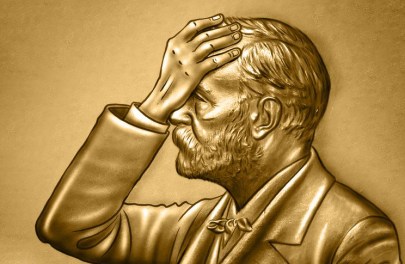
“Nobel pursuit” (Odic Force)

NOBEL

Baron Dr. Karl Ludwig Freiherr von Reichenbach had a better name than you or me. And unless I have assembled supremely erudite readership, he was more intelligent as well, having won the Nobel Prize for chemistry. It was the most prestigious of his many honors received for numerous discoveries of chemical products with economic use.

Regrettably, he tarnished his good and distinctive name by spending his final 30 years researching his pet project. He was convinced of the existence of an unproven field of energy that emanated from all living things, similar to qi, prana, and other “life forces” of alternative medicine infamy. The baron called this mysterious phenomenon the Odic Force, a name almost as ridiculous as the idea attached to it.

Despite my dismissive nature, I must concede that his having initially pondered the notion might be understandable. At one time, somebody had to be the first person to contemplate Earth being round, to speculate on the existence of atoms, to ponder rocket travel, and to consider if diseases could be arrested through a process we came to call vaccination.

Further, Nobel Prizes are given to those who conceive of and then confirm an original idea. They are awarded to forward thinkers who either expand on or shatter existing knowledge. It requires sizable fortitude and the ability to endure ridicule to publicly put forth an unproven notion. Having sustained this ridicule to take home the most revered honor in science, it’s understandable why the recipient would again ignore derogatory comments and persevere through failed experiments.

But in rare cases, perseverance turns into denial and we see the Nobel Delusion, where an elite scientist grows fixated on his or her idea regardless of whether it can ever be validated. This unfortunate phenomenon has taken place about a dozen times. Examples include Pierre Curie championing the medium Eusapia Palldino, Linus Pauling touting Vitamin C as a panacea, Brian Josephson endorsing the concept of psi, and Kary Mullins expressing a belief in astrology, while throwing in climate change and HIV denials for good measure.

With the baron, his obsession centered on persons he called Sensitives, whom he was convinced were the only ones who could detect the Odic Force. Here, von Reichenbach committed the affirming the consequent fallacy. He declared that if someone said they can feel the force, that means it exists. But with no means of measuring the force, with no way to detect what type of energy it was, and with no explanation of what mechanism was transmitting it, his descriptions were merely unsubstantiated assertions. They also involved special pleading because he asserted that the force emanated from all living beings, yet any test subject who reported feeling nothing was dismissed as not being one of the Sensitives.

Yet another of the baron’s logical fallacies was ad hoc reasoning. In a controlled test not overseen by von Reichenbach, subjects were placed in a completely darkened room to see if they could detect the presence of a magnetic current, which was activated half the time. After the Sensitives performed no better than chance, von Reichenbach attributed the failures to the magnetic force reacting upon the Odic current and confusing the Sensitives.

The baron came up with the concept of Sensitives while doing unrelated research on sleepwalking. He came across the idea that those who take somnambulistic strolls are allergic (or sensitive) to something that rides in on the moonlight. Rather than examining this claim, perhaps starting with seeing if day sleepers also walk, he extrapolated this notion into being the Odic Force, a powerful omnipresent entity which controlled sleepwalking and much more.

Earlier, von Reichenbach was investigating how the human nervous system could be affected by various substances and he conceived of an undiscovered force that combined electricity, magnetism, and heat, and which radiated from most or all substances. He thought such a force, if it existed, might impact the nervous system.

So far, so good. Making an observation, then developing a hypothesis based on it are the first steps in the Scientific Method. But he failed to include adequate controls in his testing and instead assumed the existence of Sensitives who can harness this mystery power, which he also just assumed to exist.  

The baron tried to establish a scientific tie by saying the Odic Force was associated with biological electromagnetic fields, as well as incorporating magnetism, electrify, heat, and light. These were pseudoscience ploys that might make the idea seem more plausible, but he failed to substantiate any of this through controlled studies or peer review.

While never explaining what type of energy it was, nor having no established a means of accessing it, nor inventing any machine to gauge it, von Reichenbach nevertheless thought the Odic force could explain dozens of phenomena, such as hypnotism, dowsing, the Northern Lights, and magnetism. He was even an early proponent of Feng Shui, cautioning churches to not place altars at the east end, lest worshippers be placed in an “an Odically unfavorable position.” I imagine this phrase was his Jump the Shark moment from which there was no chance of his returning to the application of rigorous scientific principles. Additionally, this was all Tooth Fairy Science, as he had yet to establish that the Odic Force existed.

His infatuation with the notion extended to associated personal habits, which would more accurately be called rituals rather than scientific protocols. On “research” days, the baron maintained a strict regimen of rest and diet and refrained from touching metals. For the experiment, he would hold a Sensitive’s hand and record the subject’s report of what was being transmitted. This included revelations that the mystery force was positive, negative, or neutral, or that the Sensitives saw glimmers of colored lights, which could have been a precursor of aura silliness.

As the Baron sadly demonstrated, expertise in one field does not confer authority in an unrelated area. Because they think it bolsters their cause, alt-med and anti-science types love to highlight iconoclastic Nobel winners who embrace unfounded ideas. But this is the appeal to authority fallacy since these Nobel Prize winners are not speaking to their area of expertise. Of course, it is possible to accurately speak about a field one is not an expert in, but such claims must be backed by credible evidence, and that’s not what’s happening here. There exists no empirical evidence for a life force which can be detected by select individuals, and an insistence from a Nobel Prize winner with a splendid name that it’s real doesn’t make it so.

“The means to justify the end” (Doomsdays)

ENDNEAR

The third week of September will be a busy one in cataclysmic circles. End of the world pronouncements happen at least every other year anymore, but as summer rolls into fall, we will be treated to two doomsdays in 72 hours. There is a day in between, but it’s doubtful it would be a constructive one, being sandwiched between two iterations of the planet being ripped asunder. No rest for the wicked, indeed.

Two doomsayers are going with a Sept. 23 date, with last month’s eclipse being the impetus for our finale. Unlike the Mayan Calendar or Harold Camping predictions earlier this decade, this prognostication is more vague on what will happen that day, with adherents insinuating it might only be the beginning (or middle) of the end. The lack of certainty is why this portent of doom is not receiving near the publicity of Camping and Mayan prognostications. Always remember, if wanting to get significant attention to you coming calamity, be specific on what will happen and when.

Because he didn’t do so, most of you have never heard of journalist Gary Ray. In the publication Unsealed, he wrote that the eclipse was one of several astronomical signs that the rapture is approaching: “The Bible says a number of times that there’s going to be signs in the heavens before Jesus Christ returns to Earth. We see this as possibly one of those.”

Of course, eclipses happened before the First Coming of Christ and have continued unabated in predictable patterns ever since, so there’s no need to assign special significance to last month’s, or think it means the Second Coming is in the offing.  

Ray is even more interested in an astronomical event that will follow the eclipse. He draws attention to a passage in Revelation which describes a woman “clothed with the sun, with the moon under her feet and a crown of 12 stars on her head,” who will give birth to a boy whose fate is to “rule all the nations with an iron scepter.

Ray interprets this Tolkienesque imagery to be a prediction of the night sky on Sept. 23. Then, the constellation Virgo, postulated by doomsayers to represent the woman in Revelation, will be clothed in sunlight in a position over the moon and under nine stars and three planets. The planet Jupiter, which will appear from our vantage point to be inside Virgo, represents an in utero child. As Jupiter moves out of Virgo, this symbolizes birth.

Even if we concede his analogies to be on point, there is the issue of this stellar alignment being not terribly uncommon. For one thing, the sun being in Virgo happens every year for about a month. Second, on the moon’s orbit of Earth, it ends up at Virgo’s feet once a month. These two arrangements come together once or twice a year.

Now onto the crown comprised of three planets and nine stars of Leo. The issue here is that there are several dozen stars in the constellation. The nine Ray references burn brighter than the rest, but it still requires special pleading to substantially reduce the number of stars in Leo to make the scenario work.

While much less frequent that the alignment mentioned two paragraphs back, multiple planets being at Virgo’s head while Jupiter is at her center and the moon at her feet is a circumstance that happens at roughly 300-year intervals, and all such occurrences have been Apocalypse-free.    

If Ray’s prediction flops like the 8,240 doomsdays that have preceded it, he will recover quickly. He has already postulated that this year’s eclipse may be the start of a seven-year tribulation that will end when another eclipse comes in 2024. Carbondale, Ill., which sits in the center of the “X” formed by the two eclipse paths, will presumably be transformed into Armageddon.  

Ray wrote, “It makes a lot of sense. There are a lot of things that really point us to that.” In truth, it makes no sense and nothing points to a period of horrors. He has merely taken astronomically observable and predictable data and turned it into a baseless assertion that a cataclysm is coming.

If preferring a more secular mass extinction event, we have the latest Nibiru hypothesis. The idea that a rouge planet will end life on Earth got a very late start compared to the Armageddon Industry. But in just 40 years, Nibiru proponents have moved into second place behind the Christian doomsayers in the End Times sweepstakes, and their panicky prognostication pronouncements make frequent Internet splashes.

There have been three prominent failures of Nibiru to annihilate the Earth since 2004. Undaunted, a fresh promise of destruction comes in a 2017 book by David Meade. Like Ray, he cites Sept. 23 as probably just a beginning of the end date, and this mistake is why you likely haven’t heard of his book either.

While not overtly religious (though it does cite Revelation when needing to have a point bolstered), the work does demonstrate a faithful fervor. For example, Meade declares, “The existence of Planet X is beyond any reasonable doubt, to a moral certainty.” Meade is equally convinced that the planet’s existence means we are doomed.

Earlier this year, he claimed that such disparate elements as the position of celestial bodies, Biblical verses, and Pyramid inscriptions have combined to reveal that Planet X and its accompanying apocalypse are imminent. His interpretation is that Nibiru will first be seen in the sky on Sept. 23, then will slam into our planet the following month.

His tortured analysis fixates on the number 33. “When the eclipse begins on Aug. 21, the sunrise will be dark, just as Isaiah predicts. The moon involved is called a black moon. These occur about every 33 months. In the Bible, the divine name of Elohim appears 33 times in Genesis. The eclipse will start in Oregon, the 33rd state, and end on the 33rd degree of Charleston, S.C. Then 33 days after the eclipse, the stars will align exactly as the book of Revelation says they will before the end of the world: 9/23/17. Such a solar eclipse has not occurred since 1918, which is 99 years.”

Since that deviates from the “33” pattern, he finagles that to read “33 x 3.” Besides this special pleading, Meade also demonstrates how simple it is to cherry-pick numbers when trying to prove a point. It took me about 33 seconds to come up with ideas that the run counter to what Meade is peddling. Lucifer, given the astronomy-friendly nickname Morning Star in the Bible, is mentioned in scripture more than 33 times; the number of states the eclipse passed through was less than 33; the biggest astronomical event to occur in the States before the eclipse, Haley’s Comet, took place 31 years prior, not 33. Any number can be arrived at, cited, and said to mean something if the adherent is allowed to choose from every historical event, date, and person.   

But at least Meade sticks with 33. By contrast, the numeral-happy website heavenlysign2017.com  considers dozens of numbers to have sacred, prophetic meaning. Worse, it presents its conclusions in an annoying centered-text format. Author Steven Sewell combines dates for Rosh Hashanah, Christ’s crucifixion, Kepler discoveries, Israel’s founding, Saddam Hussein threats, the Dead Sea Scrolls being made public, Trump attacking Syria, the United States entering World War I, and much more. Out of this gobbledygook emerges an end of the world date of Sept. 21, 2017.

He incredulously asks, “Could all this be a coincidence?” I’m not calling it a coincidence. I’m calling it leaching onto whatever historical events, dates, or persons one feels like manipulating, then twisting and tossing them into a gumbo that results in an idiosyncratic version of evidence.