“Mistake your claim” (Errors in this blog)

SCHOOL

My journey to skepticism was a meandering one with regular rest stops. I always thought psychics, astrologers, and Ouija boards were silly, but in the seventh grade I was friendly to notions of ghosts, alien visitors, Nostradamus, and the Loch Ness Monster firing from the Grassy Knoll.

That started to change when a friend picked up the James Randi book, Flim Flam! This terrific tome explained how fraudsters worked and outlined how misinterpreting or distorting data can lead to mistaken beliefs in phenomena such as the Bermuda Triangle

But in my late 20s, I still remained vulnerable to the appeal to nature fallacy and would accept personal testimony in lieu of double blind studies. Part of that was because of where I lived. I was surrounded by the Green Mountains, so when someone spoke about the power of nature, I associated it with the flowing streams, verdant hills, and amazing autumns I was treated to. The town I lived in had a population of 13,000, the same size as the place where I grew up.  That’s where the similarities ended. Those 13,000 Green Mountain boys, girls, men, and women included Wiccans, burned out hippies, naturopaths, and all manner of spiritualists and spirit-seekers. While I doubted those who said they were communicating with garden fairies, I believed in the purported power of wheatgrass and took it as true when someone told me a pine cone cured their rash.  

But those beliefs melted away as I started reading Discover and got a grasp on the basics of science I had sprinted from in high school and college. To try and make up for lost classroom time, I would pick up publications like Cliff’s Notes edition on chemistry. The good thing about it was that it was a $10 chemistry education. The bad thing about it was that it was a $10 chemistry education. But I was on the right path regardless.

The final holdout for me was Roswell. The government had changed its story about the incident so many times that it had little credibility on the issue. Further, it would be closedminded to think life could not exist elsewhere and arrogant to think Earthlings are without question the most enlightened creatures in the universe. My belief in a crashed spacecraft started to evaporate when I considered the time it would take aliens to reach us, even from a relatively close exoplanet. This got me looking into it deeper, and when I concluded four foot critters had not wound up in the New Mexico desert, my conversion to all-out skepticism was complete.

My gradual embrace of the movement is among the reasons I refrain from personal attacks on those who see these ideas from a more credulous perspective. We are all here to learn and should be capable of being persuaded by evidence. Besides, a personal attack will alienate the recipient, will be irrelevant to the point, and is unbecoming of a man purporting to blog about critical thinking.

Besides, I screw up, too. Today we will review some of the things I have gotten wrong in this forum. And I don’t mean just pointing I once wrote that Moline seemed to have about one chiropractor for every 2,000 persons when I now realize it’s about one for every thousand (sigh). Rather, we will look at when I have gotten substantive issues wrong, how I came to realize my errors, and what I have done about it.

The one that I most wish I had gotten right was when I wrote that 100 percent of Reiki practitioners have no medical training. I wrote this as a means of highlighting the practice’s lack of scientific backing or confirmatory double blind studies. While I have seen nothing since then to suggest Reiki has this evidence on its side, I was mortified to learn there are many nurses who ignore this and use Reiki on hospital and clinic patients. My mistake was being blissfully unaware that faux medicines had infiltrated legitimate institutions. When I learned that included hospitals in Moline, I launched an unsuccessful one-man campaign to change that. 

Around the same time, I blogged that a person following the Paleo diet would have difficulty getting enough fiber. A reader who followed the diet pointed out the Paleo allows for plenty of crunchy vegetables, so my assertion was erroneous. I thanked him for pointing this out, noting that I want all nonsense exposed, even if it appears on my blog. 

Next we’ll examine a point about which I was correct – but mistaken about what it meant. I wrote there was more formaldehyde in a pear than in a vaccine, which is true. But then I read on an anti-vaxxer’s blog that eating a substance was different having it injected subcutaneously because of the way the body would process it. By way of comparison, one could add a dash of mamba venom to the morning orange juice and suffer no ill effects. This does not mean that formaldehyde-containing vaccines are dangerous. It comes down to dose, and the amount in immunizations is far below the hazardous threshold.

This highlights the importance of being willing to consider angles that conflict with what we believe. While the anti-vaxxer was wrong on his overarching themes, he got this one item right. Because I considered this specific position and fact-checked it, I now know that when jousting with anti-vaxxers, I should reference dosage, not make the accurate but meaningless point about formaldehyde in fruit.

Keeping with emotionally-charged issues, I once wrote that circumcision was based entirely on religion and tradition and had no redeeming medical value. I have since learned of 40 studies that suggest there may be one benefit. One such study was of Ugandan couples, where the woman was HIV positive and the man was not. In the study, no infections occurred among the 50 circumcised men over 30 months, whereas 40 of 137 uncircumcised men became infected during this time. Both groups were given instructions on preventing infection and were supplied with condoms, though only one men in 10 used them.

The scientific reasons behind the HIV transmittal among the uncircumcised is that the inner surface of the foreskin contains Langerhans cells with HIV receptors, and those cells are probably the virus’ primary point of entry.

I maintain my objection to removing a healthy, functioning, highly innervated piece of flesh from the most vulnerable members of society. We don’t lop the breasts of developing females even though doing so would eliminate almost all instances of breast cancer. Circumcision should be an adult decision, as should the condom use that would prevent the great majority of transmissions from an HIV positive female to an uncircumcised male. But my future anti-snip rants will include the caveat that studies have shown it to reduce HIV transmission rates in Africa.

Moving on, I whiffed on my claim that there were no ape fossils in North America. I made this mistaken point while arguing against the likelihood of Bigfoot. A reader responded that there were indeed primate fossils on the continent. She provided a link to a reputable source, Popular Science. That article quoted Dr. John Flynn, a paleontologist at the American Museum of Natural History. Flynn said the fossil record confirms there were primates in North America 50 million years ago.

I did not label him a shill for Big Sasquatch. I did not pull the secular equivalent to the Answers in Genesis statement of faith by declaring evidence invalid if it contradicted my unbending, preconceived notions. I accepted the proof and no longer make this disproved point when debating the existence of lumbering bipedal hominids outside a WWE ring.

Since I mentioned Answers in Genesis, let’s close with a claim from an admitted AIG disciple. Again, we will see that shutting off off everything from a person with which you disagree will eliminate the chance of learning something valuable from the exchange.

I wrote that bird and human embryos have gills, indicating common ancestry with fish. A creationist blogger responded, “Humans never have gill slits. We have pharyngeal pouch wrinkles which – if you squint just right – look a little like fish gills, but which are never slits into the baby, and which are never used in respiration and so are nothing like gills. No gills, no slits, no gill slits.”

He is correct on linguistic grounds, but not as far as this structure pertains to humans’ deep ancestry. What human embryos have are, in fact, not gills, but they are still signs of evolution. Dr. Jerry Coyne, University of Chicago biology professor emeritus explained, “Both chick and human embryos go through a stage where they have slits and arches in their necks like the gill slits and gill arches of fish. These structures are not gills and do not develop into gills in chicks and humans, but the fact that they are so similar to gill structures in fish at this point in development supports the idea that chicks and humans share a common ancestor with fish.”  All vertebrate embryos develop these structures, which are almost certainly vestigial remnants of the clefts of our fish ancestors.

Tony Britain added that when saying the folds aren’t slits, creationists are “partly correct, if by slit one means an unobstructed opening from the outside of the neck region to the inside of the throat of mammal embryos. They are technically correct as far as normal mammal development goes, however this is not the case with all non-fish vertebrates, nor is it always the case with mammals including humans. In most normal amniotes, the only thing keeping us from having at least one open slit in our first pharyngeal clefts are the thin membranes of skin, the ear drums. Without your ear drums you would have open channels from your outer ears, through your middle ears and Eustachian tubes, into your throat.”

Vestigial wing buds of kiwis do not enable the New Zealand bird to take flight, yet we still call them wings. It’s the same concept with the human embryo feature. Whether called gills or pharyngeal structures, they are vestigial traits. Even though they no longer develop into functioning gills, they are homologous to those characters in organisms where such functions develop.

I have this argument in my arsenal only because I entertained a creationist response and investigated what he wrote. Never be afraid to consider competing notions; in fact, be wary of straying into an echo chamber.

My ideas will not always be right, as the above examples show. I have been wrong before and will be again. There’s no shame in that. The shame would come in not admitting it and failing to allow my thinking to, how shall we say, evolve.



“Good luck harm” (Superstitions)

rabbitfootmissing

You find a four-leaf clover, but when bending down to pick it up, a black cat crosses your path and you’re back to break-even on the luck front. In our culture, other traditional signs of good fortune have been number 7, horseshoes, and a rabbit’s foot. Meanwhile, misfortune is said to await those who break mirrors, walk under a ladder, or open an umbrella indoors.

Of course, these vary by culture. The Chinese see 8 as lucky and the swastika was considered a symbol of good fortune in Sanskrit-speaking lands being coopted by the Nazis in an extreme act of cultural appropriation.

While most persons see superstitions as quaint, others take them more seriously and are convinced they are behind good or bad luck. When persons do this, their actions can accurately be ascribed to post hoc reasoning and subjective validation.

But there may be a scientific explanation for why humans fall prey to such beliefs. According to Dr. Steven Novella of the New England Skeptical Society, superstitions arise from a need to feel in control. The illusion of control can be either primary or secondary. The former occurs when the person undertakes a physical action he or she hopes will lead to positive results, such as clutching a favorite stuffed animal, a pitcher pointedly avoiding stepping on the foul line, or an employee wearing red to every job evaluation. Secondary control refers to trying to access an external force, be it astrology, a deity, or a cosmic energy, and seeking to benefit from it. Novella writes that humans have developed overactive detection sensors and sometimes assume that events result from design instead of chance. This leads them to attempt to control or contact the entity responsible.

But overactive sensory detection may also carry an evolutionary advantage. Noticing an authentic pattern, such as cobra-strike victims succumbing to a painful death, would be a significant survival tool. Meanwhile, the detector misfiring and causing us to freak out over a harmless spider or to think that a lucky fedora will help our team win will have little detrimental effect. This would push the brain’s pattern-recognition ability into overdrive and cause it to error on the side of caution.

The British Journal of Psychology referenced a study in which subjects gauged the relationship between pressing a button and a light coming on. There was no connection between the two; the illuminations were randomly generated. But most subjects considered the relationship to be at least moderately casual, even though this was an illusion. Crucially, the magnitude of this illusion increased in a pattern consistent with how superstitious the person was. Their level of superstition had been determined in pre-study questionnaire.   

In another finding cited by Science, participants who lacked control of their situation were more likely to perceive a variety of illusory patterns, such as seeing images in noise, forming mistaken correlations about the stock market, detecting conspiracies and, yes, developing superstitions.  

Then in “Evolution of Superstitious Behavior,” by Kevin Foster and Hanna Kokko, the authors assert that superstitions arise because of a misunderstanding of cause and effect. But they also posit there may be times when natural selection adopts strategies that lead to frequent errors in assessment, as long as the correct responses help with survival and adaptation. In other words, the baseless fear of a black cat crossing your path is the tradeoff for your fright at a cobra doing the same.


“Asbestos reproval business” (Previous science errors)

classcancelled

Everyone loves science even if they don’t realize it. I thought I didn’t care for it in junior high, when my obsession with baseball was at its peak. I failed to comprehend that chemistry made possible the glove that a diving Ozzie Smith used to snare line drives. I remained clueless about physics being behind the Neikro brothers’ fluttering knuckleballs.

By college, I still hadn’t developed an appreciation for science, taking as little as I could en route to my degree. I was much more into AC/DC and Jane’s Addiction, all while being indifferent to how principles like acoustics, dynamics, and resonance were enabling me to rock out to Van Halen’s latest.  

Whether one is into baseball and music, or any other activity, science makes it possible. Still, there are a few folks who describe themselves in so many words as anti-science. This is most ironic when they make such declarations on a cell phone, i-Pad, or social media forum. But most anti-science sentiment comes from those who largely embrace the field until it brushes up against their pet cause. This can happen with adherents of astrology, cryptozoology, creationism, energy healing, homeopathy, or those denying climate change, vaccines, and GMOs.

Being unable to cite scientific evidence for their ideas, these proponents try and build support for their positions by tearing down the opposing notion. This represents the argument from ignorance since disproving the prevailing scientific consensus would not buttress their contrarian position. When trying to tear it down, they often point to past mistakes made by scientists, but in so doing fail to understand what science is – a self-correcting, self-critical, self-challenging research method aimed at understanding how our world works.

These types may say that medics once thought smoking was healthy, that scientists branded thalidomide as safe, or that the consensus was once that our planet was a stationary plane (this point is not made by two specific sets of anti-science groups, the flat Earthers and geocentrists). Often, such assertions are mistaken, but the more relevant point is that those making them are misunderstanding or misrepresenting what science is. Past mistakes were part of the process and they are not a good reason to reject conclusions in an unrelated field, especially ones as grounded in overwhelming evidence as are GMO safety, climate change, vaccines, and evolution.

One approach favored by the selectively anti-science is to claim that scientists once declared asbestos to be safe. Asbestos is a generic name for six silicate mineral types, which humans have used for 5,000 years to create flexible objects that resist fire. The EPA considers all six types to be human carcinogens and asbestos is responsible for nearly all mesothelioma cases. Because of these dangers, asbestos use has been significantly curtailed since the 1970s and some nations have banned it entirely.

The selectively anti-science try to use the fact that asbestos was used for millennia as a strike against science. Yet it is only because of research and the development and refinement of the Scientific Method that anyone today knows that asbestos is harmful.

Even if scientists got it wrong the first time, the continued research that defines the Scientific Method means they eventually got it right. This point was made by the brilliantly-nicknamed Credible Hulk: “The premise that ‘science was wrong’ takes for granted something we only know thanks to science, which, according to the claimant’s conclusion, cannot be relied upon.” Indeed, the science makes it clear that asbestos has damaging effects, but according to the detractors’ reasoning, that can’t be believed since science is saying it.

Besides that, the claim that science thought asbestos was safe has little support. Proponents of this idea sometimes try to combine it with the appeal to antiquity gambit and assert that ancients knew what stuffy modern medicine doesn’t. They claim that Pliny the Elder noticed adverse health effects among slaves who wove asbestos into fabrics. While the Roman author did reference asbestos thrice in his Natural History, none of those passages mention consequent health problems. If anything, Pliny might have considered asbestos to contain healing properties, writing that it, “effectually counteracts all noxious spells.”

Twentieth Century physicians and medical researchers didn’t declare it safe; they just didn’t know enough about it until they started doing the science their detractors say can’t be trusted.

According to The History of Mesothelioma by D.D. Smith, the earliest documented case of the disease was likely in 1767, but it was another 200 years before the connection to asbestos was made. Regarding the silicate minerals’ connection to lung disease, the Credible Hulk wrote, “It was in 1928 that the first non-tuberculosis case of asbestosis was unambiguously diagnosed, named, and documented. Compelling preliminary evidence of an association between asbestosis and malignant mesothelioma didn’t emerge until the late 1940s or early 1950s, and it wasn’t until the 1960s that a strong scientific consensus started to take shape.”

By then, asbestos had been used for thousands of years and only about 100 years ago did the study of its effects begin. There had never been a scientific consensus  about its safety. Rather, the Scientific Method revealed its dangers, which are now known because of decades of rigorous independent study and sound research. That same method got us the truths about GMO safety, climate change, vaccines, and evolution, which is why even if those with contrarian views on those topics were right about science once being pro-asbestos, they are still wrong about what that means to their pet cause.

“Value-added facts” (Morality and religion)

SECVALDES

Last fall, I addressed the assertion that one needs religion to be moral. In that post, I focused on the views of Dennis Prager and Frank Turek, but they have many teammates on their God Squad with similar positions.

TV host Steve Harvey veers sharply from his congenial nature when the topic of atheism is broached. While it’s not the nastiest thing he has said about them, Harvey insists atheists have no place from which to draw their morals.

Then earlier this month, the prolific conservative Catholic blogger Matt Walsh launched this strawman at nonbelievers: They feel life is “objectively meaningless,” they are without a moral code, and their “only logical position is moral relativism.”

A column for The Washington Post by sociology professor Phil Zuckerman challenged those notions. Zuckerman cited the studies of USC gerontology and sociology professor Vern Bengtson, who for four decades has conducted the Longitudinal Study of Generations, the most thorough study of religion and family life in U.S. history. He has said, “Far from being dysfunctional, nihilistic, and rudderless, secular households provide a sound and solid foundation for children. The vast majority of nonreligious parents appeared to live goal-filled lives characterized by moral direction and sense of life having a purpose.”

Bengtson has more secular families to choose from than when his study began. The number of persons raised in such households has tripled in that time. According to the Post, 23 percent of U.S. adults say they have no religion, a number that creeps up to 30 percent in the 18-to-29 demographic.

This underscores the principle that you have to get them while they’re young. A person raised in a religious home may try another denomination or may not place as much emphasis on rituals and worship attendance as their parents did, but they are unlikely to forsake the faith altogether. Likewise, adult converts from atheism to religion are rare. Similarly, a person raised Hindu is extremely unlikely to start practicing Shinto, while few lifelong Muslims will eschew Islam to embrace Wicca.

While Walsh and Harvey insist religion in necessary for morality, countries with the lowest religious rates also have the lowest crime rates, i.e. Sweden, Denmark, Japan, Belgium, and New Zealand. The lack of religion may not be the reason for the low crime, but it does throw a theological monkey wrench into Walsh’s and Harvey’s assertion that a lack of spiritual beliefs leads to calamity.

Bengtson also noted that many nonreligious parents were more coherent and passionate when outlining their ethical principles compared to their religious counterparts. I think that’s because they are required to justify their beliefs. For Harvey, it is wrong for a woman to speak in church because a First Century religious figure wrote as much in an epistle to parishioners. There is no need to further consider the issue or to entertain competing notions. By contrast, a secular person may think it over and look to the writings of Elizabeth Cady Stanton, Nellie Bly, Mary Wollstonecraft Shelley, and Susan B. Anthony when deciding whether both sexes should be allowed to have their opinions known.

Of course, a secular individual could have a moral compass that is stellar, compromised, or deplorable. There would never be one set of secular values just like there would never be one set of guidelines for religion, a specific religion, a denomination, or one church within that denomination. There are so many ways to interpret the same text and so many texts to choose from that seven billion people will never come to the same conclusion about what the rules are.

But Bengtson and Zimmerman have found that nonreligious families generally emphasize rational problem solving, personal autonomy, independent thought, continual questioning, and the bypassing of corporal punishment. In my household, the focus is on honesty, responsibility, teamwork, equal rights, being well-rounded, and consideration of others.  

Such tenets might be consistent with religion – the 10th chapter of the Bhagavad Gita encourages honesty. Or they may reject religion – the 33rd chapter of the Koran endorses slavery. But whether an idea is promulgated in a religious text will have no bearing on whether I promote it. Religious dictates are not necessarily good or bad, but if the idea is sound, I teach it to my children. The Golden Rule appears in many religions but following it requires no belief in the supernatural, an afterlife, or the miraculous.

If one does ply their children with religious instruction, I recommend augmenting it with secular values. That’s because the offspring will be inclined to keep the latter no matter where their spiritual quest leads. But if their morality is connected to a god and they end up questioning that deity’s existence, does the morality go with it? Would it now be OK to steal since they have rejected the 10 Commandments? Not if a secular version has been taught as well. At the same time, if my children end up adopting religious beliefs, they can still keep the secular morals I’m imbuing in them.

“Chance of a ghost” (Spirit photography)

GHOSTSELFIE2

For a decade, Kenny Biddle has hosted workshops and maintained a vlog in order to explain the causes of ghostly images in photographs and videos. These apparent apparitions are usually the result of long exposures, lens flare, and dust particles, though sometimes fraud is the answer. His expertise in photography and his focus on this specialized area have made him the go-to skeptic on such matters.

This year, Tim Scullion put out a book he described as the “world’s first photo study of ghosts,” which naturally attracted Biddle’s interest. Where Scullion was seeing floating transparent corpses, Biddle was seeing lighting and equipment issues.  

In a column for the Center For Scientific Inquiry, Biddle wrote, “Long exposures seem to be the technique of choice, evidenced by motion blur, use of ambient light  in low light environments, and even examples of light painting, a technique where a light source such as a flashlight is used as a “paint brush” to paint designs or words with light during a long exposure. Ghost hunters often accidentally get this effect when they turn the camera flash off, causing the camera to take long exposures. Any background lights or other ghost hunters who are carrying devices with lights can cause streaks of light to appear in photos.”

In the early days of “ghost photos,” the pictures were of humanoid apparitions somehow still in clothes. This interpretation was consistent with an era of Dickens and Poe. Today, the ghost is more likely to be an orb, echoing the notions of auras and transcending spiritual planes. Biddle noted that in many of Scullion’s shots, a straight line can be drawn from the orbs to an overexposed light source. Also, most of the orbs form hexagons, which Biddle explains is a common feature of lens flare which occurs when light reflects off the inside of an aperture.

Scullion addresses these criticism in his book, writing, “Until I can get a thorough, scientific explanation that debunks anything paranormal, I have to dismiss the lens flare explanation of these light anomalies. If my camera is stationary on a tripod, then by the definition of a lens flare, the lens flare would not move nor would it shape-shift!”

But even if it were not lens flare, Scullion is not allowed to go unchallenged when he tries to make ghosts the conclusion. He is saying nothing more than, “We don’t know what this image is, so it has to be a disembodied spirit.” This is the argument from ignorance, a logical fallacy where a fact is assumed because of a lack of contrary evidence.  

Scullion is also inverting the burden of proof, putting the onus on skeptics, scientists, and photography professors to prove he’s NOT taking pictures of floating dead persons.

While Biddle has no such burden, he still offers a retort, citing Scullion’s failure to employ proper testing controls when trying to get snapshots of Casper. He wrote, “Rather than taking multiple images consecutively from the same angle using the same camera without moving the camera/tripod, he changes multiples variables with each image. He took the images at different times of the year, different angles, different lighting conditions, and different cameras. The camera was in a different position each time, which changed the angle of the images, thus changing how the light entered the lens.”

This reveals sloppy research and a misunderstanding of intermediate photographic principles. However, another example from Scullion’s collection morphs into outright fraud. He blogged about visiting Gettysburg and taking images of ghosts – this time the throwback variety, fully upright and dressed in military garb.

According to Scullion, “I picked up a white figure near the trees, and it turned navy blue — indicative of a Union uniform.” Biddle examined this image and, with help from his friend and Gettysburg resident Andy Keyser, quickly determined it was of a statue that had been reworked in PhotoShop.

There may be still more intentional deception from Scullion. Biddle wrote, “Looking through more images on his blog, I found many faces, most of them appearing in window panes from various historic sites and a few appearing in fog or mists. They are not actual human faces such as in a photograph or real life. They appear to be paintings and/or chalk drawings that have been edited into the photos. The faces share an artistic style, the proportions are slightly out of proportion and/or irregular, and it’s painfully obvious they are artwork, not ghosts.”  

Biddle offered to interview Scullion and go over his work. Scullion initially agreed, but since then his only response to Biddle’s inquiries has been to remove the altered Gettysburg photo from his website. Not that he’s been quiet. He’s been plying gullible, credulous media with tales of his poltergeist photography.

When geniuses bestow a monumental change on society, they want it known and their methods revealed. They announce what they did, how they did it, and welcome questions and scrutiny. That’s how Copernicus, the Wright Brothers, Alan Turing, Jonas Salk, and Albert Einstein operated.

Uncovering proof of an afterlife would be a substantial development that would have monumental impacts far beyond the photography field. Scullion has been offered the chance to have his potential proof put to the scientific test by arguably the planet’s foremost expert on ghost photography. So far, he has bypassed that offer to instead have chummy chats with TV news producers and to blog that skeptics, whom he won’t meet with, have yet to prove him wrong.

“Time of the signs” (Secret hand signals)

untitled

Perhaps preparing for the annual Congressional baseball game, Senate Republicans lobbed softballs at Brett Kavanaugh, who revealed little about his positions beyond expressing a fondness for theocracy. But for a few observers, the focus was less on the man representing a historic swing of the Supreme Court and more on the woman sitting behind him. More specifically, they were captivated by her hand gesture.  

While sitting in camera view, lawyer Zina Bash brought her thumb and index finger together while jutting the three remaining fingers skyward. The symbol has long meant “OK,” but some interpret this digital juxtaposition to mean “White Power,” with the hand supposedly spelling WP. The third, ring, and pinkie fingers come close to forming a W, but the circle created by the index finger and thumb looks nothing like a P. This more sinister meaning of the traditional OK sign likely started as joke or a Poe, but has come to be taken as gospel in some swaths of the no-evidence-required Internet.

Like alien and cryptozoological enthusiasts who ignore the amazing astrological and biological wonders of our world to chase after something still more, those who find racist code in the OK sign flashed at the Kavanaugh hearings are trying way too hard. Dr. Eugene Gu Tweeted that the hand gesture equated to “flashing a white power sign. They want to bring white supremacy to the Supreme Court.” His fellow Twitter warrior, author Amy Siskind, agreed that the gesture was inherently bigoted and should sink the Kavanaugh nomination. But with reports surfacing of the Trump Administration deporting U.S. citizens of Hispanic lineage, government actions are terrifyingly racist right now without having to make stuff up.

The situation is reminiscent of the Procter & Gamble Satanic panic during the 1980s, when the company’s bearded man-in-the-moon logo was said to form three sixes. It took extremely creative interpretations to reach this conclusion, and even then, the connected celestial facial hairs didn’t much resemble the number in question. More recently, Monster energy drinks have been subject to the same slander, as the company’s logo, when turned outside down, is said to vaguely resemble the Hebrew symbol for 666, even though 666 wouldn’t be written in such a way in that language. The funk rock group 311 has had similar baseless allegations thrown at it. The band takes its name from the Omaha police code for indecent exposure, but a rumor had “311” referring to three consecutive iterations of the alphabet’s 11th letter, or KKK. It speaks to a conspiracy theorist’s motivation that their deducing of a letter equivalent for 311 would end up being KKK instead of CCCCCCCCCCC. 

Back in the present day, Bash is from Mexico and she has a Jewish parent, making her a supremely unlikely white power proponent. But maybe she’s a self-loathing conspirator. That’s as good a reason as theorists have come up with for this or any other furtive silent message supposedly sent by the rich and powerful. Such allegations lack any proof and believers are unable to provide specifics on why the message is being sent or for whom it is intended.

While famous persons may sometimes be photographed with unexplained or unusual hand positioning, skeptic leader Benjamin Radford has a good explanation. He wrote, “Any high-profile person in the public eye enough may be photographed tens of thousands, or even millions, of times in a wide variety of contexts. Anyone wishing to spend the time and effort to comb through photos searching for a specific, seemingly significant wave or position of the hand or fingers can surely do so.”

Most of us prefer patterns over ambiguity, which explains why were see animals in clouds, sailboats in Rorschach blots, a face on Mars, and Jesus in our linguini. While we are all subject to this pareidolia, those with conspiracy leanings add sinister meaning to hand symbols. This is all the easier since they are determined to find it. During a Beyoncé Super Bowl performance, the megastar posed with her hand making a diamond shape. This could have been her expressing love for solid forms of carbon, a reference to her husband’s Roc-a-Fella record company logo, or something else. But for some conspiracy theorists, it could only mean endorsing world domination by Illuminati overlords who may have reptile tails.

But all this comes with a massive contradiction. Theorists insist the conspirators have a secret plot to subjugate or destroy us, yet they ensure clues about this are broadcast worldwide. They ignore this contradiction and spread their slander. And that’s not OK.


“Carb berater” (Keto diet)

POTATO

All successful diets involve decreasing calorie intake and/or increasing the amount of calories burned. The only other relevant factor is metabolism. There are tricks one can do to help it along, such as drinking water to feel full, consuming satiating foods, or having a workout partner since one is less likely to stand up a friend than to skip the gym out of laziness.

But for a diet to work, it has to fall under the less calories in, more calories out umbrella. That’s why the most successful long-term ones are not so much diets as sustainable lifestyle changes, to include  moderate meal portions and snacking on baby carrots instead of baby Snickers.

Fad diets might work, but again, only if it involves more calories going out than in. One of the more prominent these days is the keto diet. While it’s touted as the latest and greatest, the SciBabe, Yvette d’Entremeont, wrote that the diet has its genesis in 1921, when doctors noticed that fasting improved cognition and decreased seizure frequency in epileptics. A little while later, it was discovered that cutting out carbohydrates caused the same metabolic change as fasting did. That’s why Mayo Clinic doctors created a formula that manipulated this effect by limiting a patient’s carb intake. This became known as the ketogenic diet and was recommended for child epileptics.

The diet was rendered unnecessary by advances in anti-epilepsy medications. And it would never have been especially beneficial to someone who was not epileptic. It could work for weight reduction, but only for the same reason that any other diet would. But like the no-gluten-for-celiac-regimen has been unnecessarily coopted by those who don’t suffer from the condition, low- and no-carb diets have become the rage among those who don’t have childhood epilepsy.

And it won’t work better for them than any other diet. The SciBabe cited a study where, for a year, 609 dieting subjects were randomly divided into low-fat or low-carb diet groups. She wrote, “Initially, low-carb dieters experienced more weight loss because glycogen molecules bind with water, and once you’ve burned through your most readily available source of energy, you’re also down a few pounds of water weight.” But eventually, the low-carb group’s weight loss evened out with the low-fat one, and similar studies have consistently yielded this result.

As noted earlier, the sustainability of dietary choices are a key factor to success and diets that exorcise an entire food group or nutrient are unlikely to be maintained for a decade. Low-carb diets can work in the short term, but only if more calories are being burned. The amount of carbohydrate intake is going to have a negligible impact.

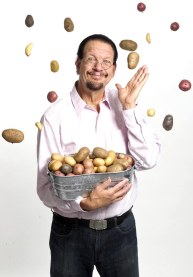
Penn Jillette lost over a hundred pounds by dining exclusively on carb-laden potatoes and limiting his daily intake to 1,000 calories. By contrast, continual gorging on low-carb salmon, cauliflower, almonds, and yogurt, will lead to weight gain if consumed in enough quantities.

“Gem membership” (Crystal healing)

CF

Despite being one of the oldest substances on the planet, crystals have a futuristic sci-fi look and this may partially explain some persons embracing them as an elixir, though gullibility is a more pronounced factor.

Good Morning America profiled persons who believe crystals are imbued with healing properties. This included Taryn Toomey, whose New York City studio features crystal-lined floors intended to “clear the energy and renew balance and confidence.” Unexplained were what type of energy it is, what it is being balanced with, and how standing on them raises one’s self-esteem.

Energy means “measurable work capability,” and Skeptoid’s Brian Dunning suggests replacing that definition with the word “energy” to see if a claim makes sense. When saying “Measurable work capability equals mass times the speed of light squared,” it’s understood what is being asserted. By contrast, “Clear the measurable work capability and renew balance and confidence,” takes a meandering sentence and leaves it even more muddled.

I once stopped by a mall kiosk once where two ladies were hawking healing crystals. It was a learning experience for all, as I was told amethyst works for backaches, anxiety, and rosacea, and they learned what a double blind study was. There have been many such peddlers over the years, but new spins are still being put on the notion of crystal power. For example, the GMA piece featured Mariah Lyons, who is likely the first person to imbed these structures in shoes. She did so after getting tired of carrying crystals in her pocket. Yes, I could see how that would get annoying.

But regardless of the method of transport, what is the owner getting out of possessing apatite and citrine? Lyons told GMA, “Crystals balance your energy.” Oh that’s right, Toomey already explained that. Me and my spotty memory, maybe there’s a gem to help with that.

Then there’s the question of how crystals access the energy and transmit it to a biological entity. For that, we look to crystalline.com, which states: “How do we access it? Crystals and other tools of transformation are just one way to get that rock star centeredness. They’re just waiting to be put to use to help us create the life of our dreams and our spirits to GLOW!” That didn’t even attempt to answer the question they posted – although the exclamation point and all caps shows that what they lack in evidence they make up for in enthusiasm.

With that, let’s go to the third crystal consumer connoisseur interviewed by GMA, Jennifer Salness, and she if she can explain how crystals transfer energy to people. She said, “Having the energy of the crystals around you transfers the vibrations of the stone to you. The longer we have it around us, our bodies can retain that same vibration as the crystal.” That wasn’t any better and we didn’t even get distinctive punctuation and lettering out of the deal. Salness just said crystals transfer energy by having the energy transferred. She prefers bottles that are embedded with crystals, saying, “I think because the water gets infused with the crystal energy and then you’re drinking that, it comes into our system.” I won’t drink to that.

Next, she said, “I think if you believe it will have some effect to it, then it will. I’ve seen the results in my life and others.” But no amount of belief makes anything true and she is also falling prey to subjective validation and preferring anecdotes over data, which is rife in the alternative medicine community. For instance, another crystal merchant, Colleen McCann, told GMA, “I had to experience a whole bunch of really mystical things to get on board with this.”

But a whole bunch of things does not equal one piece of data. Perceptions are prone to error, people experience good, bad, and indifferent days, and most illnesses fluctuate. Because of this, double blind studies are required to find out what is effective. Without any guidelines, certification, standards, or reliable data, there’s no way to determine what crystal would work for what malady, or whether they work at all.

McCann, who is releasing a book this fall entitled Crystal Rx, described herself as skeptic who fought the notion of healing crystals “tooth and nail.” In that case, she would have been better off buying dentures and metal fasteners than quartz and jasmine.


“Not so fast” (Speed reading)

BOLTBOOK

I used to collect Easton Press books, which are extremely ornate copies of classic works. I would go through one or two a week, then enjoy them even more on the bookshelf, owing to their opulent appearance. Then the children came along and with them, the shoving, crinkling, and tearing of the terrific tomes. Additionally, the time available for reading dropped drastically. After previously going through two books a week, I now congratulate myself on finishing one ad-heavy magazine a month.

There’s nothing I can do about the torn pages, damaged ears, or sewn-in silk bookmarks ripped out. But according to claims made by speed-reading proponents, I could still markedly decrease the time it takes to get through a book and could once again be reaching for Austen, Dickens, and Dostoevsky.

These claims range from being able to manage an impressive 500 words per minute to the utterly implausible 25,000 words per minute asserted by late-night infomercial mainstay Howard Berg. This pace means Berg could order a delivery pizza, start reading Clarissa, and have the book finished before his last bite of cheese and pepperoni.

One person who did credibly attain five figures per minute was Kim Peek, whose life and abilities were loosely portrayed in Rain Man. Peek had no corpus callosum, which connects the brain’s hemispheres, and this congenital condition likely explains his superhuman ability to read two pages simultaneously, one with each eye. But while this would double his speed, it fails to explain how he managed to read and comprehend about 10,000 words per minute with a 98 percent retention rate. He consistently displayed this ability, whether he was reading Highlights or an advanced astrophysics journal. Since no one, including Peek, knew how he did it, his techniques are not taught to others and they are not the focus of speed-reading courses.

Indeed, among non-savants who did not inspire Academy Award-winning films, results from speed-reading courses are far more modest. Berg’s claim of being 2.5 times faster than Peek was never independently verified, but studies have shown show that some of his students quadrupled their speed and hit about 800 words per minute. But this comes with a substantial caveat. The technique is mostly a form of skimming, where swiftness takes precedence over comprehension.

Skeptoid’s Brian Dunning cited author Ronald Carver, whose research included extensive testing of different speed reading techniques. In his work, Carver consistently found that the maximum pace attained was 600 words per minute, with 75 percent retention. The average person reads about 300 words per minute and, if they pay attention and are without distractions, will retain most of what they’ve read. This means the 75 percent rate is a fairly steep tradeoff for the doubling of speed. The technique has some value, but it usually comes down to the reader’s goal. If cramming for an exam, it may be the way to go; if wanting to enjoy the latest from a favorite author, probably not.

Speed-reading emphasizes gulping down roughly 10 lines at a time, eliminating pauses. But these brief stops are likely integral to retention. Readers need to occasionally reflect or soak in what they’ve read. It may take just half a second to do so, but eliminating all the pauses greatly decreases the time it takes to read something, though again, there is a sizable drop in knowing what you’ve just read. And clearly, going back to re-read for clarity or confirmation is out.

In short, speed reading is like me listening to my wife when football is on. I get some of what is being put out, can maybe form a general outline, but there’s a good chance I’m missing the key point.

Sometimes it’s not even that good. According to Cecil Adams at Straight Dope, several trained speed readers were once asked to read a manuscript in which the even-numbered lines came from one source and the odd-numbered lines from another source. The speed readers averaged 1,700 words per minute, yet none of them found the script’s juxtaposition odd. They were so focused on getting through the text rapidly that they failed to notice it was the written equivalent of Take the Skinheads Bowling, a Camper Van Beethoven song in which every line is an intentional non sequitur.  

In another study, researcher Michael Masson tested three groups: Speed readers, normal readers, and skimmers, whose only “training” was being told be read quickly. The results showed that speed readers plowed through 700 words per minute, skimmers clocked in at 600 words, and those going at a normal pace read 240. However, those in the last group easily had the best compression, followed by the skimmers and then the speed readers. These types of studies have usually found that speed readers have a poor grasp of a text’s specifics, but they can generally pick out the main theme and could probably produce a decent outline of the script.

The name most synonymous with speed reading, Evelyn Wood, instructed students to move their hand rapidly across the page. But Masson’s research has shown this caused the hand to perform more like metronome than a pointer. It and the eye moved at the same pace, but the eye was not following the hand.

But all is not lost. There are ways to pick up the reading pace without a drop in comprehension, according to Cal-Berkeley education professor and reading expert Anne Cunningham. In the Skeptic’s Dictionary speed-reading entry, Cunningham says reading faster with high retention rates can be managed through building vocabulary, improving study skills, and polishing reading comprehension abilities. So unless you read and understood this post in 15 seconds, those methods are the ones to try.