“A better pill to swallow” (Fentanyl candy)

Goblins, gremlins, ghosts, and ghouls cease to be scary in adulthood, so into the Halloween fright vacuum steps a moral panic. Be it razor-laden Snickers, confectionary-distributing pedophiles, or poisoned Pixie Stix, there are imaginary fears that follow some past the teen years. This year features a new twist on the traditional boogeyman of drugged treats. Keeping with the times, Fentanyl has replaced the now-tame marijuana as the culprit.

Republican National Committee Chairwoman Ronna McDaniel took it upon herself to represent every American mother and said that 100 percent of them are freaking out about their child getting a rainbow-colored Fentanyl. Never one to let a good panic go to waste, the DEA also chimed in, with warnings about an “alarming emerging trend” of drug dealers targeting these pills to our young’uns.

Writing for Snopes, Bethania Palma noted that this update on a time-dishonored tale features plenty to panic over: “A novel version of a dangerous street drug, a threat to children’s safety, and the U.S.-Mexico border, an evergreen source of political flame-throwing.”

Indeed, during her spiel, McDaniel sounded the alarm than in August alone “2,000 pounds of fentanyl came across our border. That could kill 500 million people…and the Democratic Party is ignoring this.”

A measured response would have been to point out that number is more people than live in this country and that there is no evidence these illicit products are making their way from Juarez to elementary school swing sets. Instead, the next day, Senate Majority Leader Chuck Schumer announced he would seek $290 million in funding to fight this kiddie crisis. For maximum effect, he displayed photos of candy alongside rainbow fentanyl and implored, “Halloween is coming up. This is really worrisome and really dangerous.”

He’s right about people being worried but there is no evidence drug traffickers are planning to give free pills to kids under the guise of candy.

Rolling Stone reporters spoke with harm reduction experts, who confirmed that rainbow-colored fentanyl pills and powders are real. However, they are not being targeting to children, and dealers have no plans for an uptick in marketing and distribution on All Hallows Eve.

Colored pills have been around for decades and their purpose is to allow drug dealers to identify their goods or to make a carbon copy of legitimate pharmaceuticals. Similarly, heroin packets sometimes come with attractive images and cool names, ecstasy is packaged in bright shapes and colors, and LSD tablets often have cartoon characters or stars, smiley faces, and band logos.

“It’s a way to brand your stuff,” explained reporter Reilly Capps in an interview with Reason’s Lenore Skenazy. They may also make the product more attractive, but this can appeal to any age group. Rolling Stone interviewed Mariah Francis, a resource associate with the National Harm Reduction Coalition, and she told the magazine that “the pills in the photos shared by the DEA are all stamped and readily identifiable as pills, making it very hard to believe children are mistaking them for colorful candy.”

Targeting single-digit age children is nonsensical since that demographic has the least amount of disposable income. Moreover, fentanyl is up to 100 times more powerful than standard opioids, and foisting these upon a 7-year-old first-time user would almost certainly be fatal. It’s hard to imagine a worse outreach strategy than an instant killing of your customer base.


“All’s well that spends well” (Wellness industry)

There are several critical thinking errors associated with wellness, an intentionally vague term that can mean most anything a marketer, company, or user wishes it to.

Some of these are among the most frequent logical fallacies, such as the ad populum. Here, the ubiquity and popularity of a product is considered synonymous with its efficiency. Sometimes products sell because they work but other times it is due to who is endorsing it, a savvy marketing approach, or manipulated data.

Another frequent fallacy which is seen in wellness products is the appeal to tradition. While some traditions endure because they are good, others exist only because that’s the way we’ve always done it (i.e. circumcision or the Lions playing on Thanksgiving). Tradition is another way of saying inertia and the duration something has been done has no bearing on its soundness. If I punched myself in the mouth every morning, that would be a bad idea. At no point would it morph into a good idea because it had been done for a certain time length.

Still another frequent fallacy that makes its way into wellness marketing is the appeal to nature. This extends to other areas too, where with the exception of motor oil, synthetic is presumed to be undesirable. Appealing to nature is gold for the wellness industry since it targets those who think they are getting back to the way things were in a glorious past, be that our grandparents’ time or the Paleo era.

Proponents will use “natural” and let the assumption be that means foods the way nature intended. Or it is meant to bring to mind snowcapped mountains and flowing streams when it also means arsenic and box jellyfish venom.

I sometimes see a putative list of ingredients in fries or chicken sandwiches as sold in the US as opposed to their counterparts in other countries. I cannot vouch for the accuracy of either nation’s food constituency, but the implication is that the number of ingredients, along with their polysyllabic nature, means they are dangerous. There is no truth to this. Writing for Skeptical Inquirer, Nick Tiller gave this example: “Consider two glucose molecules —one synthesized in a lab and one found in nature. Both have the chemical formula C6H12O6, both appear as identical under an electron microscope, and both will have an identical effect on the body when consumed.”

Now we’ll move onto some fallacies that are less seen in general but which are still common in the wellness industry. We’ll start with the use of pseudoscience. This refers to using scientific terms improperly or fabricating terminology designed to sound scientific. In any event, the goal is to obfuscate.

Tiller cited the PowerBalance bracelet that enjoyed popularity among elite athletes early this century. It purported to harness the power of “holographic technology,” which is not a thing, with the bracelets said to be “embedded with frequencies that react positively with the body’s energy fields.” Frequency, positivity, and energy are all legitimate scientific terms but as used here are meaningless. Always beware of references to energy and remember that this refers to “measurable work capability.” Insert this phrase in place of “energy” when you see it in ads and it will usually become clear that the claim is absurd.

Along with energy, other words frequently bandied about are balance, immunity, and anti-inflammatory. Again, these are all valid concepts but likely are not so in the way they are used in wellness advertisements. At other times, the peddlers will just coin a term like bioharmonic in hopes of impressing the scientifically illiterate.

While hardly the exclusive purview of wellness, the industry it often guilty of observational selection, which refers to only counting the results you like. I have gone on extreme diets before and lost 25 pounds in a matter of a few weeks. I could highlight this as a success, but to tell the whole story, I would need to tell what happened when I went back to my old habits rather than instituting a lifestyle change. Ignoring such stories enables companies to tell the truth, but not the whole truth.

We also often see a confusing of correlation with causation, often in the form of post hoc reasoning. There might be a connection or it might by coincidence or it could be causation. But we need data and double blind studies to determine this, not anecdotes. As Tiller explained, “Personal accounts trigger emotion and contrast sharply with empty messages from large data sets of cold numbers and statistics. Products are often sold alongside customer testimonials and ‘before and after’ images to compensate for a lack of scientific legitimacy.”

“Thoughts for food” (Raw and organic myths)

For a food to be labeled organic, it must meet a set of established criteria. For it to be considered raw requires no distinction other than not being cooked or prepared in any way. Despite these differences, both organic and raw foods are the focus of rumors that are partially or completely false.

We’ll start with raw, which can be a more nutritious offering than its cooked alternative (depending on how those types are prepared), in addition to being cheaper than their packaged-with-added-ingredients counterpart. However, some enthusiasts go beyond these attributes to make some dubious claims.

For example, they assert wild animals, who consume only raw food, never get sick, a desirable fate which would befall us of we did the same. This is, literally, wildly off the mark, as disease is a leading contributor to animal mortality. Further, the few persons who subscribe to an entirely all-raw food diet sometimes fall ill just like the rest of us.

A less extreme but just as mistaken claim is that munching raw foods increases the consumer’s lifespan. It might make one’s life healthier but there will be no appreciable delaying of death. Skeptoid’s Brian Dunning looked into this and concluded, “The greatest driver in longevity is heredity. Diet is not a significant factor, statistically.”

Looking at the raw numbers, so to speak, there can appear to be a longer lifespan attached to such a diet, but this is because most raw foodists become so in adulthood and never succumbed to fatal newborn or child illnesses and disease. So an apparently increased lifespan would be true amongst almost any adult group, be they red meat lovers, fruitarians, or stamp collectors.

Another mistaken notion is that we are the only meat-eating primates. In truth, most apes are omnivorous. And even if true, this claim would have no bearing on the health benefits of raw fruits and vegetables.

Still another erroneous idea is that cooking foods zaps nutritious enzymes, without which the body struggles to properly digest food. However, we naturally produce digestive enzymes, which make their way through our glands. Moreover, almost anything that is digested is destroyed in the process, which in fact describes digestion. Dunning noted that this process causes enzymes to break down into amino acids, which are absorbed by the intestines.

Most of these notions were based on a false premise or a misunderstanding. Others are total fabrications, such as the claim that white blood cells rush to the stomach to try and fend off the poison that cooked foods yield. This is a complete myth and unsubstantiated fear-mongering.
There is also an assertion that cooking makes organic compounds non-organic. This is an impossibility. Dunning explained that organic chemistry “is the study of carbon compounds, and organic compounds are those formed by living organisms, with molecules containing two or more carbon atoms, linked by carbon-carbon bonds.”

Yet carbon-carbon bonds only begin to break at 750 degrees, so unless preferring one’s chicken carbonara in a charred-beyond-recognition state, this bond-breaking won’t happen. And it wouldn’t matter anyway, as we will see in the second portion of this piece, the focus on organic food. When my children ask what that is, I usually tell them it means more expensive. If I am feeling loquacious enough, I will add that it is supposed to mean grown without synthetic chemicals, though there are about 30 exceptions and even then, natural is no safer than artificial. With that, let’s examine some of the claims associated with organic food.

One is that buying organic food benefits family farms rather than Big Agra, or some such smear. This is wholly untrue since organic food is a corporate behemoth. Dunning explained that major food producers realized the commercial potential of organic would allow them to charge higher prices for fewer products. According to Dunning, “Nearly all organic crops in the United States are either grown, distributed, or sold by the same companies who produce conventional crops.”

A second claim is that organic foods are healthier. But when farmers take the same strain of a plant and grow it in two different ways, its chemical and genetic makeup remain the same. Genes, rather than production method, determine a food’s chemical makeup.

Additionally, some organic enthusiasts say chemical residue remains on non-organic foods. Perhaps, but since organic pesticides are less efficient than their synthetic counterparts, such foods are saturated with up to seven times as many pesticides as what is used with conventional agriculture. Further, organic food, which is one percent of food sold in the US, is responsible for eight percent of E. coli cases.

Finally, we have the notion that organic growing methods are better for the environment. This is also wide of the mark since organic methods require about twice the acreage to produce the same crop.

Eat raw and/or organic if you want to, just do in knowing the facts.

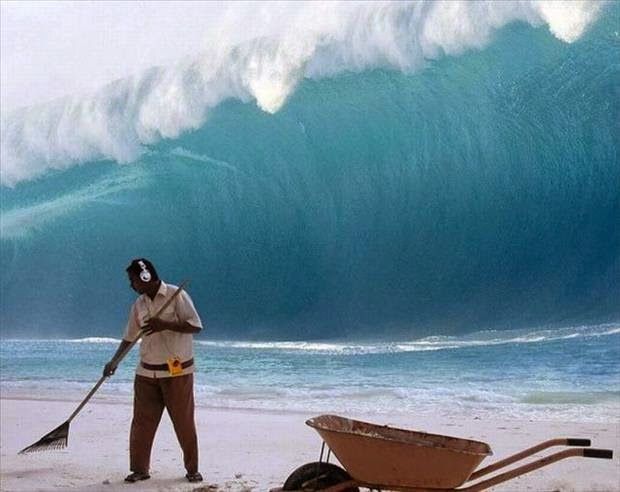
“Fit to be tide” (Early Earth tsunamis)

When the moon was in its earliest days, Earth and its satellite were closer to each other and orbited faster around one another. Our moon’s gravity controls the planet’s tides, so with the heavenly bodies being closer and spinning faster, there is a notion that all those years ago there were massive waves a mile high, regularly destroying and reshaping the landscape at tremendous speeds every day.

To see if this is real, Skeptoid’s Brian Dunning looked into the deep past, 4.5 billion years back, to a time when the solar system’s planets coalesced from the dust from leftover material from a dying star.

The remnants of what are today known as Theia and Gaia became our planet and moon. The two bodies would have stayed in the orbit they were in at the time for billions of years had it not been for Venus happening by and forcing Theia to wobble away. Disrupted from its Lagrange point, Theia plunged toward Gaia, drawn by its gravity, and the two stellar bodies collided.

When Theia slammed into Gaia, the resulting explosion coalesced into Earth. A ring likewise formed and this become the neophyte planet’s satellite. Earthly temperatures were extremely hot, to the point of having lava seas.

Tides cause oceans to move and this movement requires energy, which is taken from the bodies’ rotation speeds. This causes the two bodies to become tidally locked, meaning the same sides face one another. Our Moon is already tidally locked with Earth, and eventually Earth will also become tidally locked with the moon.

When trying to figure out how far away the moon was at some point in time, Dunning writes that there are clues from Earth’s geologic record. Sedimentary rock layers record rhythmic events, including some tidal cycles. This enables geologists to determine annual tide intensity. They know that by the time Earth had liquid oceans, the Moon sat 80 percent as far away as it is now. This would cause a tidal force of about 40 percent greater than today.

But since the intensity of tides varies, this increase is less than today’s normal range. While tides were larger overall, in most places they were still less than the swings experienced today. Dunning wrote, “There were never vast walls of whitewater crashing across the planet…It’s probably for the best, for if that had indeed been the case for a billion or so years of Earth’s history, our advanced form of life likely wouldn’t be here yet, or perhaps ever.”

“Taking a charge”(Electric car myths)

Electric vehicle detractors make a number of claims which have a grain of truth and others which lack even this single morsel.

For example, they have pointed out that there is not enough infrastructure to support an explosion in electrical vehicle usage. It is true that if today, magically, the number of such means of conveyance tripled, there would be an insufficient support network. However, when the internal combustion engine was a novelty, there were no auto mechanics, gasoline stations, or AAA. The market adapted and evolved, as would be the case if the number of electric vehicles mushroomed.

The disdain for EVs is comparable to that for veganism. The mythological protestor chiming in with “Meat is Murder” on a beef page is nowhere to be seen. Yet when one posts an animal-free recipe, the majority of replies feature anger, derision, and revulsion. In the same vein, a post about a traditional vehicle will likely merit no negative comments or at least none that condemns the industry in totality. By sharp contrast, information about EVs is met with hostility, mocking, and perhaps even a declaration that they are a plot to conquer and control the population.

One of the least venomous arguments is that they are too expensive. And while EVs do cost more on average than their gasoline counterparts, the price has been steadily declining as they become more common. More importantly, as Skeptoid’s Brian Dunning points out, there is more than retail price at play. When one considers resale, maintenance, fuel costs, and depreciation, EVs come out ahead. Imagine 10 years of no trips to the gas pump and no oil changes, all while having fewer components that can break down, and one can see the long-term benefit.

Next, let’s tackle the notion that charging can take untold hours. Compared to the two minutes it takes to complete a gasoline refueling, this seems like a lot of wasted time. But Dunning noted that most users only charge as much they need to get to their next destination so most don’t spend three hours waiting around for the charge to complete. Dunning reported that he spent a month on an 8,000-mile drive (aided by Tesla’s autopilot), where he averaged about 10 minutes per recharge. While that’s a little longer than one spends pumping gasoline, if you throw in a restroom break and a Snickers purchase that are common on cross-country journeys, it’s the same amount of time. Moreover, an EV can be powered at home, which is where about 75 percent of recharging takes place. There is no gasoline refueling equivalent in most people’s driveway.

Another expense-related criticism is that the batteries need frequent replacement at $40,000 a pop. This is a total myth. Dunning wrote, “EV batteries last just as long as, and are far more reliable than, car engines. You’re no more likely to need to replace an EV battery than you are your V8. And even if you did, federal law in the United States requires EV batteries to be warrantied for eight years or 100,000 miles.”

Moving onto the more fear-based complaints, there is the notion that an EV driver is in a bad way if the battery dies. This is sometimes extrapolated to a dystopian scene where all cars are electric and the duped drivers all remain stuck in a blizzard or backed up traffic, resulting in all the cars transforming into a makeshift coffin. While being stranded is undesirable, poor decision making by a single EV driver is no more a condemnation of the entire concept than a motorist running out of gas is an indictment of the entire oil industry. Dunning wrote that he once was unable to recharge because the power in town went out. Stupid him, right? Well, only if one applies the same distinction to the hundreds of traditional vehicle drivers who were also unable to refuel due to the electrical outage. As to everyone being stuck to die together, this is based partly on the myth that the batteries don’t hold a charge for very long. This is untrue, and would be especially so if the car were idling.

Detractors raise concerns about environmental and humanitarian disasters – isolated concerns from a segment not usually worried about such things. Those who consider the damage that climate change does to Earth and its inhabitants to be mythological now fret over the harm caused by lithium mining. However, we need to do more than to appeal to hypocrisy. We need to look at whether this is a valid worry.

Dunning writes, “Lithium…is more an issue of supply and demand and cost. It creates ugly open-pit mines but is not particularly dirty or destructive. Most lithium mining is in Australia, which complies very well with environmental regulations.”

But that still leaves cobalt, which traditionally has had the worst humanitarian impact. Much of the world’s supply comes from the Democratic Republic of the Congo, and mining there has often been done in deplorable conditions, sometimes by children.

This is of utmost concern, but Dunning noted that international pressure and increasing demand has tempered the problem. “The picture has changed dramatically,” he wrote. “Demand has surged to the point where child laborers can no longer meet it. About half of Congolese cobalt mines are owned by well-financed Chinese companies, and the vast majority of Congolese cobalt is now produced in mechanized open-pit mines with heavy equipment and not a child laborer in sight.”

This is not to suggest all is well. According to Dunning, there are still 40,000 Congolese children, and it is therefore necessary is to continue to monitor the companies producing cobalt and to snuff out their use of child labor.

As to EVs impact on planet health, when considering the entire production and use cycle, the average electric car generates half as much greenhouse gas as the average internal combustion vehicle.

Finally, there is the myth that the grid is insufficient to support a significant uptick in EVs. In truth, EVs make a modest impact on the grid. An entire electric fleet would add about 10 percent to overall demand. And since any increase would be gradual, proper planning and management could alleviate any trouble.

“Min at Work” (Australian Outback lights)

It’s hard to imagine a more excellent location than an Australian Outback ghost town. So it is fitting that one such locale, Min Min, is infrequently home to a mystery known as the Min Min Light. It has been sighted off and on (mostly off) for decades, though stories about similar lights are featured in Aboriginal tales that predate those accounts.

A composite report of the light mostly describes a white or color-changing fuzzy disc hovering just above the horizon. The greatest variation in descriptors relates to its luminosity, as it is alternately called dim, bright, or in between.

The first printed account of the phenomenon came from rancher Henry Lamond in 1937. He wrote that he initially that it was an approaching car, but that “it remained in one bulbous ball instead of dividing into two headlights, which it should have done as it came closer.” Additionally, the light, size, and location were inconsistent with a traveling vehicle.

Author Mark Moravec examined some possible explanations for the mystery in his book investigating the subject. Some were pseudoscientific, such as ghosts or alien spacecraft. Others were grounded in known entities, such as natural phenomena like phosphorescence, luminescent insects, light reflection, or ball lighting.

With regard to the bioluminescence hypothesis, scientist Jack Pettigrew argued that the lights may be swarming insects that were contaminated by agents in fungi. Or they might be an owl with a bioluminescence source. However, no bug or bird has been confirmed to have the characteristics, nor is any known bioluminescent source as bright as the Min Min. Similarly, marsh gas has been floated as an answer, but the lights sometimes appear far from any marsh.

Skeptoid’s Brian Dunning ruminated on Piezoelectric effects perhaps being responsible. This effect occurs in some crystals that change shape upon receipt of an electrical current. Dunning notes the opposite is also true, that applying mechanical force to the crystal likewise produces an electrical current. But he also noted there are some challenges with this hypothesis. The effect produces weak electrical voltage but not light. Also, the voltage is measurable only on the crystal and is never projected into the air.

We now move to a possible explanation involving optical science. Pettigrew wondered if the Min Min Light were a manifestation of a Fata Morgana. This refers to mirages caused by a wide temperature difference between air layers, and one in which an object appears higher than its actual position. The phenomenon is the result of the atmosphere’s thermal inversion layers.

And indeed, the Min Min Light often appears in a desert with temperature inversions in the atmosphere. The hollows and ravines trap warm air, and on a cool night at the end of a warm day, the situation is ripe for just such a mirage. With these conditions in place, Pettigrew and his cohorts experimented by parking a car with its headlights on, then traveling six miles in another vehicle, past intervening high ground and out of the line of sight. Upon arriving at their destination, they saw that the headlights resembled past descriptions of the Min Min Light.

There was a second discovery that supported this hypothesis. The morning after their experiment, the team took photos of faraway mountains that displayed the aforementioned distortion. The distortion gradually faded as the atmospheric conditions changed. This lends credence to the idea that a refraction of car headlights over the horizon were reflected and being seen to move in a manner consistent with the Min Min Light.

The answer isn’t as exciting or spooky as some would have hoped, but it is a plausible explanation supported by evidence and research.